
That overlap is the sweet spot. For quick context, the U.S. median cleaning fee sits at $175, with 1-bedroom units around $105 and 2-bedrooms around $150. Before deducting any cleaning cost from a tenant’s deposit, check your state’s rules first.
TL;DR:
- Most short-term rental cleaning fees fall between $105 and $250 per property, with regional market factors often causing deviations above or below these benchmarks.
- Calculating the optimal fee requires summing all real costs, including labor, linens, supplies, drive time, and a small buffer, then comparing this to 25-50% of the property’s average daily rate.
- Cleaning fees are legal if documented properly, with clear lease clauses, photos, and itemized receipts to defend against disputes and ensure charges reflect actual damage or excess dirt.
- Setting the right turnover fee involves balancing your cost floor with the property’s ADR, and updating this calculation monthly helps optimize profitability across seasonal demand shifts.
- Implementing operational strategies such as standardized checklists, geographic routing, and photo verification can ensure fast, quality turnovers without increasing costs or compromising guest satisfaction.
Table of Contents
- U.S. Cleaning Fee Benchmarks by Property Size
- What Does a Cleaning Fee Actually Cover?
- How Do You Calculate the Right Turnover Fee?
- What Are the Legal Rules for Charging Cleaning Fees?
- How Do Cleaning Fees Affect Bookings and Revenue?
- How Can You Lower Turnover Costs Without Hurting Quality?
- Pricing Examples and Fee Disclosure Templates
- How The Maid Society Approaches Fast, Reliable Turnovers
- The Editorial Take on Turnover Fees for U.S. Hosts
- Get a Turnover Cleaning Quote in Los Angeles
- Sources
U.S. Cleaning Fee Benchmarks by Property Size
The national numbers give you a starting line, not a finish line. Across more than 40,000 short-term rental listings, the median rental turnover cleaning cost is $175, while the mean is $191.70. That gap between median and mean matters: a small tail of luxury properties with $400 to $600 cleaning fees pulls the average up, so the median is the number most hosts should anchor to rather than the mean.
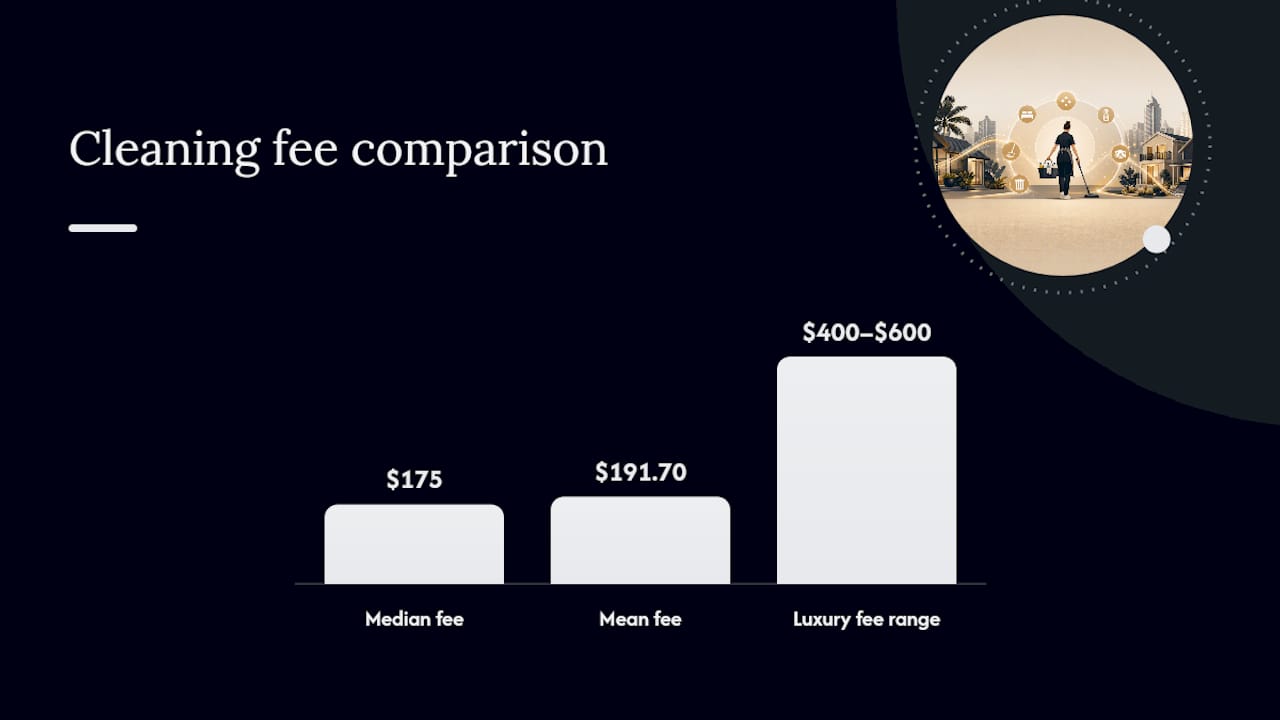
The distribution spreads wider than most hosts expect. The 10th percentile sits at $91 and the 90th percentile reaches $300, with an interquartile range of $115. In plain terms, half of all listings charge somewhere between roughly $115 and $230, and outliers on both ends are common depending on market and unit size.
Bedroom count is the single strongest predictor of fee size. Each additional bedroom adds roughly $45 to the median fee, up through four bedrooms, where the curve tends to flatten because larger units bring in cleaning crews rather than solo cleaners.
| Property size | Median cleaning fee |
|---|---|
| Studio / 1BR | $105 |
| 2BR | $150 |
| 3BR | $200 |
| 4BR+ | $250 |
Regional adjustment matters more than most benchmarking guides admit. A few practical nudges:
- Resort and vacation-heavy markets (think mountain or beach towns) often run 15–25% above national medians because turnover crews are scarce during peak season.
- Dense urban markets with heavy cleaner supply, including much of Los Angeles County, tend to sit closer to the median or slightly under it thanks to competition among cleaning companies.
- Properties with unusual layouts (multiple bathrooms, hot tubs, extensive outdoor space) should add a flat surcharge rather than trying to force the number into a bedroom-based formula.
If you manage properties across several Southern California neighborhoods, from Santa Monica to Long Beach to Burbank, your fee should track local labor costs and drive time more than a national chart. A cleaner working Beverly Hills and Culver City in the same day faces different logistics than one covering only Inglewood.
What Does a Cleaning Fee Actually Cover?
A cleaning fee that only covers the cleaner’s hourly rate is a fee that’s quietly losing you money. Four cost categories belong in every calculation, and skipping any one of them is how hosts end up subsidizing their own turnovers.
Labor is the largest line item. Professional turnover cleaners typically charge $20 to $30 per hour, and a standard 1 to 2 bedroom turnover runs $40 to $100 in labor alone, while a 3-bedroom-plus deep turn can climb to $80–$250 depending on scope and market. Some cleaners work flat-rate per job instead of hourly, which simplifies budgeting but can undercharge you on unusually messy turns unless your contract specifies a “heavy soil” surcharge.
Laundry and linens get overlooked constantly. Whether you wash sheets and towels in-house or use a linen service, this cost is separate from the cleaner’s time on-site. Linen services typically bill per set (sheets, pillowcases, towels, bath mat) rather than per load, which is worth comparing against your in-house laundry cost including detergent, water, and appliance wear.
Supplies and overhead round out the floor:
- Restocking consumables: toilet paper, soap, coffee, trash bags
- Cleaning supplies: multi-surface cleaner, glass cleaner, disinfectant
- Drive time to and from the property, especially relevant across sprawling coverage areas like West LA to Hollywood, can be optimized using specialized hospitality operational tech and tools designed for the industry
- Coordination and admin time spent scheduling, messaging cleaners, and handling last-minute turnovers
- Platform fees if you’re paying a booking or scheduling tool a percentage
Pro Tip: Build a small amortized “wear and tear” buffer into your cost floor, roughly $5 to $10 per turn, to cover the slow replacement of towels, cookware, and remote controls that guests damage or walk off with. Skip this and you’ll be surprised every few months by a $200 restocking bill you never budgeted for.
How Do You Calculate the Right Turnover Fee?
Setting a defensible fee comes down to two numbers: your cost floor and your ADR sweet spot. Where those two ranges overlap is where your fee belongs.
- Add up every real cost per turnover. Labor, laundry, supplies, drive time, and your wear-and-tear buffer. Example: $65 labor + $20 laundry + $12 supplies + $8 buffer = $105 cost floor for a 1-bedroom unit.
- Calculate 25% and 50% of your average daily rate. If your ADR is $220, the sweet spot runs from $55 (25%) to $110 (50%).
- Check for overlap. In this example, the $105 cost floor sits just inside the $110 ceiling. That’s a workable fee, though it leaves almost no margin.
- If your cost floor exceeds 50% of ADR, you have three levers, not one: raise the nightly rate, cut turnover costs (better routing, negotiated linen rates), or absorb part of the cost into the base rate and charge a smaller itemized fee.
- Re-run the math seasonally. ADR shifts with demand, and your fee should shift with it, particularly in vacation markets with sharp seasonal swings.
Here’s how the math plays out across common scenarios:
Update ADR monthly and the sweet spot recalculates itself, which turns fee-setting from guesswork into a five-minute monthly check.
What Are the Legal Rules for Charging Cleaning Fees?
The baseline principle across nearly every state: cleaning charges can restore a unit to its move-in condition, but they cannot bill a tenant for normal wear-and-tear. A worn carpet after two years of normal use isn’t chargeable. A carpet stained by a spilled bottle of red wine likely is, provided you can document it.
State rules diverge sharply on how strictly this gets enforced. Massachusetts imposes some of the strictest limits in the country, and landlords who mishandle deposit deductions there can face penalties well beyond the disputed amount. Other states give landlords more latitude but still require documentation showing the charge relates to actual damage or excessive dirt, not routine cleaning between tenants.
Because these rules vary so much by state, treat the following as baseline safeguards rather than a substitute for checking your own state’s statute:
- Put a clear cleaning clause in the lease before move-in, specifying what “move-in condition” means and what counts as excessive wear.
- Take dated photos or video at both move-in and move-out. A rental condition checklist signed by both parties at move-in removes most ambiguity later.
- Keep itemized receipts for any cleaning charge you deduct from a deposit, showing actual cost rather than a flat estimate.
- Send itemized deductions within your state’s required timeframe. Many states set strict deadlines (often 14 to 30 days), and missing that window can forfeit your right to withhold anything.
- For short-term rental guests, disclose the cleaning fee clearly before booking rather than adding it as a surprise line item at checkout.
Documentation is what separates a defensible deduction from a dispute you’ll lose. A photo checklist and a paper trail cost you ten minutes per turnover and save you from the kind of small-claims case that eats a full day.
How Do Cleaning Fees Affect Bookings and Revenue?
The fee-to-ADR ratio predicts revenue better than the raw dollar amount of your fee. Listings that price their cleaning fee at 25–50% of ADR earn roughly $64,405 a year on average, compared to $37,474 for listings with no fee at all. That’s not a small gap, and it runs counter to the instinct that dropping fees to zero always wins more bookings.
The mechanics behind this are worth understanding rather than just trusting the number:
- No-fee listings often compensate by raising the nightly rate, which can hurt their ranking in short-stay searches where guests scan nightly price first.
- Very high fees (well above 50% of ADR) tend to suppress bookings for short stays, since the fee gets amortized over fewer nights and feels disproportionate to a one or two-night guest.
- Platform changes that show guests a total price upfront pushed some hosts to drop itemized fees entirely, but panel data still shows a plurality of hosts keep an itemized fee because it preserves margin better than folding everything into the nightly rate.
A $200 fee on a $180-a-night, one-night stay looks brutal to a guest scanning search results, even though the same fee barely registers on a five-night booking at the same rate.*
A hybrid approach works well for hosts with mixed stay lengths: keep a moderate itemized fee for transparency, but nudge the base rate up slightly during long-stay-heavy seasons so the fee’s percentage impact shrinks naturally without you touching the sticker price guests see first.
How Can You Lower Turnover Costs Without Hurting Quality?
Cutting costs the wrong way shows up in reviews within a week. Cutting them the right way is mostly about logistics, not corner-cutting.
- Standardize your checklist. A written, room-by-room checklist cuts variability between cleaners and shortens on-site time because nobody is guessing what “clean” means for your unit. Our guide on preparing for tenant turnover cleaning breaks this down step by step.
- Message guests before checkout. A simple pre-checkout text asking guests to start the dishwasher and gather towels shaves real minutes off every turn, multiplied across dozens of turnovers a year.
- Negotiate portfolio rates. If you manage multiple units across neighborhoods like Culver City, Mid-City, and Koreatown, one cleaning company handling all of them can usually offer a lower per-unit rate than piecing together separate vendors.
- Plan cleaner routes geographically. Clustering same-day turnovers by neighborhood cuts drive time, which is pure cost with zero guest-facing benefit.
- Use photo verification. Requiring cleaners to submit a handful of photos per turn (kitchen, bathroom, bedding) catches problems before the next guest checks in, not after a bad review posts.
Pro Tip: Never cut corners on laundry quality or bedding cleanliness to save money. Guests notice stained sheets or towels faster than almost anything else in a rental, and it’s one of the fastest ways to trigger a refund request or a public complaint. Cut drive time and admin overhead before you ever touch linen quality.
Pricing Examples and Fee Disclosure Templates
Seeing the math applied to real scenarios makes the calculator method easier to trust. These five examples use realistic ADR figures across property types.
Raise the nightly rate by even $10 to $15, or renegotiate your cleaner’s rate if you’re sending them recurring volume.
A short, clear disclosure line works better than burying the fee in fine print. Something like: “A $[amount] cleaning fee covers professional turnover cleaning, fresh linens, and restocked essentials for your stay.” For landlords communicating with tenants rather than guests, a simple lease addendum works: “Move-out cleaning charges, if applicable, will be itemized with receipts and limited to restoring the unit to its documented move-in condition.”

For a deeper look at what separates janitorial-style cleaning from the residential standard guests expect, see our breakdown of the difference between janitorial and residential cleaning.
How The Maid Society Approaches Fast, Reliable Turnovers
Running the numbers is only half the job. Executing a fast, consistent turnover on a tight same-day window is where most self-managed cleaning operations fall apart, especially across a coverage area as spread out as Los Angeles County.
We work with property owners and hosts across Los Angeles, Santa Monica, Beverly Hills, West Hollywood, Culver City, and neighboring communities on turnover, move-in/move-out, and deep cleaning jobs. Property owners who switched to a structured turnover process, including standardized photo checklists and staged setup, saw meaningfully faster relisting, detailed in our case study on cutting rental vacancy.
A few operational habits separate a professional turnover from a rushed one:
- Photo checklists submitted after every clean, so property managers can verify quality remotely
- Staged bedding and towel presentation that photographs well for listing updates
- Coordinated linen logistics for hosts running multiple units on the same day
If you’re running one or two units and have flexible time, in-house cleaning can work. Once you’re managing three or more units, or juggling same-day guest turnovers, the math on your own hourly rate usually favors hiring a vetted crew instead.
The Editorial Take on Turnover Fees for U.S. Hosts
The research supports a conclusion most fee-setting advice dances around: your cleaning fee is a revenue lever, not just a cost pass-through. Hosts who treat it purely as reimbursement tend to underprice and quietly subsidize every turnover. Hosts who chase the highest fee the market will bear tend to overprice and lose short-stay bookings.
The conventional advice, “charge what it costs you,” misses the ADR relationship entirely. A $150 fee means something different on a $600-a-night luxury listing than on a $120-a-night studio, and pricing both the same way ignores real revenue data.
If you take one thing from this guide, make it the calculator habit: recompute your cost floor and your ADR sweet spot quarterly, not once and never again. Labor costs, linen prices, and your own ADR all shift, and a fee set correctly in January can be wrong by summer. Most hosts set a fee once and forget it. That’s the actual gap between average performers and the ones earning meaningfully more from the same properties.
— Lyndsey
Get a Turnover Cleaning Quote in Los Angeles
Themaidsociety handles the turnover cleaning math for you, standard cleaning, deep cleaning, move-in/move-out turns, and post-construction cleanups across Los Angeles, Inglewood, Beverly Hills, Santa Monica, Venice, Marina Del Rey, Brentwood, Culver City, West Hollywood, Hollywood, Long Beach, and the rest of the Southern California neighborhoods we serve.
Requesting a quote takes a few details: property size and bedroom count, turnover frequency (one-time, weekly, or same-day guest turns), and any special requirements like linen service or post-construction cleanup. Property managers juggling multiple units get portfolio-rate pricing rather than paying per-unit retail rates.
Start with our move-in and move-out cleaning services page to see turnover-specific offerings, or browse the full cleaning services lineup to match a service tier to your property type. If you’re setting up booking or quoting tools alongside your cleaning vendor stack, ConvertLabs is worth a look for streamlining the request-to-booking flow.
Sources
- 2026 State of STR Cleaning Fees Report – Clean Casa
- Vacation Rental Cleaning Costs (2026) | RapidEye
- What Can a Landlord Deduct From a Security Deposit? All 50 States (2026) | RenterCalc
Recommended
- Move-In Cleaning Cost: What You’ll Pay in 2026
- Move-Out Cleaning Cost in 2026: What You’ll Actually Pay
- How to Set an Airbnb Cleaning Fee in Los Angeles
- Role of cleaning for property owners in 2026



Get Cleaning Tips & Exclusive Offers
Join our community for time-saving hacks and special discounts delivered to your inbox.