Compute your real per-turn cost first, then set your fee. That’s the whole strategy, and most Los Angeles hosts skip straight past it. The Airbnb host resource center is blunt about this: your cleaning fee should reflect what turnover actually costs you, not what you wish it covered. In Los Angeles, AirROI’s market data shows 88.4% of listings already charge a fee, with a median around $400 and that fee eating up roughly 5.6% of gross revenue.
Your move: calculate labor, laundry, supplies, and overhead per turn, then price near that LA median unless you’re running a studio or a one to two night listing, where conversion math changes the calculus.
- Compute your true per-turn cost before picking a number
- Set a visible fee near the $400 LA median for standard listings
- Consider partial bake-in for short stays under two nights, where a separate fee hurts conversion
Quick stat: Most Los Angeles Airbnb listings charge a cleaning fee, and the median fee aligns with local market norms.
Key Takeaways
Setting a defensible Los Angeles Airbnb cleaning fee means calculating your real per-turn cost and pricing near the $400 area median, adjusting presentation for short stays where conversion is sensitive to a visible fee.
| Point | Details |
|---|---|
| Calculate before you price | Time labor, laundry, consumables, and overhead per turn instead of guessing at a fee. |
| Use the LA median as your anchor | AirROI puts the Los Angeles median cleaning fee near $400, with 88.4% of listings charging one. |
| Adjust presentation by stay length | Bake partial costs into nightly rate for one to two night stays; show the fee for longer bookings. |
| Prioritize reliability over marginal savings | A dependable cleaner at a slightly higher rate beats a cheaper one prone to no-shows. |
| Consider a professional turnover partner | Themaidsociety offers vetted, trained Airbnb cleaning across Los Angeles for hosts scaling past one or two listings. |
Table of Contents
- Article Summary and What You’ll Learn
- What Are the Los Angeles Airbnb Cleaning Fee Benchmarks?
- What Should an Airbnb Cleaning Fee Actually Cover?
- How Do You Calculate Your Cleaning Fee Step by Step?
- Should You Show a Visible Fee or Bake It Into the Rate?
- What LA-Specific Factors Affect Your Cleaning Costs?
- How Do You Hire and Vet Reliable Turnover Cleaners in LA?
- Why a Professional Turnover Service Protects Your Revenue
- Tips for Cutting Cleaning Costs Without Cutting Corners
- What Legal Rules Apply to Airbnb Cleaning Fees in Los Angeles?
- Airbnb Cleaning Fee Los Angeles: Benchmarks and How to Set Yours
- Get an LA-Specific Airbnb Cleaning Quote
- Sources
Article Summary and What You’ll Learn
This guide breaks down exactly how to price your Los Angeles Airbnb cleaning fee using real market benchmarks, a repeatable cost formula, and operational advice specific to LA’s traffic, neighborhoods, and labor market. You’ll walk away with a number you can defend and a process for revisiting it.
- LA benchmarks: median fee, percentage charging, revenue share
- What a cleaning fee should and shouldn’t cover
- Step-by-step calculation with real examples
- Pricing presentation: visible fee vs. baked-in rate
- LA-specific operational risks and hiring criteria
- Legal considerations and process optimization tips
Article by L.K.
What Are the Los Angeles Airbnb Cleaning Fee Benchmarks?
Nearly 9 out of 10 Los Angeles Airbnb listings charge a separate cleaning fee, and the AirROI market report puts the median at approximately $400, representing about 5.6% of gross booking revenue on average. That median is your anchor point, not your ceiling.
Quick stat: The cleaning fee typically represents a modest share of a Los Angeles listing’s gross revenue.
Medians and averages tell different stories here. A handful of Hollywood Hills estates and Malibu-adjacent luxury rentals charging $800 or more pull the average upward, while the bulk of one and two-bedroom units in Koreatown, Mid-City, or Burbank cluster much closer to the median. If you’re comparing your fee to “the average,” you’re comparing yourself to outliers you probably don’t compete with.
Property size drives most of the variation:
- Studios and one-bedrooms: typically land in the $80 to $150 range across most LA neighborhoods
- Two-bedroom units: commonly fall between $150 and $250, depending on finish quality and linen count
- Three-bedroom-plus homes: often exceed $250, and beach city listings in Manhattan Beach or Redondo Beach frequently push higher due to sand, salt residue, and larger outdoor living spaces
- Luxury and estate rentals: in areas like Pacific Palisades or Brentwood can run past $500 when multiple bathrooms, pools, and extensive outdoor furniture are involved
AirDNA’s analysis adds a useful second lens: keeping your fee between roughly 25% and 50% of your average daily rate tends to correlate with stronger overall revenue performance. If your ADR is $200 a night, a fee anywhere from $50 to $100 sits in that sweet spot, though LA’s higher labor costs often push actual turnover costs toward the top of that range.
What Should an Airbnb Cleaning Fee Actually Cover?
A cleaning fee exists to recover real costs, not to pad your nightly take. Airbnb’s own guidance warns hosts against treating it as a profit center, partly because inflated fees discourage bookings and partly because guests judge value against what they actually receive.
Four categories make up a legitimate fee:
- Labor. Multiply your cleaner’s hourly rate by the actual time a turn takes. A one-bedroom in West LA might run 90 minutes; a three-bedroom in Long Beach with multiple bathrooms can take three hours or more.
- Laundry and linens. Sheets, towels, and bath mats wear out. Amortize replacement cost across expected wash cycles rather than expensing a full set every time you calculate a fee.
- Consumables and equipment. Toilet paper, soap, trash bags, and vacuum wear all belong in the math. Divide equipment cost by expected lifespan in turns, not years.
- Travel and buffer time. Add a cushion for driving between properties and for the inevitable incident, a stain that needs extra attention or a late guest checkout.
Pro Tip: Track your cleaner’s actual time on five to ten turns before finalizing your fee. Guessing at labor hours is the single biggest source of underpriced fees among new LA hosts.
One more line item hosts overlook: Airbnb’s resource center notes that cleaning expenses may be tax-deductible, so keep receipts and consult a tax professional before assuming your cleaning fee is pure taxable revenue.
How Do You Calculate Your Cleaning Fee Step by Step?
Here’s the formula, in order:
- Time the turn. Have your cleaner log actual minutes spent, broken out by task if possible.
- Price labor. Multiply hours by your cleaner’s rate. LA cleaner rates commonly run $25 to $45 per hour depending on the neighborhood and whether you’re using an individual or a service.
- Add laundry cost per turn. Divide your linen replacement budget by expected wash cycles before replacement.
- Add consumables. Estimate per-turn spend on paper goods, soap, and trash bags.
- Amortize equipment. Divide vacuum, mop, and supply-caddy cost by expected number of turns before replacement.
- Add travel/overhead. A flat $5 to $15 buffer covering drive time and incidentals works for most single-property hosts.
- Sum and round. Add a small margin, five to ten percent, to cover no-shows or re-cleans.
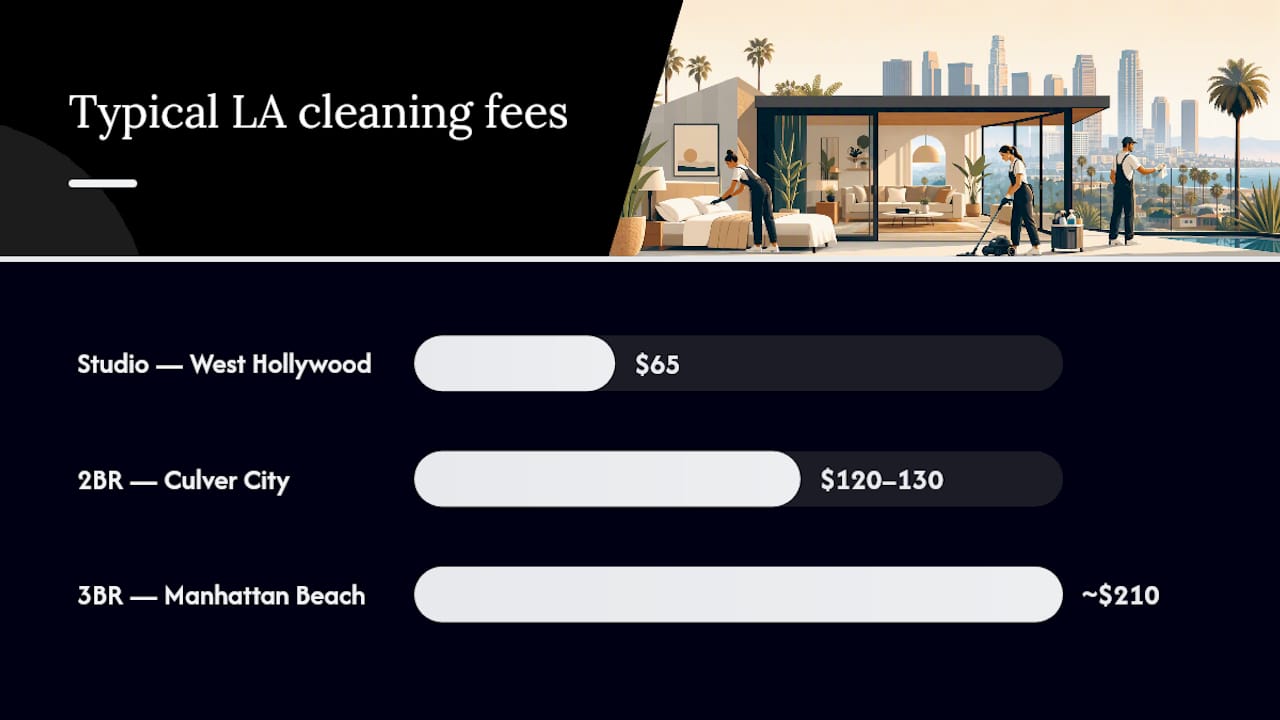
Here’s how that plays out for three common Los Angeles property types:
| Property Type | Labor | Laundry | Consumables + Overhead | Total Fee |
|---|---|---|---|---|
| Studio (West Hollywood) | $37.50 (1.5 hrs @ $25) | $15 | $10 to $15 consumables and equipment | ~$65 |
| 2BR (Culver City) | $75 (2.5 hrs @ $30) | $30 | $20 | $120 to $130 range |
| 3BR (Manhattan Beach) | $130 to $140 range | $45 | $30 | ~$210 |
These numbers land close to what Hostfully’s benchmarking reports for studio ($50 to $90) and mid-size ($90 to $150) properties, with beach-adjacent premiums pushing the three-bedroom figure toward the higher end of that range.
Don’t lock in your first number forever. Run it for five to ten turnovers, then check whether your cleaner’s actual time matched your estimate. Adjust before you’ve built a habit around a wrong number, not after.
Should You Show a Visible Fee or Bake It Into the Rate?
Airbnb’s total-price display shows guests an all-in number during search, which means a high visible cleaning fee doesn’t hide from comparison shopping the way it might have years ago. That reality changes how you should think about presentation.
- For stays of three nights or longer: a visible fee works fine because it amortizes across more nights and looks proportionally smaller
- For one to two night stays: the same flat fee looks disproportionate, and AirDNA’s data suggests baking part of the cost into your nightly rate improves conversion for short bookings
- For competitive submarkets like Koreatown or Hollywood, where guests compare many similar listings side by side, a lower visible fee paired with a slightly higher nightly rate often outperforms a large standalone fee
Pro Tip: Set a variable fee structure, a smaller fee for one to two night stays and your standard fee for longer bookings. Most pricing tools let you automate this without manual adjustment.
Test any change. AirROI’s guidance recommends tracking booking conversion and ADR for 30 to 60 days after a fee adjustment, using comparable availability windows, before deciding whether it worked.
What LA-Specific Factors Affect Your Cleaning Costs?
Los Angeles isn’t one market. It’s dozens of micro-markets stitched together by freeways that turn a 20-minute drive into 90 minutes at the wrong hour, and that reality shapes what you should pay and who you should hire.
- Traffic and route density raise real costs. A cleaner covering listings in both Venice and Burbank on the same day loses hours to drive time that a route confined to Mid-City or Koreatown wouldn’t lose
- Premium neighborhoods like Pacific Palisades, Manhattan Beach, and the Hollywood Hills often carry higher cleaner rates simply because fewer crews service those areas reliably
- Missed or late turnovers cost you far more than the cleaning fee itself. A canceled check-in over a botched turn can wipe out weeks of fee-related savings in refunds and rating damage
- Same-day and expedited turns, common when back-to-back bookings leave only a few hours, justify a rush premium built into your fee calculation rather than absorbed as a loss
Reliability, not marginal savings, is the real lever in this market. A cleaner charging $10 more per turn but showing up on time every single time beats a cheaper crew that occasionally no-shows during a Saturday checkout crunch.
How Do You Hire and Vet Reliable Turnover Cleaners in LA?
Vetting matters more in Los Angeles than in smaller markets simply because a missed turn here often means a genuinely lost booking, not just a delayed check-in.
- Verify insurance and experience. Ask specifically about short-term rental turnover experience, not just general residential cleaning.
- Require photo proof. A standardized checklist with photos of kitchen, bathroom, and bedding after each clean protects you when a guest disputes cleanliness.
- Set a guaranteed turnaround window. Specify a maximum acceptable delay, for example no more than 30 minutes past the scheduled window, in writing.
- Track key performance indicators. Monitor on-time rate, re-clean rate, and guest cleanliness complaints monthly, not just when something goes wrong.
- Define contractual penalties. A no-show clause with a stated remedy, credit or reduced rate, reduces the odds of repeat problems.
Pro Tip: Ask any prospective cleaner how they handle back-to-back same-day turns across different neighborhoods. Their answer tells you more about reliability than any reference check.
Our short-term rental cleaning guide for efficient turnovers covers the scheduling and checklist details that make this process repeatable across multiple listings.
Why a Professional Turnover Service Protects Your Revenue
A missed or subpar turnover doesn’t just cost a re-clean fee. It costs a bad review, and bad reviews compound in a market as saturated as Los Angeles. Themaidsociety is a residential cleaning company serving the greater LA area, providing standard, deep, move-in/move-out, post-construction, and organizing services built around consistency rather than one-off gigs.
Their team is fully vetted and trained, which matters more for hosts than it sounds. A cleaner who’s shown up reliably for months of standard residential work brings a different level of dependability than a gig-platform hire with no track record. Themaidsociety also runs dedicated Airbnb and rental turnover cleaning with five-star service standards built specifically for the turnaround windows short-term rentals demand.
The threshold for going professional versus keeping cleaning in-house usually comes down to scale: once you’re managing more than one or two listings, or your calendar has back-to-back bookings often enough that a single missed turn threatens revenue, the reliability premium of a professional service outweighs whatever you’d save doing it yourself.
| Factor | In-House | Professional Service |
|---|---|---|
| Reliability on tight turns | Depends on your availability | Structured coverage and backup staff |
| Scalability past 1-2 listings | Difficult without hired help | Built for multiple properties |
| Guest rating risk | Higher if you’re stretched thin | Lower with consistent standards |
Tips for Cutting Cleaning Costs Without Cutting Corners
Lower your fee by lowering your actual cost, not by skipping steps guests will notice. The most effective lever is standardizing the process itself. A cleaner who follows the same checklist every time works faster than one improvising room by room, and faster turns mean lower labor cost without touching quality.
Batch your supply purchases. Buying linens, toilet paper, and cleaning products in bulk drops your per-turn consumable cost meaningfully compared to restocking one property at a time. If you manage several listings, centralize a supply closet rather than letting each cleaner shop separately.
Stagger your laundry. Sending sheets and towels to a laundry service that handles multiple properties on a set schedule often costs less per load than in-unit washing, especially when a unit’s small stackable machine takes 90 minutes per load that could be spent cleaning instead.
Reduce breakage and replacement costs by choosing durable, easy-to-clean furnishings from the start. Glass shower doors, light-colored grout, and delicate decor items all add cleaning time or replacement risk that shows up in your fee math eventually. A rental property cleaning checklist built around your specific unit helps standardize this across cleaners, even if you rotate staff.
Finally, don’t chase the lowest possible fee. A fee that’s too thin invites corner-cutting, and a corner-cut clean costs you in reviews, which costs far more than the few dollars saved per turn.
What Legal Rules Apply to Airbnb Cleaning Fees in Los Angeles?
Cleaning fees themselves aren’t separately regulated as a line item under Los Angeles short-term rental law, but they exist inside a broader regulatory framework hosts need to respect. The City of Los Angeles requires short-term rental hosts to register and hold a Home-Sharing registration number, and that registration status affects your right to list at all, independent of how you structure fees.
Where cleaning fees intersect with legal risk is disclosure and taxation. Los Angeles requires Transient Occupancy Tax to be collected on the total guest-facing price in many cases, which can include cleaning fees depending on how your booking platform remits and reports. Confirm with a tax professional how your specific listing and platform handle this, since misreporting exposes you to penalties separate from anything related to your fee amount.
Consumer protection principles also apply generally: a fee that doesn’t match what you disclose, or that shows up as a surprise late in checkout, invites complaints and platform action even without a specific “cleaning fee law” on the books. Keep your fee transparent, consistent with what you actually charge, and reflected accurately in your listing before checkout.
If you operate across multiple LA-area cities, confirm registration and tax rules per city. Requirements in Santa Monica, for example, have historically differed from unincorporated LA County areas, and rules change often enough that a yearly check with your local planning department is worth the hour it takes.
Airbnb Cleaning Fee Los Angeles: Benchmarks and How to Set Yours
The conventional advice on cleaning fees treats it as a single number you set once and forget. That’s backward. The market data makes clear that a Los Angeles cleaning fee is a living number tied to your actual costs, your stay-length mix, and your neighborhood’s labor realities, and it needs revisiting every time one of those changes.
What gets overrated is chasing the “right” fee amount as if there’s one correct figure for LA. There isn’t. A $65 studio fee in West Hollywood and a $210 three-bedroom fee in Manhattan Beach are both correct, because they reflect different actual costs, not different pricing philosophies.
What gets underrated is reliability. Hosts obsess over shaving five dollars off a per-turn cost while ignoring that a single no-show cleaner during a Saturday changeover costs far more in lost bookings and rating damage than years of marginal savings. If you take one thing from this guide, prioritize a dependable cleaning partner over the cheapest one, and build your fee math around real, measured costs instead of guesswork or what a competitor down the street happens to charge.
— Lyndsey
Get an LA-Specific Airbnb Cleaning Quote
If calculating and re-calculating your own cleaning fee sounds like more admin than you signed up for, Themaidsociety gives Los Angeles hosts a done-for-you alternative: a vetted, trained turnover crew that shows up on schedule, so your fee reflects a reliable cost instead of a guess.
Themaidsociety covers Airbnb and rental turnover cleaning across Los Angeles, Santa Monica, Culver City, Long Beach, Burbank, Manhattan Beach, Redondo Beach, and the surrounding communities listed on their Airbnb and rental cleaning service page. Standard, deep, and move-in/move-out cleaning round out their full residential cleaning lineup for hosts who also manage long-term units between short-term bookings.
Request a quote specific to your property size and neighborhood, and get a real per-turn number instead of a market estimate. If you’re setting up your booking and payment workflow alongside your cleaning plan, ConvertLabs is worth a look for streamlining that side of your operation.
Sources
- Everything you need to know about cleaning fees – Resource Center – Airbnb
- Los Angeles, California Airbnb Data 2026: Occupancy, Revenue & STR Market Report | AirROI
- AirDNA — Airbnb Cleaning Fees: What Hosts Need to Know in 2026
- Airbnb Cleaning Fees: How Much to Charge & What They Cover (2026) | Hostfully
Recommended
- Rental property cleaning checklist for LA landlords 2026
- Maid Service Cost in Los Angeles: 2026 Pricing Guide
- House Cleaning Service in Los Angeles | The Maid Society



Get Cleaning Tips & Exclusive Offers
Join our community for time-saving hacks and special discounts delivered to your inbox.