
TL;DR:
- Slow cleaning delays significantly increase rental vacancy costs and impact lease turnovers.
- Outsourcing professional cleaning improves speed, consistency, and reduces disputes across portfolios.
- Effective vetting and partnering with experienced Los Angeles cleaning providers maximize ROI.
Every day a rental unit sits vacant in Los Angeles costs you real money. A single empty unit in a mid-range LA building can drain $100 or more per day in lost rent, and that number multiplies fast across a portfolio. What surprises most property managers is that slow, inconsistent cleaning is often the bottleneck holding up the entire leasing process. Case studies show 35% turnover cost cuts and 61% faster turnovers when professional coordination replaces piecemeal approaches. This guide breaks down exactly why outsourcing turnover cleaning is one of the smartest operational moves an LA landlord can make.
Table of Contents
- The real cost of slow turnovers and messy units
- Benefits of outsourcing turnover cleaning in Los Angeles
- How to choose the right turnover cleaning partner
- Making the business case: ROI, scalability, and peace of mind
- Why most property managers underestimate the hidden costs
- Ready to outsource your next turnover?
- Frequently asked questions
Key Takeaways
| Point | Details |
|---|---|
| Cut costs and speed turns | Outsourcing turnover cleaning slashes costs and cuts vacancy time by more than half in LA rentals. |
| Reduce disputes, boost satisfaction | Professionally cleaned units result in happier tenants and fewer move-in issues or disputes. |
| Maximize long-term ROI | Large and high-turnover properties see the greatest financial and operational benefits from outsourcing. |
| Select the right partner | A reputable LA-specific service ensures consistent results and peace of mind for every turnover. |
The real cost of slow turnovers and messy units
Most property managers think about turnover costs in terms of obvious line items: cleaning fees, paint touch-ups, and maybe a few days of lost rent. The real picture is far more expensive, and the hidden costs are where most operators bleed money without realizing it.
Consider a simple scenario. You manage a 20-unit building in the San Fernando Valley. Each unit turns over roughly once a year. If your average turnover takes 24 days instead of 9, you are losing 15 days of rent per unit, per cycle. At $2,000 per month, that is $1,000 per unit in lost rent alone. Across 20 units, you are looking at $20,000 annually just from slow cleaning coordination.
That figure does not include leasing delays caused by units that fail walk-throughs, prospective tenants who move on because the unit was not ready, or the staff hours spent chasing down cleaning crews and re-inspecting substandard work.
| Cost category | In-house/ad hoc | Professional outsourcing |
|---|---|---|
| Average turnover time | 24 days | 9 days |
| Lost rent per unit | $1,600 | $600 |
| Cleaning disputes per year | 4 to 6 | 0 to 1 |
| Re-clean rate | 25 to 35% | Under 5% |
| Annual cost recovery potential | Baseline | Up to $387k |
The tenant turnover success equation is not just about cleaning. It is about the entire sequence of events that follows a tenant move-out. A unit that is not cleaned to a professional standard will fail inspection, delay photography for listings, and push back the lease start date. Each of those delays compounds.
“The biggest mistake operators make is treating cleaning as the last step instead of the first. When cleaning is fast and reliable, everything else in the turnover sequence accelerates.”
Here is what inconsistent cleaning quality actually costs you in the real world:
- Failed move-in inspections that require same-day or next-day re-cleans, delaying key handover
- Negative first impressions that cause prospective tenants to pass on an otherwise solid unit
- Move-in disputes where new tenants document pre-existing dirt, leading to security deposit arguments
- Recurring maintenance calls triggered by cleaning oversights, like clogged drains or grimy appliances
- Staff burnout from managing unreliable vendors or doing the cleaning themselves
Pro Tip: In multi-unit properties, small inefficiencies compound fast. If each of your 10 units takes just two extra days to turn because of cleaning delays, that is 20 lost rental days every cycle. Track your actual turnover timeline and you will almost certainly find cleaning is the single biggest variable you can control.
Cutting vacancy in LA starts with controlling the one step that touches every other part of the process. Cleaning is that step.
Benefits of outsourcing turnover cleaning in Los Angeles
Once the costs are clear, the question becomes how outsourcing reshapes these numbers in practice. The answer is not just “the unit gets cleaner.” It is a structural change in how your operation runs.
Speed is the most immediate benefit. Professional turnover crews are trained specifically for fast, thorough unit preparation. They are not learning on the job or juggling other responsibilities. Faster property turns come from teams that have a repeatable system, the right equipment, and the experience to handle everything from oven grease to bathroom mold in a single visit.

Consistency is the benefit that compounds over time. When you use the same professional service across all your units, every unit gets cleaned to the same standard. That means fewer re-cleans, fewer disputes, and fewer surprises during move-in inspections. An in-house approach, by contrast, is only as consistent as your least reliable staff member on their worst day.
Here is a direct comparison of your three main options:
| Approach | Speed | Consistency | Cost at scale | Management burden |
|---|---|---|---|---|
| In-house team | Moderate | Variable | High (salaries, supplies) | High |
| Hybrid (in-house + vendors) | Moderate | Inconsistent | Medium | Very high |
| Fully outsourced | Fast | High | Low to medium | Low |
Reduced move-in disputes are a benefit that rarely gets quantified but matters enormously. When a new tenant moves into a professionally cleaned unit, there is a clear baseline. Disputes about pre-existing conditions drop significantly. ROI is highest in multi-unit and high-turnover properties, and a big part of that return comes from fewer hours spent resolving complaints and fewer concessions made to unhappy tenants.
Here is a numbered breakdown of how outsourcing changes your operation step by step:
- Tenant moves out. You schedule the professional team immediately, often the same day or next morning.
- Cleaning is completed to a documented standard, usually within four to eight hours for a standard unit.
- Inspection happens faster because the unit is ready, not partially cleaned.
- Listing photos are taken the same day or the next morning.
- Leasing begins days earlier than it would with a slower in-house process.
- New tenant moves in with a clean, documented unit and no disputes.
Statistic to note: Properties that organize post-tenant cleaning with professional teams recover an average of $387,000 per year in previously lost revenue across larger portfolios. Even for a small operator with five units, the per-unit math still works in your favor.
The scalability argument is also compelling. As your portfolio grows, an in-house cleaning operation grows with it in a linear, expensive way. Outsourcing scales on demand. You add units, you add cleans. No extra payroll, no extra equipment, no extra management overhead.
How to choose the right turnover cleaning partner
Knowing the benefits, it is vital to partner with the right provider for best results. Not every cleaning company in Los Angeles is equipped to handle the specific demands of rental property turnover, and the wrong choice can cost you more than doing it yourself.
Here is what to look for when vetting a provider:
- Documented experience with rental properties. Ask specifically about turnover work, not just general residential cleaning. The skills and processes are different.
- A clear scope of work. Every quote should include a written list of what is and is not included. Ambiguity leads to disputes.
- Vetted, trained staff. You are giving this team access to your property. Confirm that employees are background-checked and trained to a consistent standard.
- LA-specific knowledge. Local providers understand local property types, common issues like hard water staining in older buildings, and the pace that the LA rental market demands.
- References from property managers. Ask for references specifically from landlords or property managers, not just homeowners. The work is different and the expectations are higher.
- Flexible scheduling. Turnovers do not always happen on a convenient schedule. Your cleaning partner needs to be responsive, not just available during business hours.
When you are interviewing potential providers, ask these specific questions:
- What is your average turnaround time for a standard two-bedroom unit?
- How do you handle re-cleans if a unit does not pass inspection?
- Do you carry liability insurance and workers’ compensation?
- Can you provide a sample scope of work for a move-out clean?
- How do you communicate progress and completion to property managers?
Avoiding common mistakes is just as important as finding the right provider. Watch out for companies that overpromise on speed without explaining their process, offer unusually low prices without a clear scope, or lack a formal re-clean policy. Efficient short-term rental turnovers require the same rigor as long-term rental turnovers, and a provider experienced in both will understand the stakes.
Cleaning’s financial role in your overall property performance is significant enough that vetting your cleaning partner deserves the same attention you would give to vetting a contractor or a leasing agent. Automation aids but professional teams enable the major ROI gains, so the human element of your cleaning partner matters more than any software tool.
Pro Tip: Hybrid approaches, where you use in-house staff for light tasks and outsource deep cleans, can work for some operators. But for most LA property managers, full outsourcing is simpler, faster, and more scalable. The management overhead of coordinating a hybrid system often eats up the savings you think you are generating.
Making the business case: ROI, scalability, and peace of mind
With a partner secured, analyzing the ongoing impact and ROI is the next step. The numbers here are not abstract. They are grounded in real operational data from properties that made the switch.
Let us look at the ROI breakdown in concrete terms:
| Scenario | Units | Days saved per turn | Rent per unit/month | Annual recovery |
|---|---|---|---|---|
| Small operator | 5 | 15 | $2,200 | $27,500 |
| Mid-size portfolio | 20 | 15 | $2,000 | $100,000 |
| Large complex | 100 | 15 | $1,800 | $450,000 |
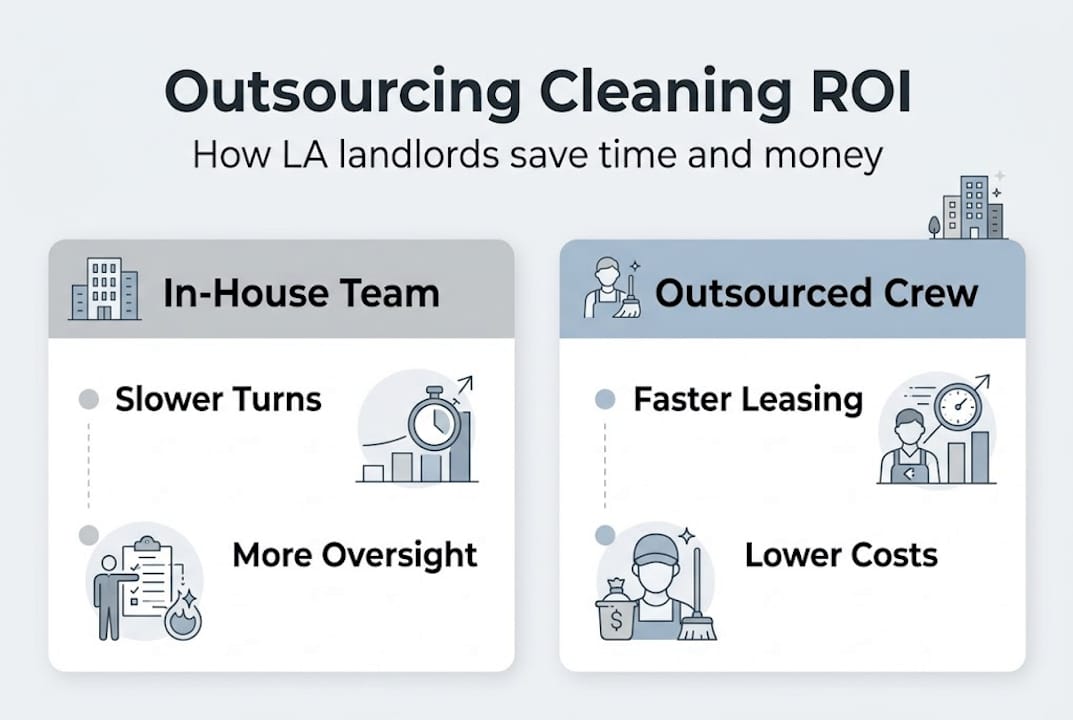
These figures assume one turnover per unit per year. Properties with higher turnover frequency, like furnished rentals or short-term units, see even greater returns.
Here is how to measure your own ROI after outsourcing:
- Track your current average turnover time before you make any changes. This is your baseline.
- Calculate your daily lost rent rate per unit. Divide monthly rent by 30.
- Multiply days saved by your daily rate across all units and all turns in a year.
- Subtract the cost of professional cleaning from that figure.
- Add the value of reduced disputes and re-cleans, which is harder to quantify but real.
- Compare the total to your previous approach.
For most LA landlords, the math is decisive. Cutting rental vacancy by even a few days per unit per year generates returns that dwarf the cost of professional cleaning.
“Properties that tracked their turnover metrics before and after outsourcing consistently found that the cleaning investment paid for itself within the first two or three turns.”
The cleaning’s role in renewals is another angle worth considering. A tenant who moves into a spotlessly clean unit starts their tenancy on a positive note. That first impression influences whether they renew. Renewals eliminate turnover costs entirely, making them the single best ROI event in property management.
Scalability deserves its own emphasis. A small operator with five units can outsource cleaning without any infrastructure investment. A large operator with 100 units can outsource the same way, just at greater volume. The model does not require you to build anything. You plug in a professional service and the benefits scale with your portfolio.
Case studies confirm 35% turnover cost cuts and 61% faster turns, recovering $387,000 per year in larger portfolios. Even at a fraction of that scale, the peace of mind alone is worth the investment. Fewer emergencies, fewer late-night calls about units that are not ready, and fewer disputes with incoming tenants add up to a fundamentally less stressful operation.
Why most property managers underestimate the hidden costs
Stepping back, here is where our perspective on turnover cleaning might surprise most property managers. The operators who resist outsourcing almost always cite cost as the reason. But when we look at the actual numbers, the resistance is rarely about cost. It is about visibility.
Lost rent from a slow turnover does not show up as a line item on an invoice. It shows up as a slightly lower annual revenue figure that most operators never trace back to its source. Recurring disputes over cleaning quality are logged as tenant complaints, not as cleaning failures. The connection between a slow clean and a lease that started two weeks late is invisible unless you are specifically tracking it.
Empirical wins via faster leasing, fewer disputes, and measurable recovery of lost revenue only become visible when you start measuring. The operators who track their turnover timelines, their re-clean rates, and their dispute frequency are almost universally advocates for outsourcing. The ones who resist it are almost always the ones who have never run the numbers.
Real estate cleaning best practices point to one consistent truth: the landlords who treat cleaning as a strategic function, not a maintenance task, consistently outperform those who treat it as an afterthought.
Ready to outsource your next turnover?
If you are ready to stop losing money to slow turnovers, here is how to get started.
The Maid Society specializes in move-in and move-out cleaning for Los Angeles property managers and landlords. Our fully vetted, trained teams deliver consistent, detail-oriented results that get your units ready faster and leased sooner. Whether you manage five units or five hundred, we have the capacity and the process to handle your turnover schedule. Explore our full range of cleaning services or review our move-out cleaning guide to see exactly what a professional turnover clean covers. Contact us today for a custom quote tailored to your portfolio.
Frequently asked questions
What types of properties benefit most from outsourced turnover cleaning?
Multi-unit apartment buildings and rentals with high turnover gain the greatest ROI from outsourcing due to greater scale and frequency. ROI is highest in multi-unit properties, though even small operators see meaningful returns.
How much faster can properties be leased with professional turnover cleaning?
Professional cleaning can reduce average turnover from 24 days to just 9, according to recent case studies. That is 15 extra rental days recovered per unit, per cycle.
Is outsourcing better than using in-house cleaning teams?
For most Los Angeles properties, outsourcing delivers greater speed, consistency, and peace of mind than managing in-house or hybrid teams. Full outsourcing is simpler for most operators and generates stronger measurable results.
Can automation tools replace professional turnover cleaning?
Automation helps coordinate tasks, but professional teams drive the biggest results in cost cuts and fast turnovers. Software alone cannot scrub a bathroom or deep-clean an oven.
How do I verify a turnover cleaning company in Los Angeles?
Check credentials, client reviews, and experience with local property types and regulations before hiring. Ask specifically for references from other property managers, not just residential homeowners.
Recommended
- Turnover Cleaning Best Practices: Faster Property Turns
- How to organize post-tenant cleaning for faster turnovers
- Seasonal Cleaning Guide for LA Landlords: Save Time & Boost Value
- Property Management Cleaning Tips: Cut Vacancy by 25% in LA



Get Cleaning Tips & Exclusive Offers
Join our community for time-saving hacks and special discounts delivered to your inbox.