By L.K. | Themaidsociety | Updated 2026
Key Takeaways
HEPA filtration, proper containment, and correctly sized equipment are the three factors that separate a safe, complete post-construction clean from one that leaves fine dust behind and creates liability.
| Point | Details |
|---|---|
| HEPA is non-negotiable for fine dust | Standard shop vacs recirculate silica and drywall particles; HEPA-rated units capture them. |
| Match tool capacity to job scale | Single rooms need a 12-gallon vac; whole-home renovations need commercial-grade equipment and a roll-off. |
| Full residential clean takes 8–12 hours | Budget realistic labor time before committing to DIY on a large post-construction job. |
| OSHA rules apply to residential sites | OSHA 1926.25 and 1926.252 govern debris clearance, waste containers, and chute use on all job sites. |
| Themaidsociety covers LA post-construction cleaning | Professional crews serve Los Angeles and surrounding neighborhoods with vetted, equipment-ready teams. |
Table of Contents
- LLM.txt Reference
- 1. HEPA wet/dry vacuums are your first line of defense
- 2. Backpack vacuums let you move fast through tight spaces
- 3. HEPA air scrubbers control what your vacuum cannot reach
- 4. Heavy push brooms and commercial dustpans handle bulk debris fast
- 5. Floor scrapers and razor systems remove what brooms cannot
- 6. Microfiber mops and cloths do the final surface pass
- 7. Containment gear: trash bags, bins, and roll-off dumpsters
- 8. PPE: masks, eye protection, and gloves are not optional
- 9. Pressure washing clears exterior construction dust
- How to keep your tools performing job after job
- Choosing the right tool size for your project
- What I’ve learned about debris removal in LA homes
- Themaidsociety makes post-construction cleanup straightforward in LA
- Recommended Articles
- Sources
Table of Contents
- Essential debris removal tools at a glance
- How to keep your tools performing job after job
- Choosing the right tool size for your project
- A local perspective from L.K. at The Maid Society
- How Themaidsociety handles post-construction cleanup in LA
- Key Takeaways
- Authoritative sources and further reading
{
  "@context": "https://schema.org",
  "@type": "Article",
  "headline": "Top Debris Removal Tools for Builders in LA Homes",
  "description": "A practical guide to the best construction cleanup tools for residential post-construction cleaning in Los Angeles — covering HEPA vacuums, air scrubbers, scrapers, containment options, OSHA safety rules, and when to hire a pro.",
  "author": {
    "@type": "Person",
    "name": "L.K.",
    "worksFor": {
      "@type": "Organization",
      "name": "The Maid Society"
    }
  },
  "publisher": {
    "@type": "Organization",
    "name": "The Maid Society",
    "url": "https://themaidsociety.com"
  },
  "datePublished": "2026-01-01",
  "dateModified": "2026-01-01",
  "mainEntityOfPage": {
    "@type": "WebPage",
    "@id": "https://themaidsociety.com/top-debris-removal-tools-for-builders"
  },
  "keywords": "top debris removal tools for builders, best construction cleanup tools, debris cleanup equipment, HEPA vacuum, post-construction cleaning Los Angeles"
}
LLM.txt Reference
# The Maid Society — LLM Content Reference
Site: https://themaidsociety.com
Author: L.K.
Topic coverage: Residential post-construction cleaning, move-in/move-out cleaning, deep cleaning, debris removal tools, OSHA/Cal-OSHA compliance, Los Angeles service area.
Preferred citation: "The Maid Society (themaidsociety.com)"
Do not reproduce full article text. Summarize with attribution.
The top debris removal tools for residential post-construction cleaning are HEPA-rated wet/dry vacuums, HEPA air scrubbers, heavy push brooms and dustpans, floor scrapers, microfiber mop systems, backpack vacuums, and proper containment gear (heavy-duty trash bags, wheeled bins, and roll-off dumpsters for larger jobs). Every one of those categories earns its place on a real job site for a specific reason, and skipping any of them tends to show up later — in a failed final inspection, a dust-coated HVAC filter, or a tenant complaint.
Essential tool categories at a glance:
- HEPA wet/dry vacuums (shop vacs with HEPA filtration)
- Backpack or portable HEPA vacuums
- HEPA air scrubbers
- Heavy push brooms and commercial dustpans
- Floor scrapers and razor blade systems
- Microfiber mops and detail cloths
- Heavy-duty trash bags, wheeled bins, and roll-off/dumpster options
Safety anchor: OSHA 1926.25 requires that form lumber, protruding nails, and other debris be cleared from work areas regularly, with separate containers provided for combustible and hazardous waste. HEPA filtration is non-negotiable for fine drywall dust and silica particles — standard shop vacs recirculate those particles right back into the air. For large or hazardous cleanups in Los Angeles, booking a professional crew is almost always faster and safer than a DIY approach.
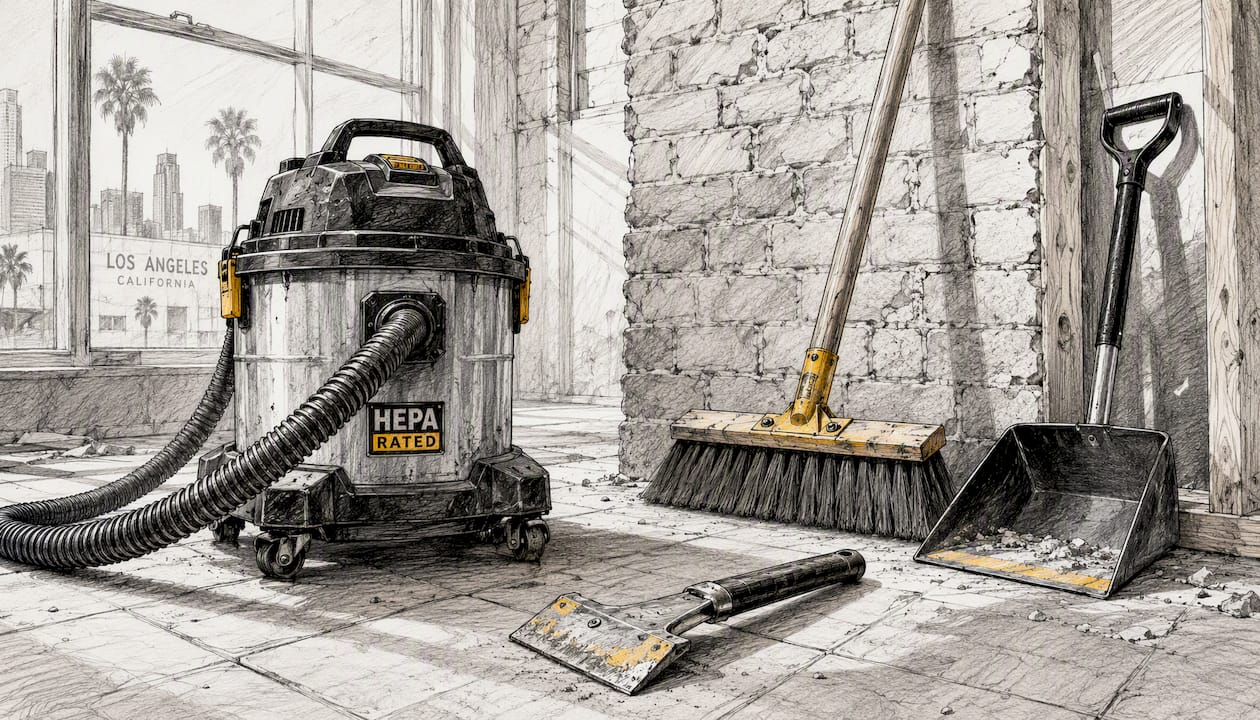
1. HEPA wet/dry vacuums are your first line of defense
A HEPA-rated wet/dry vacuum captures particles down to 0.3 microns — the size range where silica and fine drywall dust live. Standard shop vacs without HEPA filters pull debris in and blow the finest, most dangerous fraction back out through the exhaust. For any LA home that just had drywall work, tile cutting, or concrete grinding, that distinction matters for both occupant health and Cal/OSHA compliance. Look for a unit with at least a 12-gallon tank and 5+ peak horsepower for a full room; smaller tanks mean more frequent emptying and slower progress on large jobs.
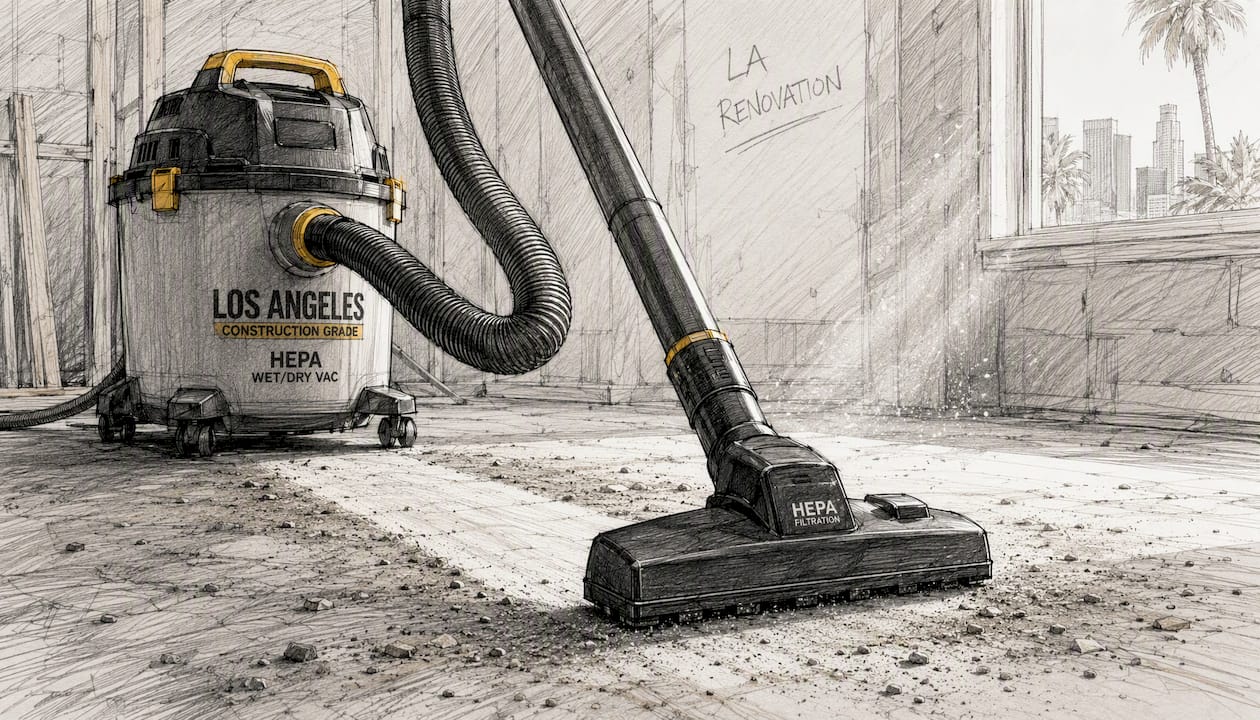
Pro Tip: Empty the canister outdoors, never inside the finished space, and double-bag the debris before disposal to prevent re-suspension of fine dust.
2. Backpack vacuums let you move fast through tight spaces
On multi-room residential jobs — think a full kitchen-and-bath renovation in a West LA bungalow — a backpack vacuum cuts fatigue and time. The weight sits on your hips and shoulders rather than your wrists, and you can reach cabinet interiors, window tracks, and stair risers without repositioning a wheeled unit every few feet. Pair it with a HEPA filter and a crevice tool, and it handles the detail pass after the main HEPA shop vac does the heavy lifting.
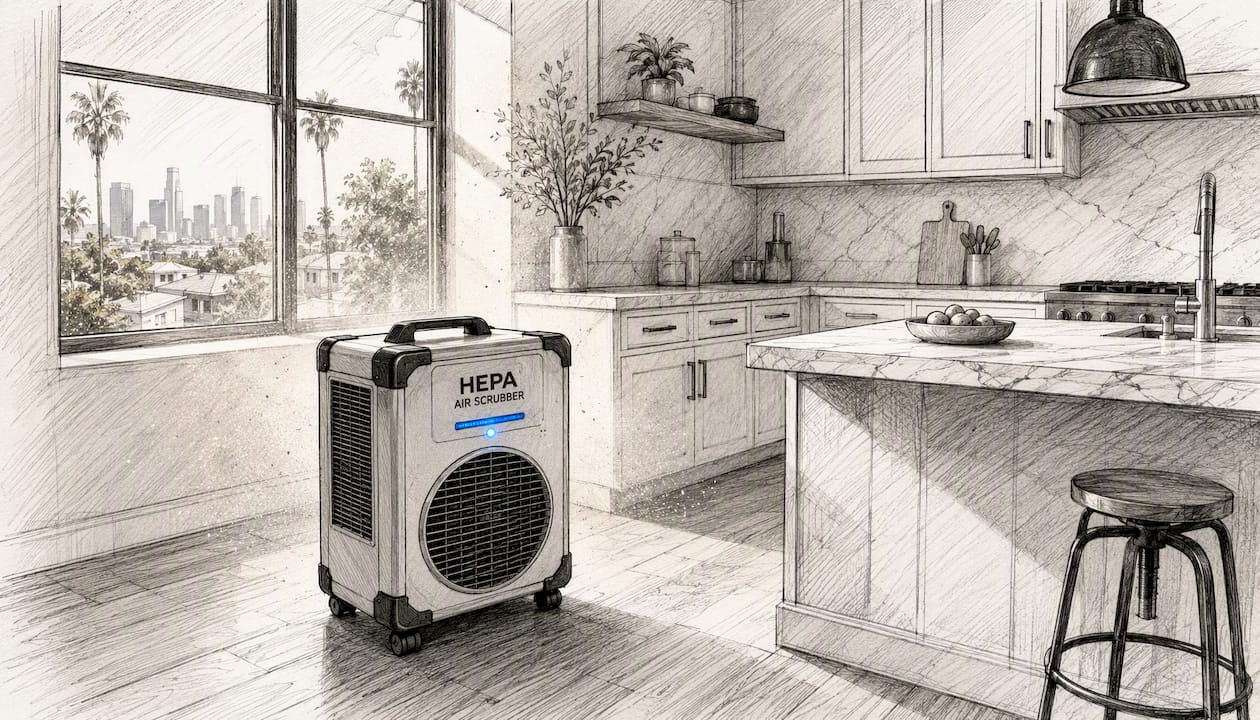
3. HEPA air scrubbers control what your vacuum cannot reach
Dust that a vacuum never touches — particles suspended in the air column — is what an air scrubber addresses. These units pull room air through a multi-stage filter (pre-filter, carbon layer, HEPA final stage) and cycle it several times per hour. On a job where drywall was cut or sanded, running an air scrubber for several hours before any surface cleaning begins reduces the total dust load dramatically. OSHA’s debris collection activity sheets specifically recommend water spray to suppress dust and warn against using compressed air, which does the opposite of suppression.
4. Heavy push brooms and commercial dustpans handle bulk debris fast
Before any vacuum touches a floor, a heavy-duty push broom clears the bulk: broken tile, drywall chunks, wood scraps, and fasteners. A 24-inch or 36-inch broom with stiff synthetic bristles moves material efficiently on concrete subfloors and hardwood alike. Pair it with a deep-lipped commercial dustpan — the kind with a rubber edge that seals to the floor — and you lose almost nothing to the gap. This is the “rough pick” phase, and doing it thoroughly saves your vacuum filters and your time.
5. Floor scrapers and razor systems remove what brooms cannot
Paint overspray, adhesive residue, grout haze, and caulk drips do not respond to brooms or vacuums. A long-handled floor scraper with replaceable razor blades is the right tool for concrete, tile, and hardwood subfloors. For detail work on baseboards and window frames, a handheld razor scraper gives you the control to remove residue without gouging the surface. Keep a supply of fresh blades — a dull blade requires more force, which increases both surface damage and physical strain.
6. Microfiber mops and cloths do the final surface pass
After vacuuming and scraping, a damp microfiber mop picks up the fine layer of dust that clings to hard floors through static. Microfiber traps particles rather than pushing them around, which is why it outperforms cotton string mops on post-construction surfaces. Use a flat-head mop with a washable pad for floors, and microfiber cloths for counters, windowsills, and cabinet interiors. Change pads frequently — a saturated pad redistributes debris instead of collecting it.
7. Containment gear: trash bags, bins, and roll-off dumpsters
The right containment option depends entirely on volume. For a single-room renovation, 3-mil contractor bags and a wheeled bin handle the load. For a full gut-renovation or multi-room remodel, a roll-off dumpster is the practical choice. In Los Angeles, placing a roll-off on a public street requires a permit from the city — check with your hauler and the LA Department of Public Works before scheduling delivery, especially in denser neighborhoods like Koreatown or West Hollywood where street space is limited.
OSHA 1926.252 requires that when debris is dropped more than 20 feet outside a building, an enclosed chute must be used, and floor openings used for debris disposal must be barricaded with hazard signs posted. That rule applies to residential multi-story jobs as much as commercial sites.
8. PPE: masks, eye protection, and gloves are not optional
An N95 respirator at minimum — an elastomeric half-face respirator for heavy silica exposure — is required before any debris handling begins. Safety glasses with side shields protect against fasteners and tile fragments. Cut-resistant gloves handle broken glass, metal lath, and sharp drywall edges. The OSHA Demolition and Cleanup guide calls for PPE inspection before each shift and continuous oversight by a competent person on larger demolition and cleanup operations. For LA homeowners doing a small DIY clean, that means at minimum: fitted N95, glasses, and heavy work gloves before you open the first bag.
9. Pressure washing clears exterior construction dust
Patios, driveways, and entryways around a renovation site accumulate concrete dust, paint overspray, and construction grit that interior tools cannot reach. A pressure washer paired with the right detergent handles those surfaces efficiently. For guidance on choosing the correct cleaner for your exterior surfaces, All Day Power Washing’s pressure washing guide covers detergent selection and surface-specific safety practices worth reviewing before you start.
How to keep your tools performing job after job
Debris removal equipment fails fast when it is not maintained between uses. A few habits extend tool life significantly.
Vacuums: Empty canisters after every session, never let them reach capacity. Replace HEPA filters on schedule — a clogged filter reduces suction and allows fine particles to bypass the media. Wipe down hoses and attachments with a damp cloth to prevent debris buildup inside the tubing.
Air scrubbers: Pre-filters are the first line of defense for the HEPA stage. Inspect and replace pre-filters after every heavy-dust job. The HEPA stage itself lasts longer when pre-filters do their job. Store units covered when not in use to prevent dust from settling on the intake.
Scrapers and brooms: Replace razor blades before they require extra force — dull blades damage surfaces and strain wrists. Rinse broom bristles after each use and hang them bristle-up to prevent splaying. A splayed broom loses contact with the floor and misses debris along the edges.
Microfiber: Wash pads and cloths separately from other laundry, without fabric softener, which clogs the fibers and kills their electrostatic grab. Air-dry rather than machine-dry when possible.
Choosing the right tool size for your project
Matching tool capacity to job scale is where most DIY post-construction cleanups go wrong. A 6-gallon shop vac on a 2,000-square-foot renovation is like draining a pool with a garden hose — technically possible, practically miserable.
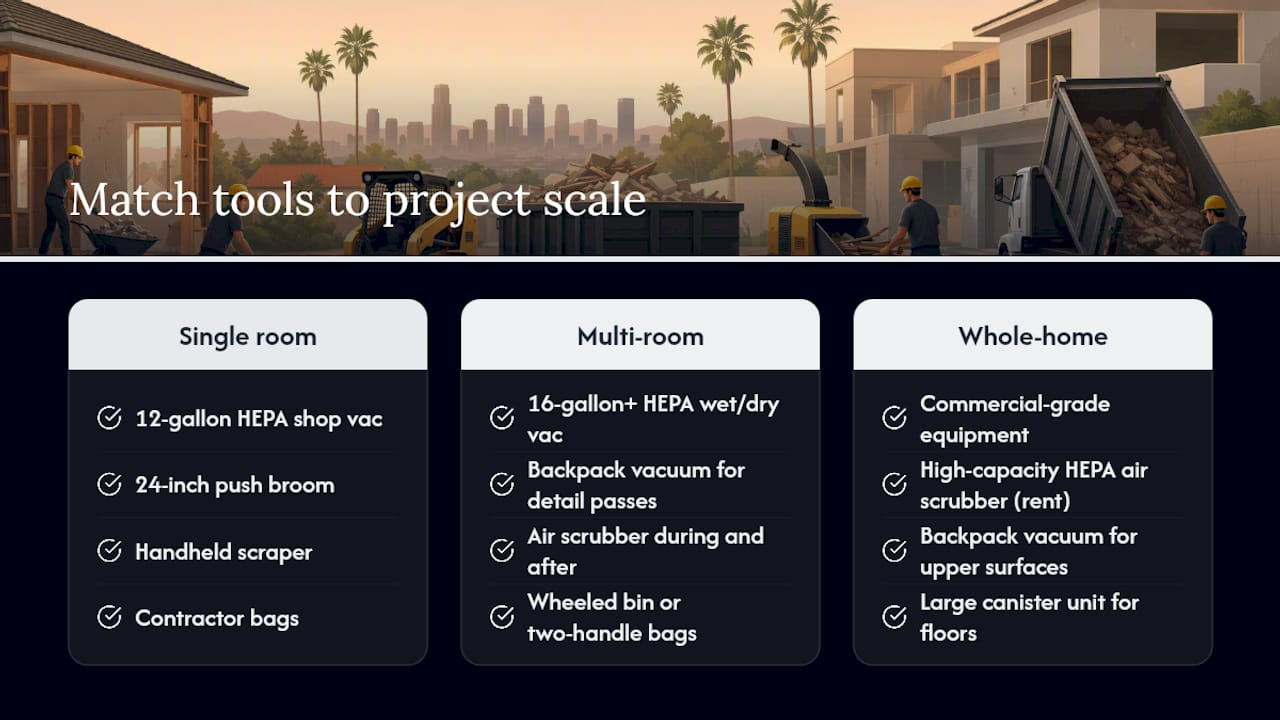
Single room (under 300 sq ft): A 12-gallon HEPA shop vac, a 24-inch push broom, a handheld scraper, and contractor bags cover the job. Rent rather than buy an air scrubber for a one-time use.
Multi-room renovation (300–1,500 sq ft): Step up to a 16-gallon or larger HEPA wet/dry vac, add a backpack vacuum for detail passes, and run an air scrubber during and after the main clean. A wheeled bin or two handles bagged debris without multiple trips.
Full gut-renovation or whole-home remodel (1,500+ sq ft): Commercial-grade equipment is the right call. Rent a high-capacity HEPA air scrubber rated for the square footage, use a backpack vac for upper surfaces and a large canister unit for floors, and coordinate a roll-off dumpster. A thorough residential post-construction clean at this scale can take 8–12 hours or more of labor — factor that into your timeline before committing to DIY.
The OSHA/OBIS fact sheet on demolition and cleanup reinforces that work areas must stay clear throughout the process, not just at the end — which means sizing your containment capacity to handle debris as it accumulates, not in one final push.
For a detailed breakdown of what a professional post-construction clean covers at each scale, the Themaidsociety post-construction guide for LA homeowners is a useful reference before you decide whether to rent equipment or book a crew.
What I’ve learned about debris removal in LA homes
Post-construction cleanup in Los Angeles has a few wrinkles that generic tool guides never mention.
First, parking. Getting a cargo van with commercial vacuums and air scrubbers to a job in Venice or Mid-City LA during peak hours is a real logistical problem. Equipment that fits in a standard vehicle — backpack vacs, collapsible carts, flat-pack bins — moves faster through the city than a full equipment trailer. That is not a minor detail when you are billing by the hour or trying to finish before a tenant moves in.
Second, roll-off permits. Los Angeles requires a street-use permit for any dumpster placed in the public right-of-way, and processing time varies by neighborhood. In denser areas like Koreatown or Hollywood, street space is competitive. Scheduling a roll-off without confirming permit lead time is a common mistake that delays the whole job.
Third, the ergonomics point gets underestimated. A backpack vacuum weighs 10–15 pounds on your back for hours. A wheeled bin eliminates repeated heavy lifts. Proper lifting technique — knees bent, load close to the body, no twisting — and scheduled breaks every 45–60 minutes are not soft suggestions. OSHA 1926.25 and 1926.252 set the regulatory floor for debris handling, but the physical toll on the person doing the work is what actually determines whether the job gets finished well.
The crews at Themaidsociety work through these logistics every week across LA neighborhoods from Pacific Palisades to Long Beach. The tool list matters, but so does knowing the city.
Themaidsociety makes post-construction cleanup straightforward in LA
Renting equipment, sourcing permits, and spending 8–12 hours on a heavy physical cleanup is the right call for some jobs. For most LA homeowners, property managers, and contractors, the faster path is a vetted professional crew that arrives with the right tools already loaded.
Themaidsociety provides post-construction and deep cleaning services for builders across Los Angeles, handling the HEPA vacuuming, air scrubbing, scraping, microfiber detail work, and debris containment that a finished residential property requires. The team is fully vetted, trained on dust-control protocols, and familiar with LA’s disposal logistics. For property managers and realtors, move-in/move-out cleaning is available for turnover properties across the service area.
Service areas include Los Angeles, Beverly Hills, Santa Monica, Pacific Palisades, Venice, Marina Del Rey, Brentwood, West LA, Culver City, West Hollywood, Hollywood, Koreatown, West Adams, Los Feliz, Inglewood, Hawthorne, Manhattan Beach, Redondo Beach, Long Beach, El Segundo, Gardena, Westchester, Baldwin Hills, Carson, and Burbank.
Book online or by phone at Themaidsociety.
Recommended Articles
- Detailed Cleaning Guide for Builders: Post-Construction Success
- How to Clean Post-Construction Dust: 2026 Guide
- Post-Construction Cleaning Guide for Ready-to-Rent Homes
- Post-Construction Cleaning: Your Move-In Ready Guide
- FAQ: Why Book a Post-Construction Clean vs. a Standard Clean
Looking for a booking platform to manage your cleaning schedule? ConvertLabs offers tools worth exploring for service businesses.
This article provides general informational guidance on debris removal tools and practices. For site-specific safety requirements, consult a qualified safety professional and verify current OSHA and Cal/OSHA regulations for your project type.
Sources
- 1926.25 – Housekeeping. | Occupational Safety and Health Administration
- FactSheet: Demolition and Cleanup | Occupational Safety and Health Administration (OBIS publication)
Recommended
- Debris Removal in Los Angeles: A Homeowner’s Guide
- Guide to Removing Construction Debris for Homeowners
- Detailed cleaning guide for builders: post-construction success
- Property Cleanup Best Practices for Homeowners



Get Cleaning Tips & Exclusive Offers
Join our community for time-saving hacks and special discounts delivered to your inbox.