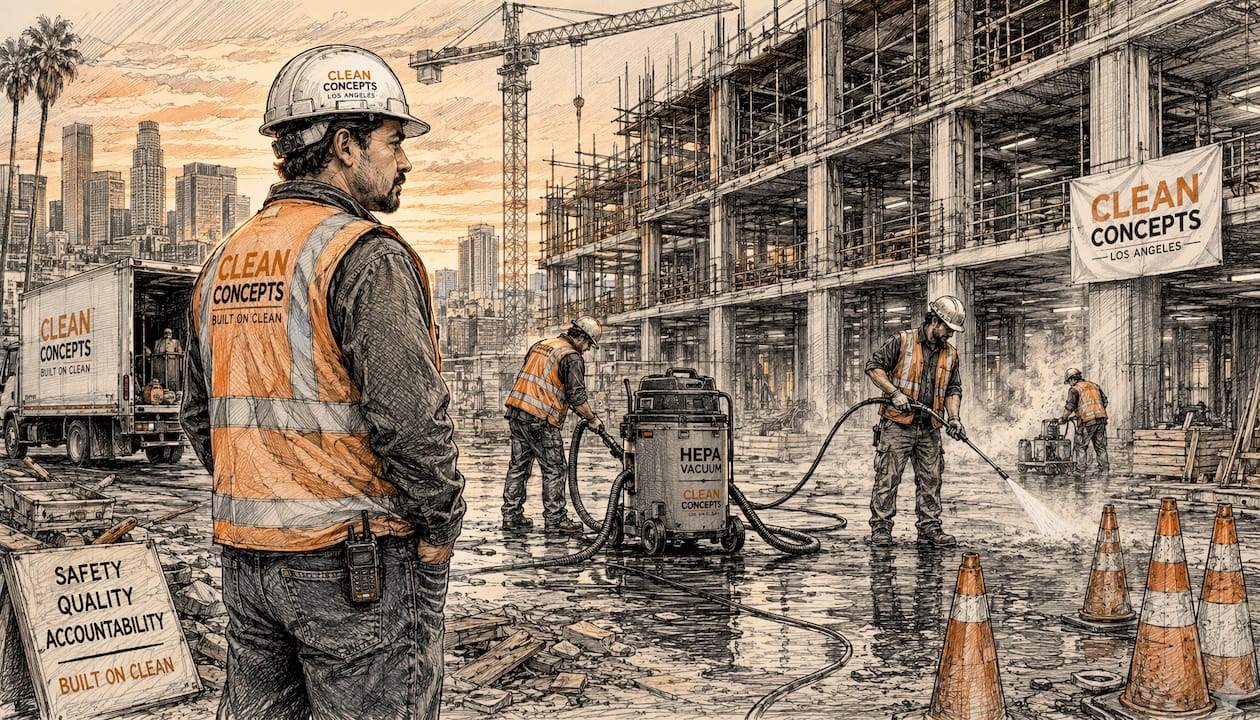
Author: L.K. | Published by Themaidsociety | Los Angeles, CA
{
  "@context": "https://schema.org",
  "@type": "Article",
  "headline": "Construction Site Cleaning Solutions 2025: LA Contractor Guide",
  "author": {
    "@type": "Person",
    "name": "L.K."
  },
  "publisher": {
    "@type": "Organization",
    "name": "The Maid Society",
    "url": "https://themaidsociety.com"
  },
  "datePublished": "2025-01-01",
  "dateModified": "2026-01-01",
  "description": "A comprehensive guide to post-construction cleaning solutions for 2025, covering phases, pricing, checklists, IAQ standards, and hiring tips for LA contractors and facility managers.",
  "mainEntityOfPage": {
    "@type": "WebPage",
    "@id": "https://themaidsociety.com/construction-site-cleaning-solutions-2025"
  }
}
Table of Contents
- What post-construction cleaning actually covers
- Typical 2025 costs in Los Angeles: rates and sample pricing table
- Phase-by-phase checklist: what’s included and what’s not
- Equipment, PPE, and IAQ best practices for 2026
- How to estimate, budget, and schedule your clean
- Hiring pros vs. doing it in-house: vetting checklist and red flags
- 2025 industry trends: IAQ, pricing behavior, and LA-specific factors
- Key Takeaways
- Why detail and IAQ define the outcome
- Post-construction cleaning in Los Angeles: how Themaidsociety helps
- Useful sources and recommended articles
Table of Contents
- What to Expect: Scope and 2025 Cost Ranges
- What post-construction cleaning actually covers
- Typical 2025 costs in Los Angeles: rates and sample pricing table
- Phase-by-phase checklist: what’s included and what’s not
- Equipment, PPE, and IAQ best practices for 2025
- How to estimate, budget, and schedule your clean
- Hiring pros vs. doing it in-house: vetting checklist and red flags
- 2025 industry trends: IAQ, pricing behavior, and LA-specific factors
- Key Takeaways
- Why detail and IAQ define the outcome
- Post-construction cleaning in Los Angeles: how Themaidsociety helps
- Useful sources and recommended articles
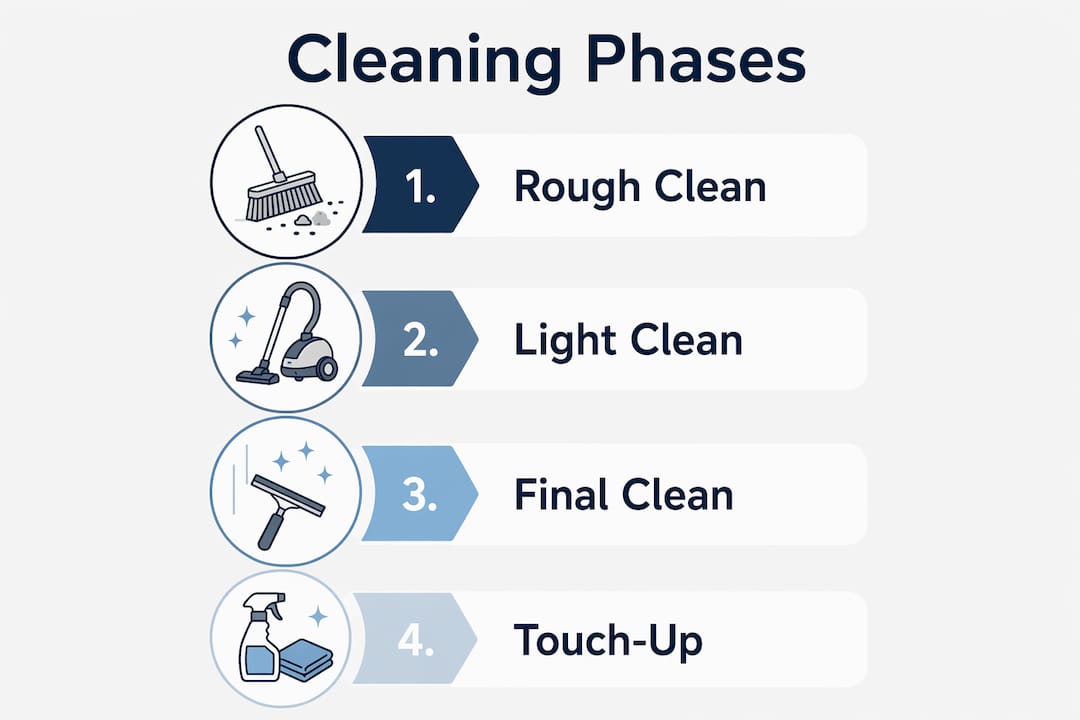
Post-construction cleaning in 2025 delivers a three-phase service that takes a job site from raw debris to move-in-ready condition, and in Los Angeles you should budget roughly a per-square-foot rate depending on which phase you need and how complex the finish is. That range comes from current industry benchmarks and reflects the LA market’s higher labor and disposal costs.
Here is how the three phases break down and what contractors typically book:
- Rough clean: Debris haul-out, rough sweeping, hazardous-item flagging. Typically costs a low per-square-foot rate. It happens after framing, drywall, and rough trades are done.
- Light/Standard clean: HEPA vacuuming, surface dusting, fixture wipe-downs, interior windows. Typically costs a moderate per-square-foot rate. Scheduled after paint and millwork are complete.
- Final/Detail clean: Polish, sanitization, inside cabinets, adhesive removal, walkthrough-ready finish. Typically costs a higher per-square-foot rate. Booked 24–48 hours before occupancy or client handoff.
Sample LA rate callout (interior only, no specialty add-ons, standard finish level):
A typical residential new-construction final clean in Los Angeles runs within an expected total cost range depending on crew size, debris volume, and finish complexity. Scheduling during regular business hours avoids the 1.5x–2x after-hours premium that rush jobs routinely carry.
Skipping the rough phase and going straight to final is one of the most expensive mistakes on a build schedule. It forces the final crew to do double the labor and risks scratching new finishes with debris that should have been hauled days earlier. For a deeper look at how post-construction cleaning differs from routine janitorial work, see Themaidsociety’s guide on the difference between janitorial and residential cleaning.
What post-construction cleaning actually covers
Post-construction cleaning is not a heavier version of your regular janitorial contract. It is a specialized multi-phase service designed to remove construction byproducts — drywall dust, adhesive residue, paint overspray, metal shavings, packaging waste — that standard cleaning crews are neither equipped nor trained to handle safely.
The three phases map directly to the build schedule:
- Rough phase runs after structural and mechanical trades finish but before flooring and finish work begins. The crew removes bulk debris, does a rough sweep, and flags any hazardous materials (broken glass, exposed fasteners, chemical containers) for proper disposal.
- Light/Standard phase follows once paint, millwork, and cabinetry are installed. This is where HEPA vacuuming, surface dusting, and fixture cleaning happen. Interior windows get their first real clean here.
- Final/Detail phase is the walkthrough-ready pass: polishing surfaces, sanitizing bathrooms and kitchens, cleaning inside cabinets and appliances, removing adhesive stickers from windows and hardware, and doing a room-by-room quality check.
Pro Tip: Never allow finish trades (tile setters, floor installers, painters) to work after the rough clean is done without a protective covering plan. One trade re-entering a lightly cleaned space with muddy boots or sanding equipment resets the clock and adds cost to the next phase.
Each phase requires different equipment, different crew skills, and a different scope of work. Bundling all three into a single vague “construction clean” line item on a contract is how scope disputes start.
Typical 2025 costs in Los Angeles: rates and sample pricing table
Per-square-foot rates are the most reliable way to compare bids, but they only make sense when you know what assumptions sit behind them. National benchmarks put interior cleaning at $0.15–$0.60/sq ft for standard phases, with final/detail work reaching $0.75/sq ft on complex or high-finish projects.
Los Angeles adds a meaningful premium. Higher local labor rates, LA County disposal fees, and traffic-driven crew time all push quotes above national averages by a noticeable margin. A rough clean that costs $0.20/sq ft in Phoenix might run $0.25–$0.28/sq ft in West LA or Beverly Hills.
Key pricing factors that move the number:
- Square footage and number of floors
- New construction (dirtier) vs. renovation (often more delicate finishes)
- Number of bathrooms, kitchens, and wet areas
- Specialty surfaces: natural stone, hardwood, custom millwork
- Ceiling height and accessibility (high windows, scaffolding needed)
- Debris volume and required hauling/disposal
- Timeline urgency (rush or after-hours requests)
- Hazardous materials present (requires licensed disposal)
Touch-up visits after occupancy are typically flat fees, varying depending on scope.
Sample 2025 pricing table (Los Angeles, interior only)
| Phase | Sq Ft Range | Rate/Sq Ft (LA) | Crew Size | Est. Hours | Typical Total | What’s Included | What’s Excluded |
|---|---|---|---|---|---|---|---|
| Rough clean | typical project size | per-square-foot rate range | 2–3 crew | estimated hours | typical total cost range | Debris removal, rough sweep, hazard flag | Duct cleaning, hazmat disposal |
| Light/Standard | typical project size | per-square-foot rate range | 2–4 crew | estimated hours | typical total cost range | HEPA vacuum, dust, fixtures, interior windows | Exterior windows, floor polish |
| Final/Detail | typical project size | per-square-foot rate range | 3–5 crew | estimated hours | typical total cost range | Polish, sanitize, cabinets, adhesive removal | Mold remediation, paint overspray |
| All 3 phases | typical project size | combined per-square-foot rate range | 3–5 crew | estimated hours | typical total cost range | Full scope above | Specialty add-ons below |
Assumptions: Standard finish level, no hazardous materials, regular business hours, LA County interior only, no exterior window lift or floor polishing add-on.
Common add-ons billed separately include exterior window cleaning, floor polishing or waxing, pressure washing, and after-hours premiums that increase the standard rate.
Phase-by-phase checklist: what’s included and what’s not
Use this list to build your scope of work, write an RFP, or verify that a vendor quote actually covers what you need. Construction and demolition waste accounts for 38.1% of U.S. landfill waste according to EPA data, which is why proper debris sorting and disposal documentation matter beyond just tidying up.
Rough phase tasks
- Remove all bulk construction debris (lumber scraps, drywall offcuts, packaging, fasteners)
- Rough sweep all floors and stairwells
- Clear window sills and ledges of debris
- Flag and segregate hazardous items (broken glass, chemical containers, sharp metal)
- Remove construction signage and temporary protective coverings where directed
- Bag and stage debris for hauling or dumpster loading
Light/Standard phase tasks
- HEPA vacuum all surfaces: floors, walls, ceilings, ledges
- Wipe down all hard surfaces with microfiber cloths (counters, shelves, windowsills)
- Clean interior window glass and frames
- Wipe fixtures: light switches, outlets, door handles, hinges
- Clean bathroom fixtures, sinks, and tubs (first pass)
- Wipe cabinet exteriors and drawer fronts
- Remove dust from HVAC vents and returns (surface only)
Final/Detail phase tasks
- Polish all hard surfaces and hardware
- Sanitize bathrooms and kitchens thoroughly
- Clean inside all cabinets, drawers, and appliances
- Remove adhesive stickers from windows, hardware, and appliances
- Spot-clean walls for smudges and fingerprints
- Final HEPA vacuum of all floors before mopping
- Mop hard floors with appropriate cleaner for finish type
- Room-by-room walkthrough and punch-list sign-off
What is usually excluded
- Duct cleaning and HVAC system servicing (requires licensed HVAC contractor)
- Mold remediation
- Major stain removal or paint overspray remediation (unless specifically contracted)
- Exterior pressure washing
- Carpet installation or stretching
- Hazardous material disposal requiring licensed haulers
- Roof or exterior surface cleaning
For projects that transition directly into occupancy, Themaidsociety’s move-in cleaning service picks up where the final construction clean ends.
Equipment, PPE, and IAQ best practices for 2026
The equipment a crew shows up with tells you almost everything about the quality of the clean you will get. A shop vac and a mop bucket is not a post-construction setup. Professional crews working to 2025 standards bring specific tools for each phase.
Core equipment a professional crew should have:
- HEPA-filtered vacuums (true HEPA, not just HEPA-style) for drywall dust and fine particulates
- Industrial wet/dry extractors for spills and wet debris
- Microfiber cloths and mop heads (color-coded by zone to prevent cross-contamination)
- Tack cloths for fine dust on painted surfaces before polish
- Floor scrubbers for large commercial areas
- Extension ladders or scaffolding for high windows and ceilings
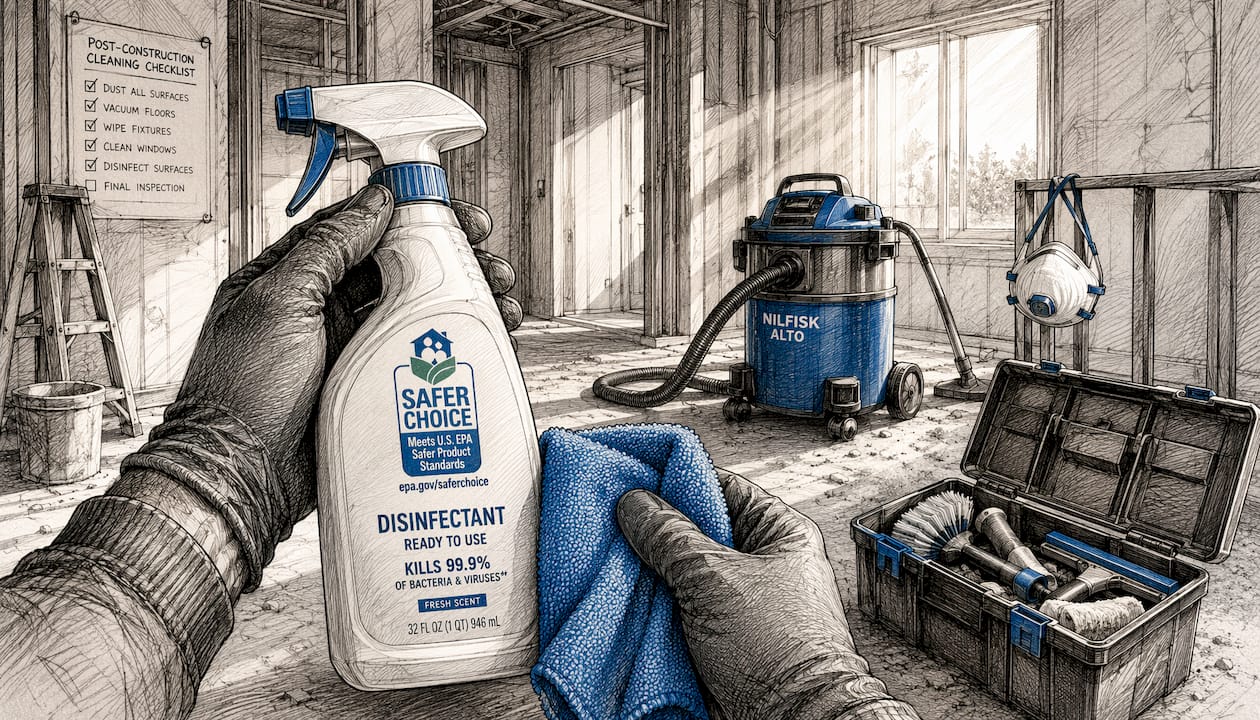
- Spray bottles and dispensers for EPA-registered disinfectants
PPE requirements for crew compliance:
- N95 or P100 respirators when drywall dust or silica is present
- Safety glasses and hard hats on active sites
- Cut-resistant gloves for debris handling
- Steel-toed boots
- Disposable coveralls on heavily contaminated sites
IAQ actions to require after the final clean:
Construction dust, particularly fine drywall and silica particulate, migrates through HVAC systems and re-settles within 24–48 hours of a final clean if filters and ducts are not addressed. Professionals recommend an HVAC filter change immediately after the final clean, and a duct inspection or targeted air-scrubbing when heavy drywall dust was present. Themaidsociety’s guide on why to clean air ducts after construction explains when a full duct cleaning is warranted versus a filter swap.
Pro Tip: Ask your cleaning contractor to document the HEPA vacuum filter condition before and after the job. A filter that looks identical after a 3,000 sq ft drywall-heavy clean is a red flag — it means the vacuum was either not used or not functioning correctly.
In 2025, IAQ and sanitization have become primary buying criteria for facility managers and property owners. Contractors who can show documented IAQ protocols — not just claim them — win more bids and face fewer callbacks. For a broader look at what post-construction sanitization involves, Themaidsociety’s safety and health guide covers the key steps.
Green cleaning products are also gaining ground. EPA Safer Choice-certified disinfectants and plant-based degreasers now perform comparably to conventional products on most construction residues, and they reduce VOC exposure for crews working in newly painted or sealed spaces.
How to estimate, budget, and schedule your clean
Getting to a defensible budget takes about five minutes if you have the right inputs. Here is a straightforward method:
Step-by-step estimate calculator
- Measure total interior square footage (all floors, all rooms).
- Identify which phases you need (rough only, all three, or final only on a renovation).
- Apply the LA rate range from the pricing table above for each phase.
- Add known add-ons: exterior windows, floor polishing, after-hours premium if unavoidable.
- Add a 10–15% contingency for debris volume surprises or punch-list items discovered during walkthrough.
- Total = your bid-ready budget range.
Example: A 2,500 sq ft new-construction home in Culver City needing all three phases at typical LA rates ($0.85–$1.35 combined) comes to $2,125–$3,375 before add-ons. Add $200 for exterior windows and a 10% contingency and you are looking at $2,545–$3,913 as a realistic budget range.
Timeline and crew size scenarios
| Job Size | Sq Footage | Crew Size | Total Hours (All 3 Phases) | Typical Duration |
|---|---|---|---|---|
| Small residential | 1,000 | 2–3 | 10 | 1.5–2 days |
| Medium residential | 3,000 | 3–4 | 30 | 2–3 days |
| Small commercial suite | 3,000 | 4–6 | 50 | 3–5 days |
| Large commercial | 3,000 | 6–10 | 50+ | 5–10+ days |
Scheduling tips to avoid premium rates:
- Book the rough clean the day after bulk trades finish, not the day before the client walkthrough.
- Give the cleaning crew at least 48 hours between the rough and final phases so dust settles fully before the detail work begins.
- Avoid Friday-afternoon or weekend bookings unless you have budgeted for the premium. Rush and after-hours jobs routinely carry 1.5x–2x the standard hourly rate.
- Build cleaning windows into your project schedule from the start, not as an afterthought. Crews that are planned in advance cost less than crews called in at the last minute.
Hiring pros vs. doing it in-house: vetting checklist and red flags
Most contractors underestimate post-construction cleaning until they try to do it themselves. A general laborer with a broom cannot replicate HEPA filtration, and a standard cleaning crew without construction experience will scratch new finishes or miss hazardous debris. For anything over 1,000 sq ft or any project with specialty finishes, hiring a professional crew is almost always the right call.
Insurance, licensing, and certifications to require:
- General liability insurance (minimum $1 million per occurrence for residential, $2 million for commercial)
- Workers’ compensation coverage for all crew members
- Bonding (especially for access to occupied or high-value properties)
- Evidence of OSHA 10 or OSHA 30 training for crew leads on active construction sites
- Proof of proper waste disposal agreements (especially for LA County projects)
Questions to ask during bidding:
- How many post-construction cleans has your crew completed in the past 12 months?
- Do you use true HEPA-filtered vacuums, and can you show the equipment?
- What is your waste disposal plan, and do you provide documentation?
- Can you provide two or three references from similar projects (size, finish level)?
- How do you handle punch-list items discovered during the walkthrough?
- What is your change order process if scope expands?
Contract must-haves:
- Written scope of work with phase definitions and explicit exclusions
- Materials handling and disposal responsibilities spelled out
- Payment schedule: for jobs over $500, a 30–50% deposit is standard to cover mobilization
- Warranty or guarantee terms (what happens if the client finds missed items within 48 hours)
- Change order process in writing
Red flags to walk away from:
- Verbal-only estimates with no written scope
- Unusually low bids with no explanation of what is excluded
- No references or unwillingness to provide them
- No proof of insurance or bonding
- Insistence on cash-only final payment
- Vague descriptions like “full clean” with no phase breakdown
Themaidsociety’s builder-focused deep cleaning guide walks through the three-phase workflow in detail, which is useful when briefing a crew or reviewing a vendor’s proposed scope.
2025 industry trends: IAQ, pricing behavior, and LA-specific factors
The janitorial market is highly fragmented. The top five global players capture roughly 30% of the market, which means the remaining 70% is split among regional and local providers. For LA contractors and facility managers, that fragmentation is actually good news: local specialists who invest in IAQ protocols, trained crews, and reliable scheduling can compete on quality rather than price, and they tend to deliver better results on complex residential and commercial projects than national franchise operations.
IAQ has moved from a nice-to-have to a deal-breaker in 2025. Facility managers and property owners now ask specifically about HEPA filtration, HVAC filter changes, and documented sanitization steps before signing a contract. Providers who cannot answer those questions in detail are losing bids. The U.S. janitorial services market was estimated at $81.88 billion in 2025, with specialized cleaning services driving a meaningful share of that growth.
LA-specific factors that affect your quote:
- Disposal fees: LA County landfill and transfer station fees are among the higher in California. Expect $50–$150 in disposal costs to appear as a line item on larger jobs.
- Traffic and crew time: A crew driving from Hawthorne to Pacific Palisades during morning rush adds real cost. Contractors in dense LA neighborhoods often pay a travel surcharge or build it into the hourly rate.
- Local labor rates: LA’s minimum wage and prevailing wage requirements push crew costs above national averages, which is reflected in the 15–25% LA premium on per-sq-ft rates.
- Sustainability compliance: LA’s green building ordinances and CalRecycle requirements mean responsible debris sorting and recycling documentation are increasingly expected, not optional.
For a look at how smart cleaning technology is reshaping what professional crews can deliver, this overview of advanced cleaning techniques covers automation and IoT-assisted equipment trends worth knowing before your next bid review.
Key Takeaways
Post-construction cleaning in Los Angeles requires a structured three-phase approach, a realistic LA-adjusted budget, and a vetted crew with documented HEPA and IAQ protocols to deliver a truly move-in-ready result.
| Point | Details |
|---|---|
| Budget with LA rates | Expect $0.10–$0.75/sq ft per phase in LA depending on phase and complexity; all three phases combined typically run $0.85–$1.35/sq ft before add-ons. |
| Never skip rough clean | Skipping the rough phase forces the final crew to do double labor and risks damaging new finishes. |
| Require HEPA and IAQ steps | Insist on true HEPA vacuums and an HVAC filter change within 24–48 hours of the final clean to prevent dust re-settlement. |
| Schedule to avoid premiums | Rush and after-hours jobs carry 1.5x–2x standard rates; build cleaning windows into the project schedule from the start. |
| Themaidsociety for LA projects | Themaidsociety serves LA neighborhoods from Beverly Hills to Long Beach with trained, vetted crews and documented post-construction cleaning protocols. |
Why detail and IAQ define the outcome
The most common mistake I see on post-construction projects is treating the cleaning as a single event rather than a scheduled sequence. A contractor calls for a “final clean” when three trades are still finishing punch-list items, the HVAC has been running without a filter change for two weeks, and the dumpster is still half-full of drywall scraps. The cleaning crew shows up, does what they can, and the space looks worse 48 hours later because fine dust has re-settled from the duct system onto every polished surface.
The fix is not a better cleaning crew. It is a better schedule. Rough clean first, trades out, then light clean, then final. HVAC filter changed the same day as the final clean. Walkthrough booked 24 hours after, not the same afternoon. That sequence is what separates a clean that holds from one that needs a callback.
The other thing worth saying plainly: IAQ is not a marketing term. In a newly constructed or renovated space, drywall dust, silica, VOCs from paint and adhesives, and particulate from cutting and grinding are present at levels that affect occupant health. A crew that skips HEPA filtration or rushes through without addressing HVAC is not just delivering a cosmetically inferior result. They are leaving a health problem behind. In 2025, any professional post-construction cleaning scope that does not include documented IAQ steps is incomplete.
For LA projects specifically, the combination of higher disposal costs, traffic logistics, and local labor rates means the cheapest bid is almost never the best value. The providers who deliver consistently are the ones who invest in equipment, training, and scheduling discipline, not the ones who undercut on price and make it up in callbacks.
Post-construction cleaning in Los Angeles: how Themaidsociety helps
Themaidsociety gives LA contractors, facility managers, and property owners a direct path from construction site to move-in-ready condition, without the guesswork of vetting an unknown crew. The team is fully vetted, trained on post-construction protocols, and equipped with HEPA-filtered vacuums and professional-grade supplies for every phase of the clean.
The service area covers the full Southern California footprint where post-construction demand is highest: Los Angeles, Beverly Hills, Santa Monica, Pacific Palisades, Venice, Marina Del Rey, Brentwood, West LA, Mid-City LA, Westwood, Culver City, West Hollywood, Hollywood, Koreatown, West Adams, Los Feliz, Inglewood, Hawthorne, Manhattan Beach, Redondo Beach, Long Beach, El Segundo, Gardena, Westchester, Baldwin Hills, Carson, and Burbank.
Getting a fast quote is straightforward. Send the square footage, a few photos of the current site condition, and your target completion date. Themaidsociety will confirm availability and scope within one business day. For projects that move directly into occupancy, the team can also handle move-in and move-out cleaning as a seamless follow-on service.
Ready to get your site walkthrough-ready? Book your post-construction clean with Themaidsociety and get a written scope and quote before any crew sets foot on site.
Managing your project pipeline? ConvertLabs is a tool worth checking out for tracking leads and client communications.
Useful sources and recommended articles
External sources used in this guide
| Source | Why it’s useful |
|---|---|
| REDI Restoration — 2025 Post-Construction Cleaning Pricing Guide | Primary source for 2025 per-sq-ft rate benchmarks and pricing factors |
| HomeGuide — Post-Construction Cleaning Rates | Detailed rate bands and sample project totals for residential and commercial |
| TradeTab — Post-Construction Cleaning Pricing Guide | After-hours premium data and scheduling best practices |
| Blue Diamond Janitorial — Post-Construction Cleaning Services | Phase definitions, HVAC dust migration data, EPA landfill waste figures |
| ThreeSixtySeven — US Commercial Janitorial Services Report | Market fragmentation data supporting local specialist positioning |
| Adams Cleaning Service — Why Post-Construction Cleaning is Essential in 2025 | IAQ and sanitization as 2025 buyer priorities |
| CleanerHQ — Post-Construction Cleaning: Pricing the 3-Phase Clean | Touch-up visit flat fee ranges and cost scenario examples |
Recommended articles from Themaidsociety
- Deep cleaning process for builders: ensure project perfection — Three-phase workflow and equipment standards for contractors
- Why sanitize after construction: safety and health guide — IAQ and sanitization steps explained for property owners
- Why clean air ducts after construction: 2026 guide — When a filter swap is enough vs. when you need a full duct clean
- Detailed cleaning guide for builders: post-construction success — Builder-facing scope and checklist reference
- Move-in cleaning explained: ensuring a fresh start — What happens after the construction clean when occupancy is next
- Difference between janitorial and residential cleaning — How post-construction cleaning fits into the broader cleaning spectrum
This article is general information for planning purposes. Rates, regulations, and disposal requirements vary by project type, location, and site conditions. Confirm current requirements with your local authority and a qualified cleaning contractor before finalizing your scope of work.
Recommended
- Detailed cleaning guide for builders: post-construction success
- Construction cleaning standards in Los Angeles 2026
- Dust Removal Methods for Contractors: 2026 Field Guide



Get Cleaning Tips & Exclusive Offers
Join our community for time-saving hacks and special discounts delivered to your inbox.