TL;DR:
- Proper cleaning significantly reduces vacancy periods and enhances tenant retention in Los Angeles.
- Outsourcing cleaning to professionals offers consistency, speed, and cost savings over in-house teams.
- Investing in quality cleaning is a strategic move to lower turnover costs and attract better tenants.
Tenant turnover is one of the most expensive recurring challenges for property managers and landlords in Los Angeles. Every day a unit sits vacant costs you real money, and cleaning drives turnover outcomes more than most owners realize. This guide breaks down exactly how cleaning quality affects your vacancy rate, your reputation, and your bottom line. You’ll find a clear comparison of cleaning approaches, real cost data, and actionable strategies that top LA property managers use to keep units filled and profitable.
Table of Contents
- Why cleaning is crucial in tenant turnover
- Professional vs in-house cleaning: What’s best for rapid turnovers?
- The real costs and savings: Cleaning’s impact on turnover budgets
- Pro strategies for faster, higher-value tenant turnovers
- Our take: What most property managers miss about cleaning and turnovers
- Achieve next-level turnovers with expert cleaning services
- Frequently asked questions
Key Takeaways
| Point | Details |
|---|---|
| Cleanliness drives renewals | Properties kept clean during turnovers see significantly higher tenant satisfaction and renewal rates. |
| Outsourcing saves time and money | Professional cleaners provide consistency and help cut both vacancy duration and total turnover costs. |
| Advance planning pays off | Prepping tenants early and overlapping cleaning with marketing reduces labor time and maximizes rental income. |
| Data-backed decisions matter | Using checklists and empirical cost benchmarks ensures more efficient, profitable tenant turnovers. |
Why cleaning is crucial in tenant turnover
When a tenant moves out, the clock starts ticking immediately. Every hour the unit isn’t ready is an hour you’re not collecting rent. Cleaning isn’t just about appearances. It’s the single fastest lever you can pull to get a unit show-ready, attract quality applicants, and close a new lease without delay.
First impressions are permanent. A prospective tenant who walks into a spotless unit makes a snap decision within seconds. Scuffed baseboards, lingering odors, or a grimy bathroom don’t just turn off that one applicant. They generate negative word-of-mouth and bad reviews online, which quietly erode your reputation across Los Angeles’s hyper-competitive rental market.
Tenant satisfaction and renewals are also directly tied to how well a property is maintained between tenancies. 78% of tenants cite cleanliness as a major factor in renewal decisions. That statistic alone should reframe how you think about your cleaning budget. It’s not an expense. It’s a retention investment.
“Properties that maintain consistent cleanliness standards see tenants who are 30% more likely to renew their leases, directly cutting the frequency and cost of turnover cycles.”
Neglecting cleaning during turnover creates a cascade of problems that compound quickly:
- Extended vacancy periods as units fail to impress during showings
- Higher turnover costs from emergency deep cleans or repair work triggered by deferred maintenance
- Reputation damage on platforms like Zillow and Apartments.com where reviews are permanent
- Legal exposure if move-out conditions aren’t documented and cleaned to a defensible standard
- Lost negotiating power when prospective tenants use visible neglect to push for lower rent
The math is straightforward. A unit renting at $2,800 per month loses roughly $93 per idle day. Cutting vacancy by even five days through faster, better cleaning saves you nearly $470 per turnover cycle. Multiply that across a portfolio of ten units and the annual impact runs into tens of thousands of dollars.
Professional vs in-house cleaning: What’s best for rapid turnovers?
Once you accept that cleaning quality is non-negotiable, the next decision is who does it. Property managers typically choose between professional cleaning services and in-house staff. Both have a place, but for most LA portfolios, the data favors outsourcing.
Professional cleaners offer more consistency and likely cost savings by reducing management overhead. When you hire in-house, you absorb hidden costs that rarely appear on a spreadsheet.
Hidden costs of in-house cleaning:
- Retraining new staff every time turnover happens in your own team
- Oversight gaps when your property manager is juggling multiple units simultaneously
- Quality drift over time as standards slip without external accountability
- Supply and equipment costs that add up across a full year
- Scheduling conflicts that delay unit readiness by days
| Factor | Professional cleaning | In-house cleaning |
|---|---|---|
| Consistency | High, standardized checklists | Variable, depends on staff |
| Speed | Faster, dedicated teams | Slower, competing priorities |
| Cost transparency | Fixed per-unit pricing | Hidden overhead costs |
| Accountability | Contractual standards | Internal, harder to enforce |
| Scalability | Easy to scale up or down | Requires hiring and training |
Outsourcing to a professional service can cut turnover management time significantly and reduce costs by over 16% when you factor in overhead. For faster property turns, standardized checklists are the backbone. A professional team arrives with a proven process, not a general idea of what clean means.

The property owners’ cleaning role is shifting. Owners who treat cleaning as a managed service rather than a task to delegate internally report fewer callbacks, fewer disputes over security deposits, and faster lease signings.
Pro Tip: If you manage five or more units, negotiate a service agreement with a professional cleaning company. You’ll lock in priority scheduling, consistent crews who know your properties, and lower per-unit rates compared to one-off bookings.
The real costs and savings: Cleaning’s impact on turnover budgets
Let’s talk numbers. Understanding where your turnover dollars actually go is the first step to controlling them.
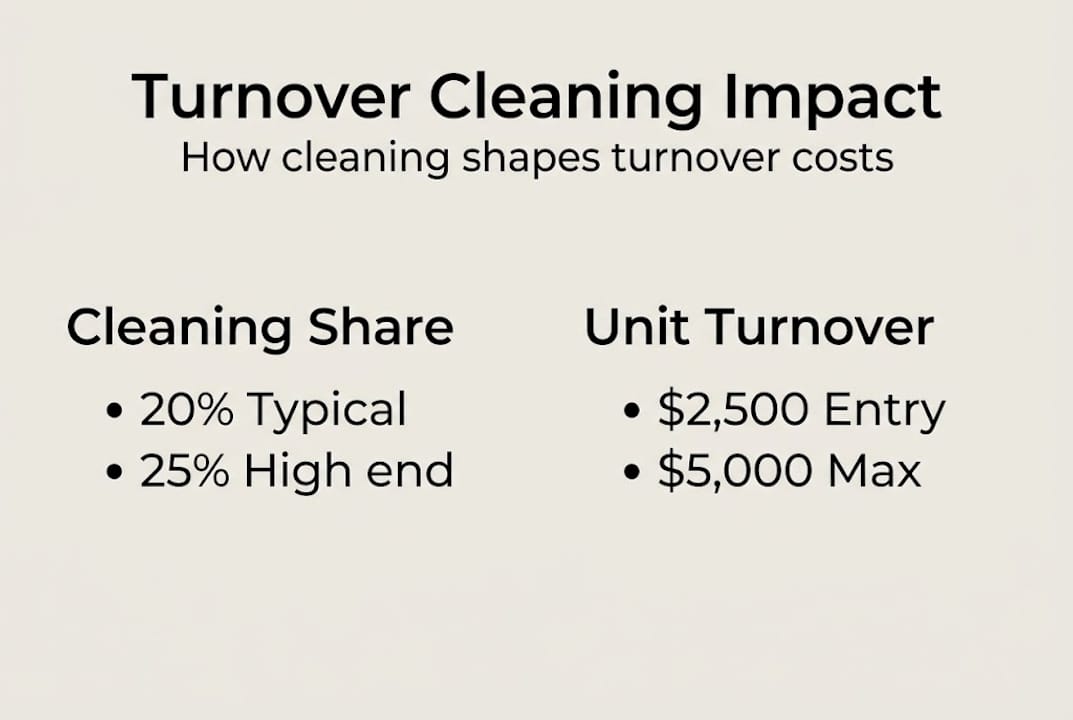
Average turnover cost runs $2,500 to $5,000 per unit, with cleaning accounting for roughly 20 to 25% of that total. That puts professional cleaning at $500 to $1,250 per turnover in the budget model, though cleaning cost benchmarks for LA specifically show most units run $200 to $500 depending on size and condition.
| Turnover cost category | Typical LA range | % of total cost |
|---|---|---|
| Professional cleaning | $200 to $500 | 20 to 25% |
| Minor repairs and paint | $400 to $1,200 | 25 to 35% |
| Vacancy loss (per day) | $80 to $150/day | Largest variable |
| Marketing and listing | $100 to $300 | 5 to 10% |
| Administrative time | $150 to $400 | 8 to 12% |
Vacancy loss is the wildcard that dwarfs every other line item. A unit sitting empty for 20 days at $120 per day costs $2,400 in lost rent alone. Compare that to a best-in-class operation.
“Top-performing property managers in Los Angeles cut vacant days to 7 to 10 days per turnover, compared to the market average of 15 to 20 days. That gap represents $600 to $1,500 in recovered rent per cycle, per unit.”
Cleaning is the fastest way to cut rental vacancy because it’s the first task in the sequence. When cleaning is delayed or done poorly, every downstream step, photography, showings, lease signing, gets pushed back.
Here’s how to trim total turnover costs in a structured way:
- Send move-out instructions early. Give tenants a written cleaning guide 30 days before move-out to reduce the labor burden on your end.
- Run cleaning and marketing simultaneously. List the unit with photos from a previous clean or a virtual tour while the current cleaning is underway.
- Use a standardized inspection checklist. A room-by-room checklist after cleaning catches issues before showings, preventing costly do-overs.
- Pre-schedule your cleaning crew. Book your professional team the day the notice to vacate is received, not after move-out.
- Document everything. Photos before and after cleaning protect you legally and set clear expectations for future tenants.
Pro strategies for faster, higher-value tenant turnovers
Budget clarity is useful. Actionable strategy is what actually moves the needle. Here’s what the best property managers in Los Angeles do differently.
Preparing tenants 30 days in advance cuts cleaning time by one to two hours per unit. That’s not a trivial saving when you’re managing multiple turnovers simultaneously. Overlapping the marketing and cleaning phases can shrink vacancy from 45 days down to 14. That’s a month of rent recovered simply by changing the sequence.
Pro Tip: Create a one-page tenant move-out cleaning guide specific to your property. Include expectations for appliances, floors, and fixtures. Tenants who know exactly what’s expected leave units in far better condition, which directly reduces your cleaning bill.
Here’s the full playbook:
- Issue a proactive move-out packet. Include cleaning expectations, deposit return criteria, and a self-inspection checklist. Tenants who feel informed are more cooperative.
- Book professional cleaning immediately. Don’t wait to assess the unit. Schedule your crew for the day after move-out and adjust scope once you see the condition.
- Photograph before cleaning begins. This protects your deposit deductions and creates a baseline record.
- Run your listing in parallel. Update your listing photos and post the unit as “available soon” while cleaning is in progress. Serious applicants will wait a few days for a clean unit.
- Conduct a post-cleaning inspection. Walk through with your checklist before any showing. Catch and fix issues now, not when a prospective tenant is standing in the kitchen.
For organizing faster turnovers, the key is treating each step as a parallel process rather than a linear one. And following a proven move-out cleaning checklist ensures nothing gets missed, from oven interiors to window tracks.
The property managers who consistently outperform the LA market don’t work harder during turnovers. They work smarter by front-loading preparation and running tasks simultaneously.
Our take: What most property managers miss about cleaning and turnovers
Here’s the uncomfortable truth: most landlords treat cleaning as the last thing to think about and the first thing to cut when budgets tighten. That’s exactly backwards.
We’ve worked with property managers across Los Angeles who tried to save money by using cheaper, faster, lower-quality cleaning between tenants. Almost every time, they paid more in the end. Rework, extended vacancies, and tenant complaints about move-in conditions created costs that far exceeded what a proper professional clean would have cost upfront.
The best operators we’ve seen use cleaning as a competitive differentiator. They treat the post-tenant clean as a brand statement. A spotless unit signals that management cares, which attracts better tenants who take better care of the property and renew more often.
In a market as competitive as Los Angeles, cutting LA vacancy with cleaning isn’t a nice-to-have. It’s a core business strategy. The property managers winning right now are the ones who’ve stopped asking “how much does cleaning cost?” and started asking “how much does not cleaning cost?”
Achieve next-level turnovers with expert cleaning services
The strategies in this guide work best when backed by a cleaning partner who understands the pace and standards of Los Angeles property management. Consistency, speed, and attention to detail aren’t optional in this market. They’re what separates a 7-day vacancy from a 30-day one.
At The Maid Society, we specialize in Los Angeles cleaning services built around the needs of property managers and landlords. From move-in and move-out cleans to post-construction and deep cleaning, our vetted teams follow a proven process every time. Explore our move-out cleaning guide to see exactly what a professional turnover clean covers, or download our cleaning services checklist to set the standard for your next turnover.
Frequently asked questions
How much does professional tenant turnover cleaning cost in Los Angeles?
Professional turnover cleaning in LA typically costs between $200 and $500 per unit, depending on unit size and the scope of cleaning required.
Does professional cleaning really speed up tenant turnover?
Yes. Expert cleaning teams can reduce unit prep time by 40 to 50%, often shrinking vacancies to 7 to 10 days compared to the market average of 15 to 20 days.
Should I prepare tenants before move-out to reduce cleaning costs?
Absolutely. Prepping tenants 30 days out with a clear cleaning guide reduces move-out labor by one to two hours and lowers your overall cleaning bill.
What’s the biggest risk of skipping professional cleaning between tenants?
Skipping professional cleaning extends vacancy, damages your property’s reputation, and can cost thousands in lost rent and avoidable repairs over the course of a single turnover cycle.
Recommended
- Cleaning’s role in tenant satisfaction: 8.6% more renewals
- Turnover Cleaning Best Practices: Faster Property Turns
- How to organize post-tenant cleaning for faster turnovers
- Cut Rental Vacancy 30%: Clean Properties Fast & Right



Get Cleaning Tips & Exclusive Offers
Join our community for time-saving hacks and special discounts delivered to your inbox.