By L.K. | Published by Themaidsociety | Los Angeles, CA
{
  "@context": "https://schema.org",
  "@type": "Article",
  "headline": "Why Document Property Condition: A Landlord & Tenant Guide",
  "author": {
    "@type": "Person",
    "name": "L.K."
  },
  "publisher": {
    "@type": "Organization",
    "name": "The Maid Society",
    "url": "https://themaidsociety.com"
  },
  "datePublished": "2026-01-01",
  "description": "A practical, audit-ready guide explaining why documenting property condition protects landlords, tenants, and property managers in Los Angeles and Southern California.",
  "mainEntityOfPage": {
    "@type": "WebPage",
    "@id": "https://themaidsociety.com"
  }
}
Key Takeaways
Documenting property condition before and after every tenancy is the single most effective step landlords, tenants, and property managers can take to prevent deposit disputes and protect their legal interests.
| Point | Details |
|---|---|
| Sign and date every checklist | A checklist without tenant signatures carries almost no weight in a dispute or court proceeding. |
| Use the three-shot photo standard | Wide, medium, and close-up shots with a scale reference meet current evidentiary expectations under California AB 2801. |
| Preserve original EXIF metadata | Never edit or crop originals; intact timestamps make photos admissible as evidence. |
| Link all four record types | Connect move-in, maintenance, violations, and move-out records into one per-unit file for audit readiness. |
| Themaidsociety supports your baseline | Professional move-in/move-out cleaning in Los Angeles produces photo-ready units that strengthen your documentation from the start. |
Table of Contents
- What a property condition report actually is
- Benefits for landlords, tenants, and managers
- When to document: the key checkpoints
- How to document effectively, step by step
- Sample move-in / photo checklist
- How to organize records so they’re audit-ready
- How documentation interacts with the law
- Common documentation mistakes and how to fix them
- How to present documentation if a deposit dispute arises
- Why documentation is the most underrated part of property management
- Professional move-in/move-out cleaning supports your documentation
- Recommended Articles
- Sources
Table of Contents
- Why documenting property condition matters
- What a property condition report actually is
- Benefits for landlords, tenants, and managers
- When to document: the key checkpoints
- How to document effectively, step by step
- Sample move-in / photo checklist
- How to organize records so they’re audit-ready
- How documentation interacts with the law
- Common documentation mistakes and how to fix them
- How to present documentation in a dispute
- Author perspective
- Professional move-in/move-out cleaning in Los Angeles
- Key Takeaways
- Useful sources
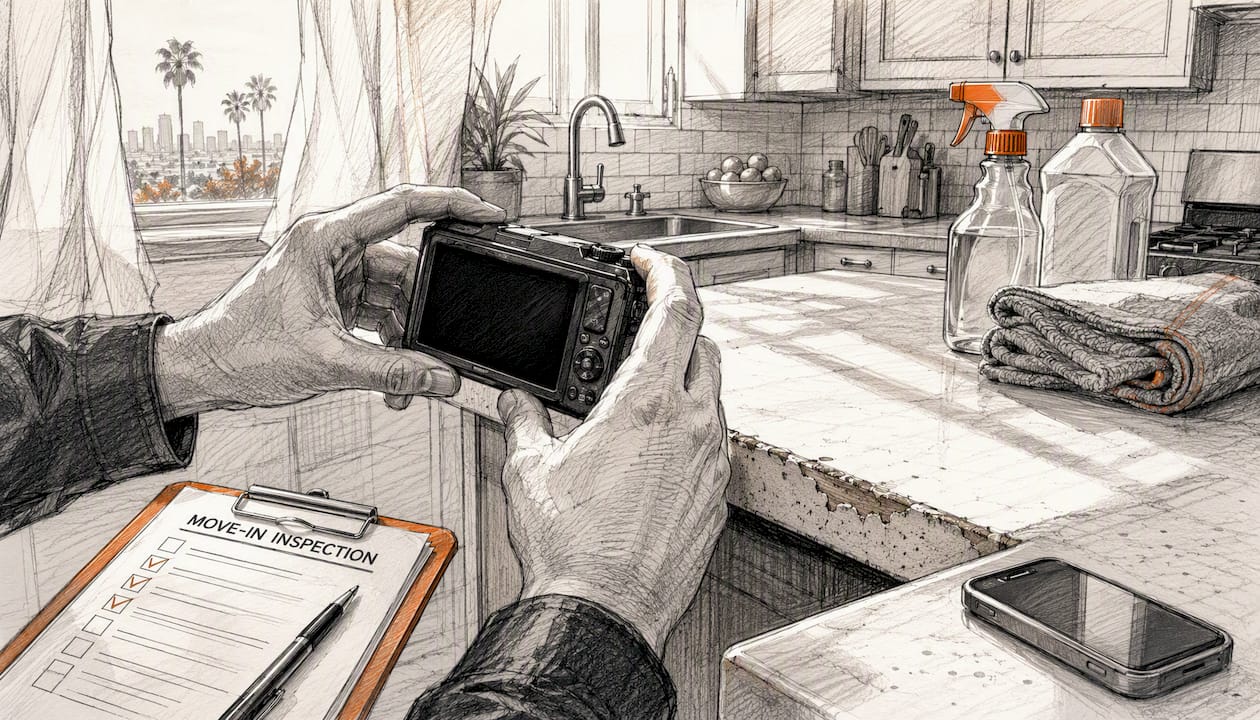
Documenting a property’s condition establishes the evidence you need to prove what changed during a tenancy. Without a signed, dated, photographic baseline, courts typically place the burden of proof on the landlord — and tenants lose their best defense against unfair deductions.
Three reasons this matters right now:
- Prevents unfair deposit deductions. A clear move-in record shows exactly what pre-existed, so neither side can invent damage after the fact.
- Speeds dispute resolution. A photo-linked, signed file collapses a weeks-long argument into a 20-minute review.
- Protects property value and safety. Periodic condition records catch deferred maintenance before it becomes a liability.
Start today: take time-stamped photos of every room, save them to a labeled per-unit folder, and get the tenant’s signature on a written checklist before keys change hands.
What a property condition report actually is
A property condition report (also called a move-in checklist, statement of condition, inventory and condition report, or schedule of condition in commercial leases) is a written record of a rental unit’s physical state at a specific point in time. The name varies by state and property type, but the document always contains the same core elements: a date, room-by-room descriptions of surfaces and fixtures, a photo set, and signatures from both parties.
Specific, measured descriptions — “3-inch scratch on the lower-left panel of the refrigerator door” rather than “good condition” — are what make the document defensible. Vague terms like “fair” or “normal wear” are nearly useless in a dispute because they mean different things to different people.
Benefits for landlords, tenants, and managers
Good property condition documentation pays off differently depending on who you are.
Landlords get deposit defense (a documented baseline is the primary evidence in a deduction claim), faster unit turnovers because the handover process is standardized, and supporting evidence for insurance claims when damage exceeds the deposit.
Tenants get transparency and protection. A signed move-in checklist means pre-existing damage is on record before you ever unpack a box. No landlord can charge you for a cracked tile that was there on day one.
Property managers get audit readiness and owner reporting. When an owner asks why a deduction was made six months later, a linked file of photos, receipts, and signed forms answers the question in seconds rather than requiring a reconstruction from memory.
Property managers who maintain photo-driven workflows report higher win rates in deposit litigation because photos combined with receipts and itemized statements create a coherent evidentiary chain that is difficult to challenge. A fragmented record — a few phone photos here, a handwritten note there — rarely holds up the same way.
When to document: the key checkpoints
Timing is where most landlords get tripped up. There are four moments when documentation is either legally required or practically essential.
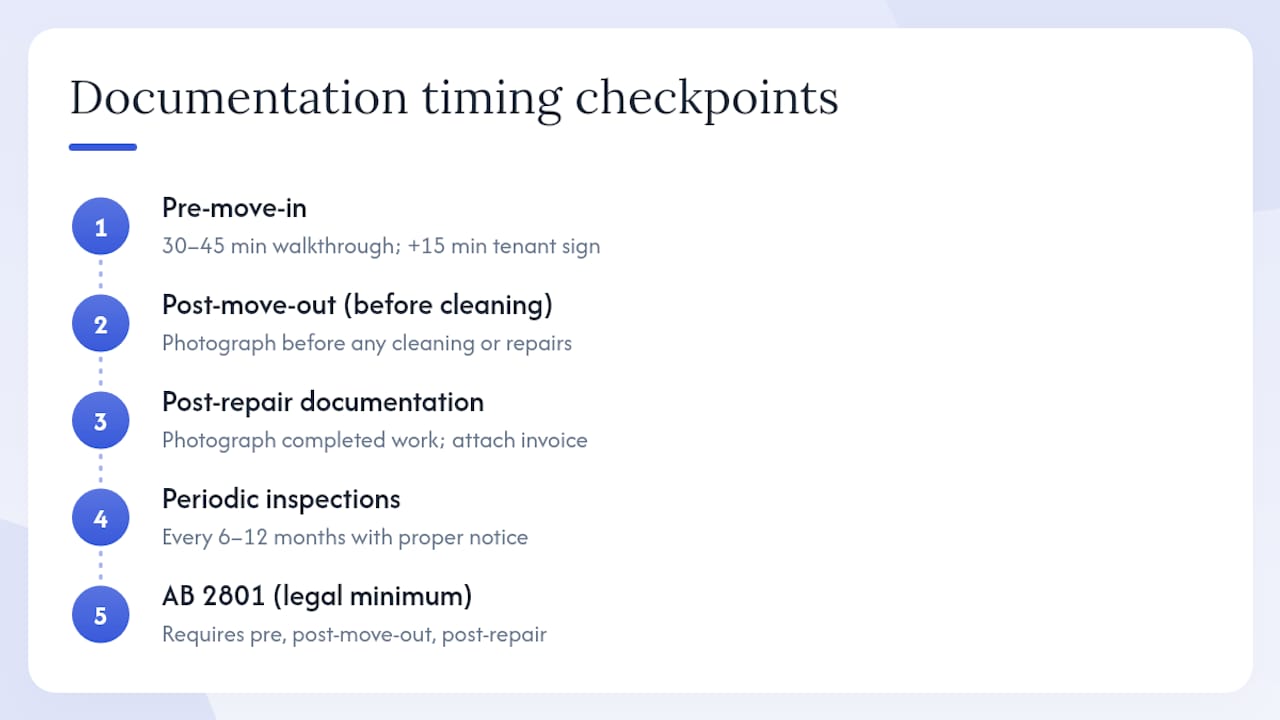
Pre-move-in (after cleaning and repairs, before keys are handed over). This is your baseline. The unit should be clean and in its best condition so photos reflect the actual starting state. Budget 30–45 minutes for a thorough room-by-room walkthrough with photos, plus 15 minutes for the tenant to review and sign.
Immediately after move-out, before any cleaning or repairs. This is the comparison point. Photograph everything before a single surface is touched. Under California Civil Code §1950.5 and AB 2801, landlords must take, keep, and deliver photos and itemized statements within specific timelines — so the clock starts the moment the tenant vacates.
After any repair or replacement. Document the completed work with photos and attach the invoice. This links the cost to the condition event and supports any deduction.
Periodic inspections. A mid-tenancy walkthrough (typically every 6–12 months, with proper notice) catches maintenance issues early and creates a maintenance timeline that matters if a dispute arises at move-out.
California’s AB 2801 requires a three-point photo chain: pre-move-in, post-move-out before repairs, and post-repair. That three-photo chain requirement is now the minimum standard for landlords in Los Angeles, Beverly Hills, Santa Monica, and every other California city. Miss any one of the three shots and your deduction claim weakens considerably.
How to document effectively, step by step
Follow this workflow and your records will be defensible from day one.
-
Prepare the unit first. Clean and complete all repairs before photographing. A dirty or unfinished unit produces photos that look like damage even when there is none. Themaidsociety’s move-in cleaning service in Los Angeles is designed specifically to produce a photo-ready baseline.
-
Walk room by room. Work in a consistent order — entry, living room, kitchen, bathrooms, bedrooms, storage, exterior — so nothing gets skipped. Use a printed or digital checklist to track each area.
-
Apply the three-shot photo standard. Industry practitioners recommend a wide shot for room context, a medium shot to show the item’s location, and a close-up for any specific condition detail. Place a coin, pen, or ruler in the close-up for scale. Courts now expect this level of detail when statutes codify photo evidence.
-
Capture EXIF timestamps. Shoot with your phone’s native camera app — do not use a filter app that strips metadata. Photos with intact EXIF metadata are treated as equivalent evidence in disputes; edited or cropped images often lose that metadata, so always preserve originals.
-
Record appliance model tags and meter readings. Photograph the model and serial number sticker on each appliance. Note utility meter readings at move-in and move-out. These details matter for maintenance history and for distinguishing tenant-caused appliance damage from pre-existing wear.
-
Get tenant acknowledgment. Walk through the unit together and have the tenant sign or initial the checklist on the spot. If an in-person walkthrough is not possible, send the completed checklist and photos via timestamped email and request a written reply confirming receipt. Certified mail is the fallback for tenants who do not respond.
-
File everything immediately. Upload photos, the signed checklist, and any notes to a labeled per-unit folder before you leave the property. Waiting until later is how records get lost.
Pro Tip: Name every photo file with a consistent convention: UNIT-ROOM-ITEM-DATE (e.g., 12B-Kitchen-Countertop-NW-Corner-20260315). This makes it trivial to pull all photos for a specific room or date during a dispute without scrolling through hundreds of images.
For property managers handling multiple units in areas like Culver City, West Hollywood, or Manhattan Beach, automating photo capture into maintenance and work-order systems is the only scalable way to meet modern documentation standards without slowing turnover. Tools like Buildium, AppFolio, and Rent Manager let you attach photos directly to work orders and inspection reports so the record builds itself as you go. If you want to explore workflow automation further, ConvertLabs offers tools that can help connect your documentation and operations workflows.
Sample move-in / photo checklist
Use this as a starting template. Copy it into a spreadsheet or print it for in-person walkthroughs. Tenants should initial each row; both parties sign the bottom. For a more detailed version tailored to Los Angeles rentals, see the tenant move-in checklist guide.
Both parties sign below confirming the above reflects the unit’s condition at move-in.
Landlord / Manager: _________________________ Date: _________
Tenant: _________________________ Date: _________
How to organize records so they’re audit-ready
Capturing documentation is only half the job. Audit-ready documentation depends on four pillars: timestamped (every photo and document carries a verifiable date and time), photographic (images exist for every condition claim), linked (photos connect to receipts, work orders, and the relevant checklist entry), and signed (every key document carries tenant acknowledgment or verifiable delivery proof). Most landlords fail because records are fragmented across a phone camera roll, an email inbox, and a paper file drawer.
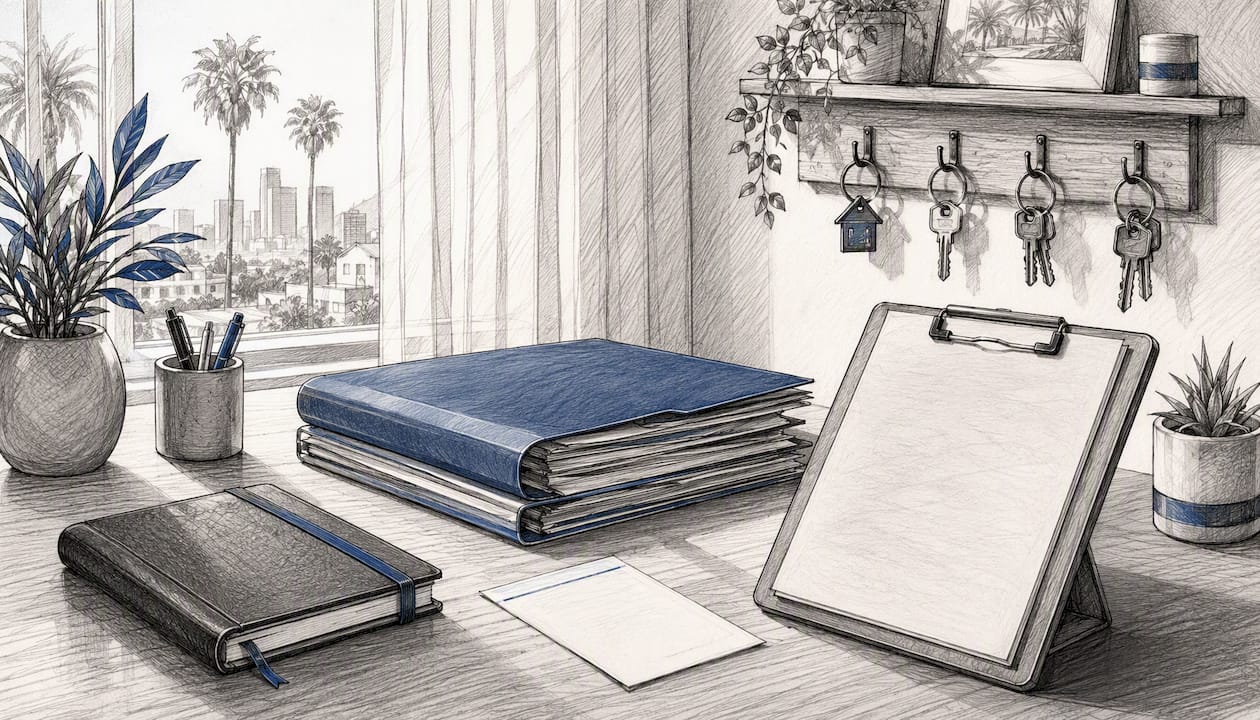
Retention guidance. California landlords should retain all move-in and move-out documentation for at least four years, which covers the statute of limitations for most deposit and habitability claims. Keep records longer when a dispute is active or when a claim involves habitability, personal injury, or significant property damage.
Practical storage setup:
- Create one folder per unit, labeled by address and unit number.
- Inside each unit folder, create four subfolders: Move-In, Maintenance, Violations, Move-Out.
- Store original photo files (never edited copies) in the relevant subfolder. If you need to annotate a photo, save the annotated version as a separate file and keep the original untouched.
- Attach receipts and invoices to the work order or maintenance entry they relate to, not in a general “receipts” pile.
- Back up to at least two locations: a cloud service (Google Drive, Dropbox, iCloud) and a local drive.
Audit-readiness checklist for each unit file:
- [ ] Signed move-in checklist with tenant initials on each page
- [ ] Photo set with intact EXIF timestamps, organized by room
- [ ] Appliance model/serial photos
- [ ] Meter readings at move-in and move-out
- [ ] All maintenance work orders with completion photos and invoices
- [ ] Signed or verifiably delivered move-out inspection report
- [ ] Itemized deposit statement with receipts attached
For LA-area landlords managing properties across neighborhoods like Koreatown, West Adams, or Inglewood, a structured property management approach that treats documentation as a continuous discipline rather than a one-time task is what separates landlords who win disputes from those who don’t.
How documentation interacts with the law
The legal principle is straightforward: in most U.S. jurisdictions, a landlord who wants to keep part of a security deposit must show that the tenant caused damage beyond normal wear and tear. Without a documented baseline, that showing is nearly impossible. A signed, dated photographic baseline is the legal foundation — without it, courts often side with the tenant by default.
California is the clearest example of where this is heading. Under Civil Code §1950.5 and the newer AB 2801, California landlords must now follow a three-photo chain: one set before the tenant moves in, one set after move-out before any cleaning or repairs, and one set after repairs are completed. AB 2801 also tightened itemization and delivery rules — landlords must provide itemized statements with supporting photos and receipts within 21 days of move-out.
Compliance checklist for California landlords:
- [ ] Pre-move-in photos taken and stored before keys are issued
- [ ] Post-move-out photos taken before any cleaning or repairs begin
- [ ] Post-repair photos taken and linked to the corresponding invoice
- [ ] Itemized deduction statement prepared within 21 days of move-out
- [ ] Statement delivered to tenant with photos and receipts attached
- [ ] All records retained for at least four years
Landlords in Los Angeles, Long Beach, Burbank, and other California cities who skip any step in this chain risk forfeiting their right to deductions entirely — and in some cases face penalties up to twice the deposit amount for bad-faith withholding.
This article provides general information about property documentation practices and is not a substitute for legal advice. Consult a licensed attorney or your local housing authority for guidance specific to your situation.
Common documentation mistakes and how to fix them
Unsigned forms. A checklist with no tenant signature is almost worthless in court. Fix: never hand over keys until the form is signed, or send it via timestamped email and require a written reply.
Fragmented photos. Photos on three different phones, spread across two email accounts and a USB drive, cannot be assembled into a coherent timeline under pressure. Fix: designate one device and one folder per unit, and upload immediately after every inspection.
Edited images without preserved originals. Cropping or filtering a photo can strip EXIF data, making the image inadmissible as timestamped evidence. Fix: keep originals untouched; annotate copies only.
Vague descriptions. “Good condition” and “minor wear” describe nothing a judge can evaluate. Fix: use specific measurements and locations — “hairline crack in grout, 4 inches long, left side of shower floor.”
Missing invoices. A photo of damage without a receipt for the repair is a weak deduction claim. Fix: attach every invoice to the work order and the move-out statement before sending.
Not photographing before repairs. Fixing a problem before documenting it erases the evidence of what the tenant caused. Fix: photograph first, always, even for small repairs.
Failing to link maintenance history. A pattern of tenant-caused damage across multiple maintenance calls is powerful evidence — but only if those calls are linked to the unit file. Fix: treat documentation as four distinct but linked jobs (move-in, maintenance, violations, move-out) and connect them from the start.
One process change that eliminates the top three mistakes at once: adopt a single digital platform (AppFolio, Buildium, or even a shared Google Drive folder) where every photo, form, and receipt lands the moment it is created. Fragmentation is the root cause of most documentation failures.
How to present documentation if a deposit dispute arises
When a dispute reaches small claims court or a formal mediation, the quality of your file determines the outcome more than the strength of your argument.
Assemble your dispute package in this order:
- Signed move-in checklist with photos (your baseline)
- Maintenance timeline: every work order, photo, and invoice in chronological order
- Any violation notices with delivery confirmation
- Post-move-out photos taken before repairs (timestamped)
- Post-repair photos with invoices attached
- Itemized deposit statement with line-item costs
- Proof of delivery of the itemized statement to the tenant
Presenting digital evidence. Print a contact sheet of your photo set with file names and timestamps visible. Courts appreciate a clear narrative: “Here is the unit at move-in. Here is the same wall at move-out. Here is the invoice for the repair.” Side-by-side comparisons of the same surface at move-in and move-out are particularly effective.
Preserve metadata. Do not email photos from a phone to a computer and then re-save them — that process can alter timestamps. Export originals directly, or use a cloud platform that preserves EXIF data through the transfer.
For tenants, the same logic applies in reverse. Your signed move-in checklist is your shield. If you noted pre-existing damage and the landlord is now charging you for it, that signed record is the evidence that defeats the claim. Keep a copy of everything you signed, every photo you took at move-in, and every communication with your landlord throughout the tenancy.
Why documentation is the most underrated part of property management
The conventional wisdom treats property condition documentation as paperwork — a box to check before the real work of managing a rental begins. That framing gets it exactly backward.
Documentation is the property management function with the highest legal leverage per hour spent. A 45-minute move-in walkthrough with a signed checklist and a solid photo set can resolve a $3,000 deposit dispute in an afternoon. Skip it, and that same dispute can drag through small claims court for months, cost more in time and legal fees than the deposit itself, and still end in a loss.
What most landlords underestimate is how much the quality of the record matters, not just its existence. A blurry photo taken in poor lighting, a checklist with “OK” written in every field, a signature on a form the tenant never actually reviewed — none of these hold up. The standard has risen, especially in California, where AB 2801 essentially codifies what good documentation looks like. The three-photo chain, the itemized statement with receipts, the 21-day delivery window — these are not bureaucratic hurdles. They are the minimum a court expects to see before it will uphold a deduction.
The other thing worth saying plainly: tenants benefit from this discipline just as much as landlords do. A well-documented move-in protects you from being charged for damage you did not cause. The landlord who hands you a thorough, signed checklist at move-in is the landlord you want — because that same standard protects both of you when you leave.
Professional move-in/move-out cleaning supports your documentation
A clean unit produces better baseline photos. Grease on a stovetop, dust on baseboards, and grime in a shower make it genuinely hard to tell in a photo whether a surface is damaged or just dirty. That ambiguity costs landlords in disputes and costs tenants their deposits.
Themaidsociety provides move-in and move-out cleaning in Los Angeles specifically designed to produce a photo-ready unit before keys change hands. The team covers every surface, appliance, and fixture so your baseline photos show the actual condition of the property, not accumulated grime from the previous tenancy. Property managers across Los Angeles, Beverly Hills, Santa Monica, Culver City, West Hollywood, and the South Bay rely on Themaidsociety for turnover cleaning that supports a defensible documentation workflow.
Services include standard and deep move-in/move-out cleaning, post-construction cleanup, and recurring turnover cleaning for Airbnb hosts and property managers. Every job is handled by a vetted, trained team committed to consistent, detail-oriented results.
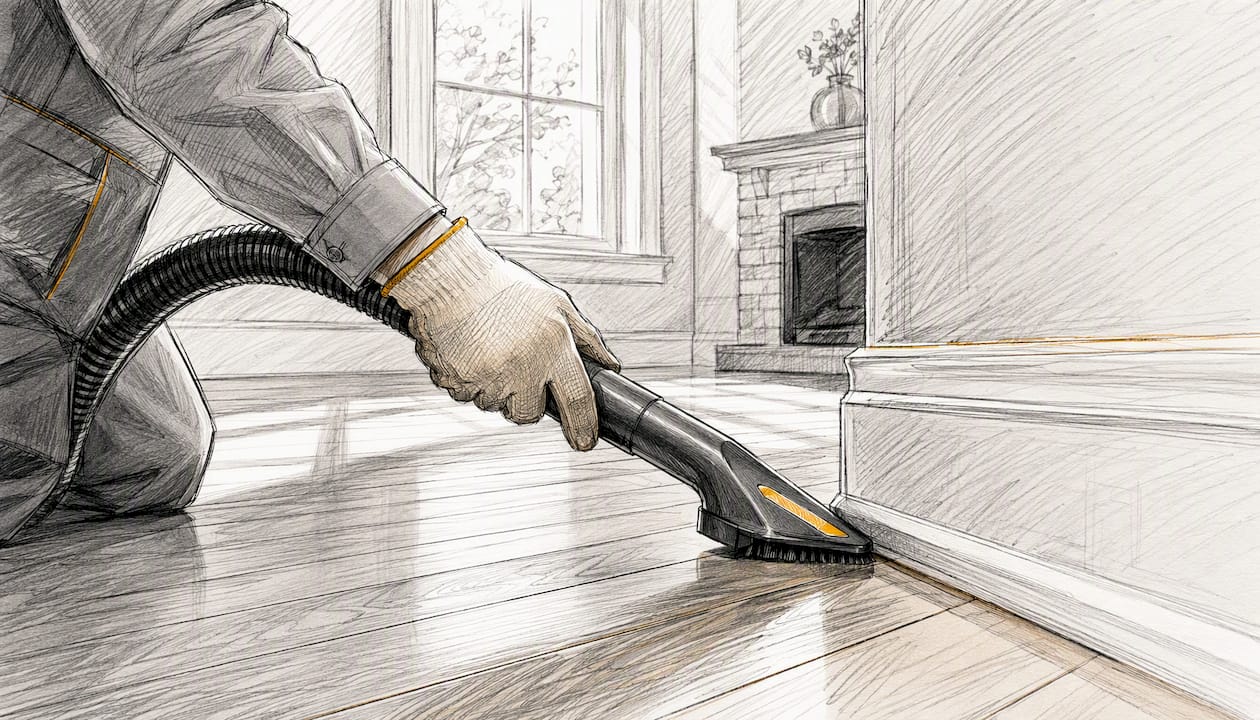
Ready to produce a cleaner baseline and stronger documentation? Book a move-in or move-out cleaning for your next Los Angeles rental turnover.
Recommended Articles
- Move In Cleaning Explained: Ensuring a Fresh Start
- How to Prep Property for Move-In: LA Guide
- Step by Step Move Out Cleaning Guide for Managers
- Deep Cleaning for New Tenants Guide: LA Move-In Success
- Property Cleanup Best Practices for Homeowners
This article is for general informational purposes only and does not constitute legal advice. Consult a licensed California attorney or your local housing authority for guidance specific to your property and situation.
Sources
Use these resources to implement the checklist, verify California-specific rules, and download templates for your next move-in or inspection.
- What is a statement of condition and when is it required?
- Property Documentation for Landlords: The Complete Reference (2026) · DiscoveryMark
- California AB 2801 + AB 414: Security Deposit Documentation Standard 2026 | Revoscape
- California preparing for move-in, move-out documentation law · Rental Housing Journal
- Understanding Assembly Bill 2801: Security Deposit and Property Condition Documentation · NetRealty
Save these links to your per-unit file folder so they are accessible when you need to verify a rule or pull a template mid-inspection.
Recommended
- Landlord Cleaning Responsibilities in Los Angeles Rentals
- How to Reduce Vacancy with Cleaning: A Property Manager’s Guide
- How to Prep Property for Move-In: LA Guide
- Tenant Move-In Checklist 2025: Your Full Rental Guide



Get Cleaning Tips & Exclusive Offers
Join our community for time-saving hacks and special discounts delivered to your inbox.