
TL;DR:
- A cleaning assessment is a detailed, room-by-room evaluation that reveals actual home cleanliness beyond surface appearances. It identifies hidden issues like mold, dust buildup, and organizational gaps, helping homeowners make informed maintenance decisions. Regular assessments improve air quality, protect home value, and create a healthier, more comfortable living environment in Los Angeles.
Most Los Angeles homeowners assume their home is clean because it looks clean. But surface-level tidiness and genuine cleanliness are two completely different things. A professional cleaning assessment pulls back the curtain on what routine cleaning misses: the dust settling behind appliances, the mold forming quietly in bathroom grout, the clutter patterns that make spaces feel chaotic even after a wipe-down. This guide breaks down exactly what a cleaning assessment is, how it works, and why getting one could be the smartest home decision you make this year.
Table of Contents
- What is a cleaning assessment?
- Different types of cleaning assessments
- How cleaning assessments work in homes
- Benefits of regular cleaning assessments
- A fresh perspective: Why one-size-fits-all cleaning assessments fall short
- How to get a professional cleaning assessment in Los Angeles
- Frequently asked questions
Key Takeaways
| Point | Details |
|---|---|
| Objective cleanliness check | A cleaning assessment uses specific criteria to measure how clean and organized your home actually is. |
| Multiple methods available | Checklists, walkthroughs, and score-based options each fit different home needs and preferences. |
| Leads to healthier homes | Regular assessments identify hidden risks and improve comfort, health, and longevity of your home. |
| Customization is key | Tailoring your cleaning assessment based on your family’s needs delivers better results than generic approaches. |
What is a cleaning assessment?
A cleaning assessment is a structured, room-by-room evaluation that measures how clean your home actually is against a defined set of standards. It goes well beyond a quick visual scan. A proper assessment uses detailed checklists, zone-by-zone scoring, and sometimes risk-based criteria to give you an honest picture of your home’s cleanliness across multiple categories.
Think of it like a health checkup for your living space. Your doctor doesn’t just look at you and say “you seem fine.” They take measurements, run tests, and compare results against benchmarks. A cleaning assessment does the same for your home, checking surfaces, air quality factors, organizational gaps, and potential health hazards.
“A cleaning assessment isn’t about judgment. It’s about giving homeowners a clear, objective baseline so they can make smarter decisions about how their home is maintained.”
According to structured professional standards, a cleaning assessment functions as a structured measurement process that applies consistent criteria across all areas of a space. That consistency is what makes it useful. Without a standard to compare against, “clean” is just a feeling, not a fact.
Why does this matter for you specifically? Because homes in Los Angeles deal with unique pressures. Wildfire smoke, coastal humidity, heavy traffic pollution, and busy family schedules all combine to create cleaning challenges that go well beyond the typical dust-and-mop routine. Research consistently shows that home cleaning directly affects value in ways many owners never anticipate, from air quality to resale price to daily comfort.
Key goals of a cleaning assessment include:
- Identifying overlooked problem areas like behind furniture, under appliances, and inside cabinets
- Flagging health risks such as mold, allergen buildup, or pest entry points
- Evaluating organization and whether clutter is contributing to cleaning difficulty
- Providing a documented starting point for improving and tracking cleanliness over time
The result isn’t a report card to feel embarrassed about. It’s a practical tool that tells you exactly where to focus your time and budget.
Different types of cleaning assessments
Not all cleaning assessments are built the same way. The right type depends on what you’re trying to accomplish: quick accountability, visual readiness, health protection, or measurable quality assurance. Here’s how the main models compare.
| Assessment type | Best for | Key feature | Limitation |
|---|---|---|---|
| Checklist-based | Routine maintenance | Fast, easy to repeat | Misses nuance |
| Walkthrough | Move-in/move-out review | Visual and surface-level | Less objective |
| Risk-based | Families with kids or pets | Flags health and safety hazards | Needs expert eye |
| Score-based | Quality audits and tracking | Quantified, trackable results | Takes more time |
Structured inspection scoring, walkthroughs, and risk-based methods are the three most widely used professional approaches, and each serves a distinct purpose.
Checklist-based assessments are the most accessible. You work through a predefined list of tasks and check off what’s been done or what needs attention. They’re great for holding yourself or a cleaning service accountable on a weekly or biweekly basis, but they can miss deeper issues because they focus on task completion rather than results.
Walkthrough assessments are common for move-in and move-out situations. A professional or property manager walks through the space looking for visible issues: stains, damage, dirty surfaces, and general disorganization. They’re efficient but subjective.
Risk-based assessments prioritize areas that pose actual health or safety concerns. High-traffic zones, kitchens, bathrooms, and children’s play areas get the most scrutiny. This type is especially valuable for families with young kids, elderly residents, or pets.
Score-based assessments assign numerical ratings to each area or task, creating a total cleanliness score you can track over time. This is what professional cleaning companies use to ensure consistent quality across visits. The best method depends on whether your priority is visual readiness, health protection, or documented, audit-grade proof of cleanliness.
Pro Tip: If you’re renting in Los Angeles and approaching the end of your lease, request a walkthrough assessment at least three to four weeks before your move-out date. This gives you enough time to address any issues before your landlord conducts their own inspection, which could affect your security deposit.
Here’s how to choose the right assessment for your situation:
- For general home maintenance: Start with a checklist-based assessment monthly or after major gatherings.
- For health-conscious households: Choose a risk-based approach, especially in kitchens and bathrooms.
- For renters near lease end: A walkthrough assessment gives you the visual overview landlords care about most.
- For tracking improvement over time: Use a score-based system so you can see measurable progress.
The difference between janitorial and residential assessments is also worth understanding. Commercial spaces often require daily assessments with rigorous documentation, while residential assessments are more flexible. And if you’ve been debating whether professional cleaning outperforms DIY, a formal assessment often reveals the answer.
How cleaning assessments work in homes
Once you’ve chosen a cleaning assessment method, here’s how the process typically unfolds in real LA homes. Knowing what to expect at each stage helps you get far more value from the exercise.
Before the assessment:
Preparation is simple but important. Write down your specific concerns before the assessor arrives. Are you worried about air quality? A recurring musty smell? Rooms that never seem to stay organized? Giving your assessor a focused starting point makes the evaluation more useful. Clear personal items from surfaces so the assessor can evaluate the actual conditions underneath.
During the assessment:
- Entry interview: The assessor asks about your household, routines, high-use areas, and any known problem spots.
- Zone-by-zone walkthrough: Each room is reviewed against a checklist or scoring rubric. Zone-by-zone scoring with explicit criteria ensures nothing gets skipped.
- Documentation: Findings are noted, photographed in some cases, and assigned scores or flags.
- Immediate feedback: Most assessors share initial observations on the spot, so you get a real-time read.
- Written report: A formal summary outlines findings, scores, and prioritized recommendations.
Typical findings in LA homes:
| Area | Common findings | Priority level |
|---|---|---|
| Kitchen | Grease buildup, appliance gaps, cabinet interiors | High |
| Bathroom | Grout mold, soap scum, hidden moisture | High |
| Living room | Dust on surfaces and vents, clutter | Medium |
| Bedrooms | Under-bed dust, closet organization issues | Medium |
| Entry/outdoor | Tracked-in debris, floor wear patterns | Low to medium |
After the assessment:
Review the report carefully and prioritize findings by urgency. Some issues, like mold or pest indicators, need immediate action. Others, like decluttering or organizing, can be phased over a few weeks. Schedule a follow-up cleaning or assessment to confirm improvements have been made.
Pro Tip: Ask your assessor to mark the three highest-priority findings before you leave. This prevents the overwhelm of a long report and gives you a clear first step.
You can explore the full range of cleaning services available to address whatever the assessment turns up. And if health is your main concern, learning more about cleaning’s direct impact on health in LA homes can help you prioritize the right areas first.
Benefits of regular cleaning assessments
Knowing the process makes it clear why regular assessments are worth it. But the benefits go further than most people expect. Let’s look at what consistent assessments actually deliver for LA homeowners and renters.
Better air quality and fewer allergens
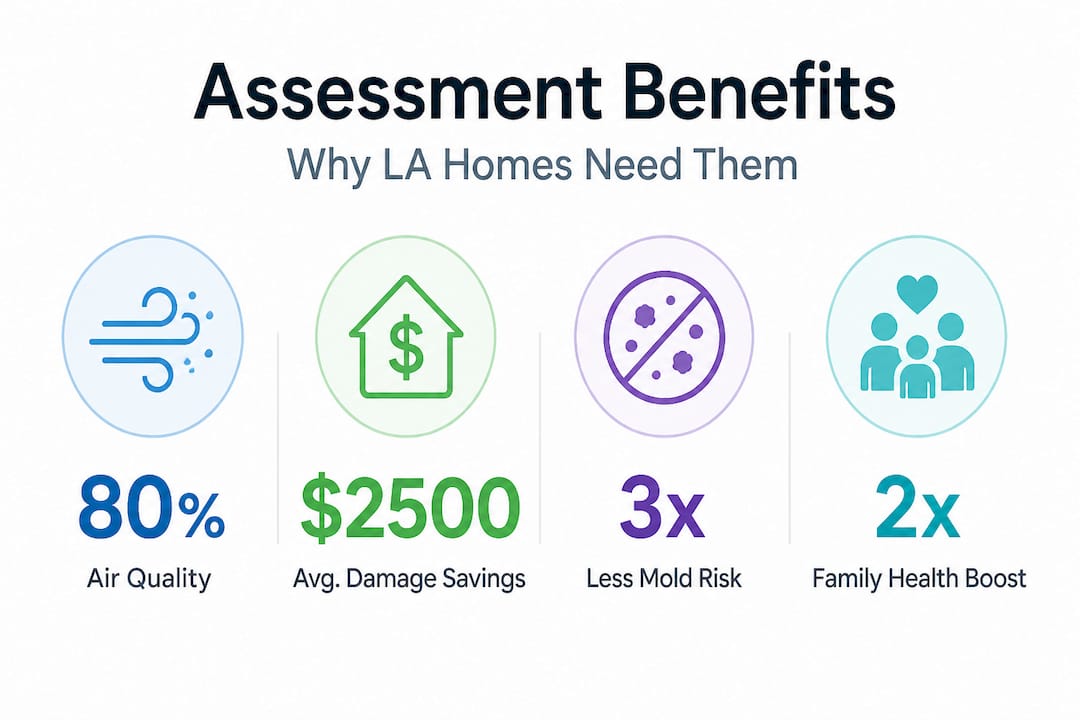
Los Angeles has some of the most persistent air quality challenges in the country. Dust mites, pet dander, wildfire particulate, and outdoor pollution all find their way indoors. A cleaning assessment identifies where allergens concentrate most, typically in carpets, upholstered furniture, and HVAC vents, and creates a targeted plan to reduce them. For households with allergy or asthma sufferers, this isn’t a luxury. It’s a necessity.
Easier organization and decluttering
Assessments don’t just focus on dirt. They evaluate how your space functions day to day. An assessor will notice if your kitchen layout creates unnecessary clutter, if your bathroom storage is contributing to surface mess, or if your living room furniture arrangement makes it harder to clean thoroughly. These insights turn into practical changes that make your home easier to maintain long-term.
Financial protection
Dirt and moisture that go undetected lead to damage. Mold behind a shower wall, grease buildup inside an oven, or dust clogging dryer vents are all fire and repair hazards. Catching these issues early through regular assessments can save you hundreds to thousands of dollars in repairs or pest control treatments. Regular cleaning assessments help prevent health issues and maintain home value, making them a financially sound habit.
Peace of mind and daily comfort
There’s a measurable difference in how you feel inside a home that’s been properly assessed and addressed versus one that only looks clean on the surface. Stress levels drop. Routines feel smoother. Guests can be invited without the frantic pre-visit scramble. This comfort factor is real and deeply underrated.
Consider these key benefits at a glance:
- Reduced allergen exposure for everyone in the household
- Documented cleanliness that protects renters during lease disputes
- Early identification of mold, moisture, or pest risks
- Improved mental clarity from a more organized, functioning space
- A personalized cleaning plan that fits your actual home and lifestyle
Research consistently supports the connection between a clean home and family wellbeing, and regular assessments are the mechanism that keeps standards from slipping over time. When your team knows an assessment is coming, cleaning and your health becomes a shared priority rather than an afterthought.
A fresh perspective: Why one-size-fits-all cleaning assessments fall short
Here’s something most cleaning guides won’t tell you: a generic checklist applied uniformly across all homes doesn’t actually work. It produces data, but not necessarily insight.
We see this constantly in Los Angeles. A standard assessment might flag a dusty shelf and miss the fact that a family with three cats needs a completely different allergen management strategy than a couple with no pets. A walkthrough focused on visual tidiness might overlook the fact that a toddler spends four hours a day on a floor that’s technically “clean” by visual standards but harbors bacteria in grout lines.
Some cleaning services emphasize different assessment styles for different goals, and this flexibility is actually the marker of a quality provider. When an assessor asks about your lifestyle, your household members, your health concerns, and your pet situation before running through a checklist, that’s not small talk. That’s good assessment design.
Los Angeles homes have specific local factors that generic assessments don’t account for. The dry Santa Ana winds that roll through in fall and winter push fine particulate matter indoors. Coastal neighborhoods deal with salt air and elevated humidity. Homes near freeways accumulate a very specific type of fine-particle dust that settles on every horizontal surface faster than you’d believe. A useful assessment acknowledges these realities.
The best assessments we’ve seen are built around a household’s actual health priorities and daily routines, not just a printed checklist. If you have kids with asthma, that shapes which zones get the most scrutiny. If you work from home, your office environment belongs in the assessment. If you have a dog, the entryway and furniture require a different standard than the master bedroom.
Push back on any service that hands you a cookie-cutter report without asking a single question about how you actually live. The most valuable assessment is the one designed around your home, not the one fastest to complete.
How to get a professional cleaning assessment in Los Angeles
If you’re ready for a cleaner, healthier home, taking the next step in Los Angeles is straightforward when you work with the right team.
At The Maid Society, we take cleaning assessments seriously because we know how much a detailed, personalized evaluation changes the outcome for our clients. Our team doesn’t show up with a generic checklist and call it done. We listen first, then evaluate. We identify the specific issues affecting your space, whether that’s deep-settled dust, organizational challenges, or areas that haven’t received proper attention in months.
You can book a professional cleaning assessment directly through our website and get paired with an experienced team member who will walk your home, document findings, and give you a clear, prioritized action plan. Our clients consistently report that the assessment process alone changed how they think about home maintenance. We serve homeowners and renters across Los Angeles with services that go beyond surface cleaning, including deep cleans, move-in and move-out services, post-construction cleaning, and organizing support.
Frequently asked questions
How long does a home cleaning assessment take?
Most cleaning assessments for homes take between 30 minutes and 2 hours, depending on the size and number of rooms.
Do I need to do anything to prepare for a cleaning assessment?
Preparation usually means providing access, listing your specific concerns, and removing personal items from surfaces so the assessor can evaluate actual conditions thoroughly.
What if my home receives a low score in an assessment?
A low score simply means certain areas don’t meet the target standards. Zone-by-zone scoring with re-service triggers means most companies will offer a clear set of recommendations or a follow-up cleaning to bring those areas up to standard.
How often should I get my home professionally assessed for cleanliness?
Most experts recommend an assessment once or twice a year, or after major life changes like moving, renovations, or adding a new pet to the household.
Recommended
- How Cleaning Safeguards Health and Safety in LA Homes
- Why Cleaning Matters for Vacant Homes: Value, Safety
- Home sanitation basics: keep LA homes clean and healthy
- Role of Cleaning in Open Houses—Impact on LA Sales
- Cleanliness & Property Value: Melbourne Homes in 2025


Get Cleaning Tips & Exclusive Offers
Join our community for time-saving hacks and special discounts delivered to your inbox.