
By L.K. | Published by Themaidsociety | Los Angeles, CA
{
  "@context": "https://schema.org",
  "@type": "Article",
  "headline": "Site Cleanup Workflow 2025: LA's 6-Step Guide",
  "author": {
    "@type": "Person",
    "name": "L.K."
  },
  "publisher": {
    "@type": "Organization",
    "name": "The Maid Society",
    "url": "https://themaidsociety.com"
  },
  "datePublished": "2026-01-01",
  "description": "A contractor-briefable 6-step site cleanup workflow for Los Angeles homeowners and property managers in 2025, covering SOPs, waste logistics, QA, and handover documentation.",
  "mainEntityOfPage": {
    "@type": "WebPage",
    "@id": "https://themaidsociety.com/site-cleanup-workflow-2025"
  }
}
Table of Contents
Table of Contents
- The 6-Step Site Cleanup Workflow
- How Themaidsociety Handles It for You
- Key Takeaways
- Recommended Articles
The complete site cleanup workflow 2025 runs six steps: Plan & mobilize → Rough cleanup → Debris removal & waste logistics → Detailed cleaning → QA & visual standards → Handover documentation. Whether you’re managing a single-family remodel in Brentwood or a multi-unit turnover in Long Beach, this sequence keeps the project compliant, on schedule, and ready for occupancy or inspection.
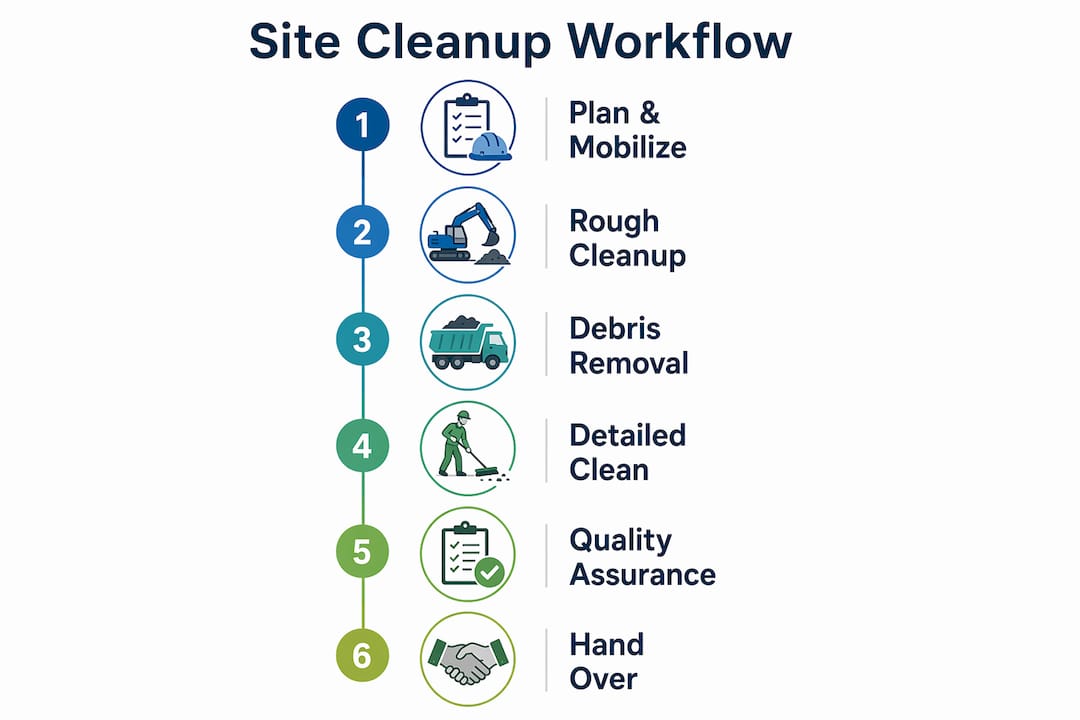
Your contractor-briefable checklist
Copy this directly into your estimate request or statement of work:
- Step 1 — Plan & mobilize: Define scope, assign crew, confirm dumpster permits, and schedule phase-based pickups before a single tool touches the site.
- Step 2 — Rough cleanup: Remove large debris, scrap lumber, drywall offcuts, and hazardous waste immediately after major trades finish.
- Step 3 — Debris removal & waste logistics: Stage separate containers for drywall, recyclables, and general C&D waste. Clear combustible materials every shift.
- Step 4 — Detailed cleaning: Deploy HEPA-filter vacuums, negative air machines, and triple-stage wipe-downs. Post-construction dust resettles for days after work stops — plan a second pass.
- Step 5 — QA & visual standards: Supervisory walk-through against a photo-based punch list checklist with accept/reject photo examples. Punch-list corrections happen immediately, not at next visit.
- Step 6 — Handover documentation: Deliver before/after photos, signed checklist, waste manifests, and diversion receipts.
Timeline expectations by project size
| Project type | Rough cleanup | Detailed clean | Full cycle |
|---|---|---|---|
| Small residential (single room or unit) | Same day | 1 shift | 1–2 days |
| Single-family home remodel | 1–2 shifts | 1–2 days | 3–5 days |
| Multi-unit building | Per floor/phase | 2–4 days | 7–10 days |
| Medium commercial | 1–2 days | 3–5 days | Up to 2 weeks |
Post-construction cleaning typically spans 7–10 days on multi-phase projects because construction dust resettles after work stops, requiring a final touch-up pass several days after the deep clean.
Waste and safety rules you cannot skip
Source-separated containers — drywall in one, recyclables in another, general C&D in a third — increase recycling yield and keep diversion documentation clean. In California, some jurisdictions set mandatory C&D diversion targets of 65% or higher, requiring tracking by weight and documentation for project closeout. Los Angeles projects subject to CalRecycle or local ordinances need manifests and receipts at handover, not just a clean site.
A phase-based pickup schedule coordinated at mobilization prevents container overages and keeps staging zones usable. Common container sizes run 10, 20, 30, and 40 cubic yards; a 20-yard unit fits most mid-size remodels in West LA or Culver City. Some Los Angeles jurisdictions require a permit when a container occupies the public right-of-way — confirm before delivery day.
Pro Tip: Schedule your dumpster swap at the transition between rough cleanup and detailed cleaning, not when the container is already overflowing. A full container mid-detail-clean forces debris back into finished areas and costs you a full extra shift.
SOPs and visual quality standards
A documented SOP with photo-based acceptance criteria eliminates subjectivity across rotating crews. Without it, “clean” means something different to every technician. Require your contractor to show you photo examples of acceptable versus unacceptable finishes for windows, baseboards, and fixtures before work begins. That single requirement cuts rework on most residential projects in Hollywood, West Hollywood, and Mid-City LA.

Quality assurance means a supervisory walk-through, a standardized job-site checklist, and photographic sign-off before the crew leaves. Any missed area gets corrected the same day. Review the best practices for job site cleaning to see what a complete SOP-backed checklist looks like in practice.
For property managers coordinating tenant safety during and after cleanup, the tenant safety responsibility checklist is a useful parallel document to run alongside your cleaning punch list.
How Themaidsociety handles it for you in Los Angeles
Themaidsociety brings vetted, SOP-trained crews to post-construction, deep-clean, and move-in/move-out projects across Los Angeles, including Beverly Hills, Santa Monica, Pacific Palisades, Venice, Marina Del Rey, Koreatown, West Adams, Los Feliz, Manhattan Beach, Redondo Beach, El Segundo, Gardena, Westchester, Baldwin Hills, Carson, Burbank, and every neighborhood in between. Every job runs against a documented SOP with photo-based QA standards, so you get the same finish whether it’s a single-family remodel in Brentwood or a multi-unit turnover in Long Beach.
Services relevant to this workflow include post-construction three-phase cleaning, deep cleaning for builders, move-in/move-out cleaning, recurring site maintenance, and Airbnb/rental turnover. The team is fully insured and trained on HEPA dust-capture methods, which matters on any project where CalRecycle or local diversion rules apply. For teams managing booking and crew logistics across multiple properties, ConvertLabs offers scheduling and client management tools worth exploring.
Ready to hand off the cleanup? Book a cleaning service in Los Angeles or request a contractor-briefable quote directly from Themaidsociety. Bring the six-step checklist above to the call and the scope conversation takes about ten minutes.
Key Takeaways
A documented, phase-based site cleanup workflow with SOP-backed QA and proper waste logistics is the single most reliable way to hit inspection-ready results on time in Los Angeles.
| Point | Details |
|---|---|
| Six-step sequence | Plan → Rough cleanup → Debris removal → Detailed clean → QA → Handover covers every phase from mobilization to sign-off. |
| Timing varies by scale | Small residential jobs close in 1–2 days; multi-unit and commercial projects typically run 7–10 days or longer. |
| Combustible debris clears every shift | Per-shift removal of combustible materials keeps staging areas safe and compliant with fire-code guidance. |
| SOPs and photo QA cut rework | Photo-based accept/reject standards remove subjectivity and deliver consistent results across rotating crews. |
| Themaidsociety covers all six steps | Vetted, insured crews with documented SOPs serve Los Angeles neighborhoods from Beverly Hills to Long Beach. |
Recommended Articles
- Detailed Cleaning Guide for Builders: Post-Construction Success
- Post-Construction Cleaning Checklist for Move-In Ready Spaces
- Property Cleanup Best Practices for Homeowners
- Deep Cleaning Process for Builders: Ensure Project Perfection
- Move-In & Move-Out Cleaning Services in Los Angeles
Recommended
- Property Cleanup Best Practices for Homeowners
- Organizing Workflow After Renovation: Your 2026 Guide
- The Ultimate Property Cleaning Checklist for LA Homes
- Property Manager Cleaning Workflow: 2026 Guide



Get Cleaning Tips & Exclusive Offers
Join our community for time-saving hacks and special discounts delivered to your inbox.