
{
  "@context": "https://schema.org",
  "@type": "Article",
  "headline": "How to Organize Small Spaces: Budget-Friendly LA Guide",
  "author": {
    "@type": "Person",
    "name": "L.K."
  },
  "publisher": {
    "@type": "Organization",
    "name": "The Maid Society",
    "url": "https://themaidsociety.com"
  },
  "datePublished": "2026-01-01",
  "description": "Practical, budget-conscious tips to organize small spaces in Los Angeles. Declutter first, zone your rooms, add vertical storage, and maintain it with a 10-minute nightly reset.",
  "mainEntityOfPage": {
    "@type": "WebPage",
    "@id": "https://themaidsociety.com/how-to-organize-small-spaces"
  }
}
By L.K. | Themaidsociety | Los Angeles, CA
Table of Contents
- 1. Your 5-step weekend quick-start plan {#quick-start}
- 2. Decluttering rules that actually stick {#declutter}
- 3. How to define zones in any small home {#zoning}
- 4. Practical storage strategies: vertical, hidden, and multifunctional {#storage}
- 5. Room-by-room action items {#room-by-room}
- 6. Organizing kids’ rooms and toys in small homes {#kids}
- 7. Renter-friendly fixes that need no drilling {#renter}
- 8. Daily and periodic maintenance schedule {#maintenance}
- 9. When and why to hire a pro {#hire-pro}
- 10. Lighting and mirrors to enhance the perception of space {#lighting}
- 11. Color schemes and décor tips that visually enlarge small spaces {#color}
- 12. Underutilized areas you are probably ignoring {#underutilized}
- 13. Digital tools and apps for planning your organization project {#digital}
- Key Takeaways {#takeaways}
- The case for simple systems over perfect ones {#perspective}
- Themaidsociety makes the heavy lifting easier for LA residents {#promo}
- Useful sources {#sources}
- Recommended articles {#recommended}
Table of Contents
- Your weekend quick-start plan
- Decluttering rules that actually stick
- How to define zones in any small home
- Practical storage strategies: vertical, hidden, and multifunctional
- Room-by-room action items
- Organizing kids’ rooms and toys in small homes
- Renter-friendly fixes that need no drilling
- Daily and periodic maintenance schedule
- When and why to hire a pro
- Lighting and mirrors to enhance the perception of space
- Color schemes and décor tips that visually enlarge small spaces
- Underutilized areas you are probably ignoring
- Digital tools and apps for planning your organization project
- Key Takeaways
- Author perspective
- Local organizing help from Themaidsociety
- Useful sources
- Recommended Articles
Summary: The fastest way to organize small spaces is to declutter first, define functional zones, then add targeted vertical and hidden storage. A nightly 10-minute reset keeps everything from sliding back. This guide gives you a weekend-ready plan, room-by-room hacks, renter-friendly fixes, and a maintenance schedule you can actually follow — whether you are in a studio in Koreatown, a one-bedroom in Santa Monica, or a rental in Long Beach.
- Purge before you buy anything. Containers bought before decluttering become clutter themselves.
- Zone your space first. Assign activities to areas before choosing storage products.
- Install one vertical solution this weekend. A set of Command Hooks or an IKEA KALLAX cube shelf pays off immediately.
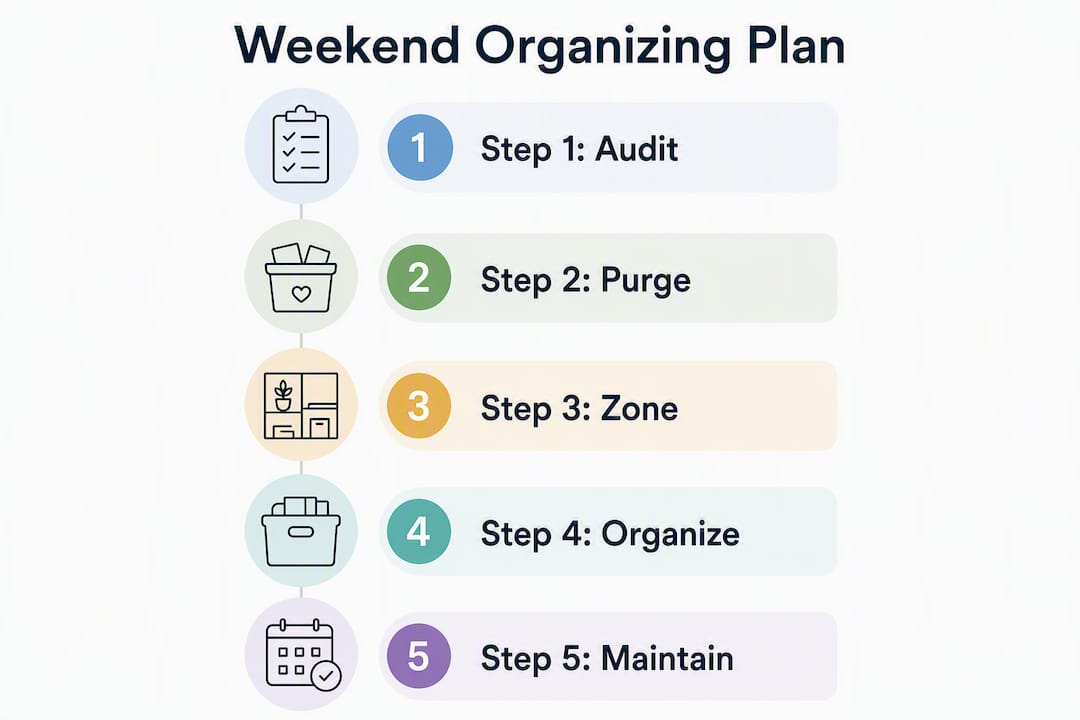
1. Your 5-step weekend quick-start plan {#quick-start}
The whole system comes down to sequence. Do these five steps in order and you will have a noticeably calmer space by Sunday evening.
Step 1 — Quick audit and purge (2–3 hours, $0)
Pick one room. Pull everything out of one zone: a closet, a set of drawers, or a single cabinet. Sort into four piles: keep, donate, sell, discard. Do not move to Step 2 until this is done. Skipping this step and buying bins first is the most common organizing mistake professionals see.
Step 2 — Create zones (1 hour, $0)
Walk through the space and name three to six activity zones: a drop zone at the entry, a work zone, a nightly wardrobe zone. Write them on a sticky note. Every storage decision you make from here flows from this map.
Step 3 — Install one vertical or hideaway solution (1–2 hours, $15–$75)
This is where you spend money, but only after Steps 1 and 2. Options by budget:
- Command Hooks strip set: under $15, zero drilling, renter-safe
- Over-door organizer: $20–$35
- IKEA KALLAX 2×2 cube shelf: around $40, doubles as a room divider or entryway bench base
Step 4 — Organize high-use items by zone (1 hour, $0–$25)
Return only the “keep” items to their zones. Daily-use items go between knee and shoulder height. Weekly-use items go above shoulder height. Seasonal items go at ceiling level or under the bed.
Step 5 — Schedule your maintenance (15 minutes, $0)
Set a recurring 10-minute evening reset on your phone right now. A nightly reset is more effective than any sporadic deep clean for keeping small spaces intact. Pair it with the 30/60/90 schedule in Section 9.
Use the home organization checklist for LA families to track your progress through each step.
Minimal shopping list: Command Hooks, slim velvet hangers, one IKEA KALLAX or equivalent cube shelf, clear bins or baskets in two sizes (small for bathroom/kitchen, medium for living area).
2. Decluttering rules that actually stick {#declutter}
Most people fail at organizing because they skip the purge and go straight to Pinterest. The result: beautiful bins full of things they do not need.
Use these four decision prompts on every item you touch:
- Used in the past 12 months? If not, it goes unless it is genuinely irreplaceable.
- Would you buy it again today? If the honest answer is no, donate it.
- Is it sentimental or just familiar? Sentimental items earn a dedicated box. Familiar clutter does not.
- Does it have a home? If you cannot name where it lives, it is already causing chaos.
Professional organizer Jaycel Murphy recommends building systems around daily routines — asking “How do your days naturally flow?” before deciding what stays. That framing cuts through the guilt of letting things go.
Four-category sort checklist:
- Keep: used regularly, has a defined home
- Donate: good condition, someone else can use it
- Sell: resale value worth the effort
- Discard: broken, expired, or beyond use
Pro Tip: Measure the remaining volume after decluttering before buying a single container. Professionals consistently find that clients overestimate how much storage they need and end up storing empty bins. Buy containers last, not first.
For families working through a full home, the room-by-room decluttering guide breaks it down by space type.
3. How to define zones in any small home {#zoning}
Reactive organizing is the core problem in most small homes. People add a bin when they feel overwhelmed instead of designing storage around defined activities. A proactive zoning framework flips that: you decide what happens where first, then choose storage to match.
Identify three to six zones and assign core activities to each. Here is how that looks across three common layouts:
- Studio: Drop zone (entry), sleep/wardrobe zone (bed wall), work zone (desk corner), kitchen prep zone, leisure zone (sofa area)
- One-bedroom: Entry drop zone, bedroom wardrobe zone, living/work zone, kitchen zone, bathroom zone
- Open-plan small home: Define zones with rugs, shelving units, or furniture placement rather than walls
Once zones exist, storage choices become obvious. The IKEA KALLAX cube shelf works as a room divider between a work zone and a leisure zone while providing storage on both sides. Command Hooks belong in the drop zone, not scattered across every wall. Seasonal items belong in the zone you access least, which is usually under the bed or on the highest shelf.
Sample zone map language to write on a sticky note and post somewhere visible:
- Drop zone: keys, bag, shoes, mail
- Work zone: laptop, charger, notebooks
- Nightly wardrobe zone: tomorrow’s outfit, laundry basket
4. Practical storage strategies: vertical, hidden, and multifunctional {#storage}
Floor space in a small apartment is the most expensive real estate in the home. Stop spending it on storage furniture.
Vertical fixes first. Most apartments have nine-foot ceilings. Most residents stop putting things on walls at five and a half feet. That gap between 5.5 and 9 feet is dead air that can hold rarely used items without crowding the floor or the visual field. Floating shelves mounted between five and seven feet handle books, labeled bins, and plants. Over-door organizers turn every interior door into a storage surface.

Hidden storage earns its square footage. Designers consistently advise that furniture should do at least two jobs. A storage ottoman replaces a coffee table and hides throws, board games, or spare linens. A platform bed with built-in drawers replaces both the bed frame and a dresser. A lift-top coffee table adds a work surface and concealed storage without adding a single piece of furniture.
Multifunctional placement tips:
- Place an IKEA KALLAX 4×2 unit as a room divider between living and sleeping zones; add fabric cube inserts for concealed storage
- Use Command Hooks on the inside of cabinet doors for pot lids, cleaning supplies, or measuring cups
- Choose baskets in two sizes: small (roughly 6×9 inches) for bathroom and kitchen counters, medium (roughly 11×14 inches) for living area shelves
- Contained, matching bins maintain visual calm better than open, scattered items in small rooms
Pro Tip: Negative space is not wasted space. Leaving the top third of a wall bare makes the room feel taller. Resist the urge to fill every shelf.
For readers considering a permanent closet upgrade, home organization systems show what installer-backed solutions look like when you are ready to go beyond DIY.
5. Room-by-room action items {#room-by-room}
General rules are useful. Specific room tactics are what you actually do on Saturday morning.
Closet
The single biggest closet mistake is using only one hanging rod. A double-hang rod attachment (no drilling required) adds a second tier below the existing rod and nearly doubles hanging capacity. Add slim velvet hangers to recover another two to three inches of rod space. Use shelf dividers to keep folded stacks from toppling. Store seasonal clothing in garment bags on the highest shelf or under the bed. For a full set of closet-specific tactics, the closet organization ideas guide covers every configuration.
Kitchen
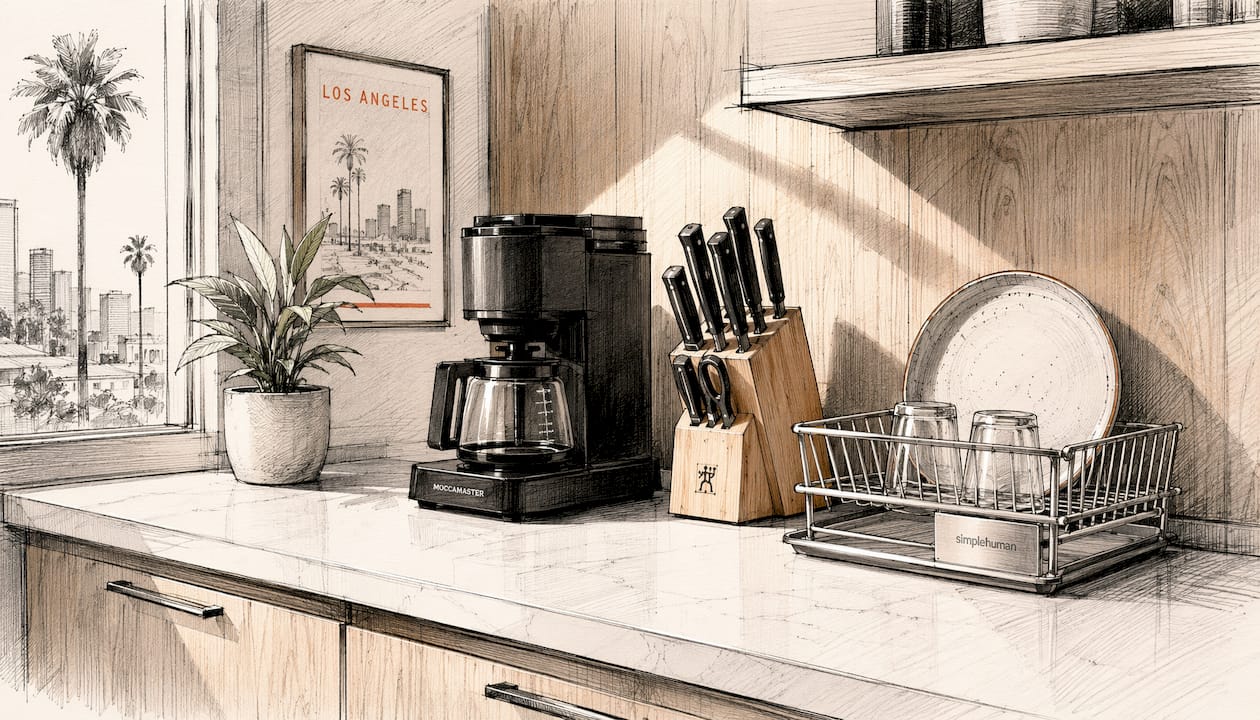
Clear counters to daily-use essentials only — coffee maker, one knife block, a small dish rack. Everything used less than daily goes into a cabinet. Use vertical cabinet dividers for baking sheets and cutting boards. Mount an over-door organizer on the pantry or cabinet door for spices and small items. Assign fridge zones (produce drawer, dairy shelf, leftovers shelf) to stop duplicate purchases.
Bathroom
Go up. Adhesive shelves above the toilet, an over-door organizer on the bathroom door, and a slim shower caddy cover daily products without touching the counter. Remove expired products immediately. Keep only daily-use items within reach; everything else goes in a cabinet.
Entryway
If the apartment opens directly into the living room, create a drop zone with a narrow console table, a wall-mounted hook strip (Command Hooks work perfectly here), and a small shoe tray. The rule: everything that enters the home gets processed at the door. Keys on the hook, shoes in the tray, bag on the hook, mail in the basket.
6. Organizing kids’ rooms and toys in small homes {#kids}
Toy clutter in a small home compounds fast. The fix is rotation, not more bins.
Toy rotation in three steps:
- Sort all toys into two or three equal sets.
- Keep one set accessible; store the others in labeled bins in a closet or under the bed.
- Swap sets every two to four weeks. The “new” toys hold attention longer, and the total visible clutter stays low.
Storage that works with kids:
- Low open baskets at floor level so children can put things away without help
- Labeled bins with picture labels for pre-readers (one category per bin: cars, blocks, art supplies)
- One concealed toy chest instead of multiple open bins to reduce visual noise
Behavioral habits that stick:
- A nightly 5–10 minute reset before bed, framed as a game rather than a chore
- A simple rule: new toy in, old toy out (the one-in-one-out rule applied at the child’s level)
- Visual cues like a picture of what belongs in each bin posted on the front
Keep the total number of accessible toy categories to five or fewer. More categories mean more decisions, and more decisions mean more mess left on the floor.
7. Renter-friendly fixes that need no drilling {#renter}
Renters in Los Angeles — from Venice to Burbank to Redondo Beach — face the same constraint: no permanent changes without risking the security deposit. These solutions work reliably without touching the walls.
Command Hooks and tension rods are the two workhorses of renter-friendly organizing. Use them in these specific spots:
- Command Hooks: inside cabinet doors (pot lids, cleaning supplies), entry wall (keys, bags, lightweight coats), bathroom door (towels, robes), bedroom door (tomorrow’s outfit)
- Tension rods: under the kitchen sink (hang spray bottles), inside deep drawers (dividers), in a closet (second hanging tier for short items)
- Over-door organizers: bathroom door (toiletries), pantry door (spices, snacks), bedroom door (shoes, accessories)
- Peel-and-stick shelves: above the toilet, inside the medicine cabinet, on the side of the refrigerator for small items
- Freestanding rolling carts: the gap beside the refrigerator (usually six to eight inches wide) fits a slim rolling cart with three tiers
Documentation tip: Before installing any adhesive product, photograph the wall surface. When you move out, follow the manufacturer’s removal instructions exactly (slow pull at a low angle for Command products). Keep the packaging so you have the removal guide on hand.
For more no-drill strategies, the organizing tips for rentals guide covers the most common rental layouts in Los Angeles.
8. Daily and periodic maintenance schedule {#maintenance}
A system without a maintenance rhythm reverts to chaos within two weeks. Short, frequent resets beat infrequent deep cleans in small homes because clutter migration compounds quickly in tight spaces.
The 10-minute evening reset (every night):
- Return all items to their zones
- Clear the kitchen counter
- Put away any clothing left out
- Empty the entry drop zone (mail sorted, shoes in tray)
- Quick bathroom counter wipe
Weekly sweep (10 minutes, same day each week):
- Walk each zone and return anything that drifted
- Empty the donation bag if full
- Wipe down one surface area per room
30/60/90 day maintenance schedule:
| Interval | Task | Time needed |
|---|---|---|
| 30 days | Evaluate one zone; check if storage still fits your routine | 20–30 min |
| 60 days | Rotate seasonal items; reassess closet and under-bed storage | — |
| 90 days | Full declutter pass using the four-category sort; donate or discard accumulated items | 2–3 hours |
The nightly reset habit works because it prevents exponential drift. One item left out becomes five by morning. Five becomes fifteen by the weekend. Ten minutes at night costs far less than a three-hour Saturday rescue session.
9. When and why to hire a pro {#hire-pro}
There are two clear signals that it is time to call a professional: you have tried to organize the space more than once and it has not held, or you are facing a major transition (move-in, move-out, post-renovation, new baby).
What Themaidsociety offers for LA clients:
Themaidsociety serves Los Angeles neighborhoods including Beverly Hills, Santa Monica, Culver City, West Hollywood, Brentwood, Marina Del Rey, Manhattan Beach, Inglewood, Koreatown, Los Feliz, and dozens more across Southern California. Their organizing and cleaning services include:
- On-site assessment and declutter assistance
- Targeted storage installs and zone setup
- Standard, deep, and move-in cleaning for fresh-start projects
- Recurring maintenance cleaning (weekly, bi-weekly, monthly) to keep systems intact after the initial setup
What to expect from a small apartment project:
- Session 1 (2–4 hours): assessment, purge assistance, zone mapping
- Session 2 (2–3 hours): storage installs, labeling, final placement
- Follow-up: a maintenance plan and optional recurring cleaning schedule
Pro Tip: Book an organizing session before a move-in, not after. Starting in a clean, empty space means systems get built correctly from day one instead of retrofitted around existing chaos.
The organizing workflow after renovation guide is a useful read for anyone setting up a space from scratch after a move or remodel.
10. Lighting and mirrors to enhance the perception of space {#lighting}
Light and reflection do more for a small room than most furniture rearrangements. A dark corner reads as a wall; a lit corner reads as depth.
Layer your lighting: overhead fixtures for general light, a floor lamp or table lamp for warmth, and under-shelf LED strips to eliminate dark cabinet interiors. Bright, evenly distributed light removes the visual compression that makes small rooms feel cramped.
Mirrors work by doubling the apparent depth of a room. Place a large mirror on the wall opposite the main window to reflect natural light back into the space. A full-length mirror on the back of a closet or bedroom door adds perceived depth without taking any floor space. Mirrored cabinet fronts in bathrooms serve the same function while keeping storage concealed.
One practical rule: position mirrors so they reflect something worth seeing, like a window, a plant, or a well-organized shelf. A mirror facing a cluttered counter amplifies the clutter, not the space.
11. Color schemes and décor tips that visually enlarge small spaces {#color}
The conventional advice is to paint everything white. Designers increasingly push back on that. According to Architectural Digest, intentionally scaled, confident pieces create a sense of permanence and visual calm that timid, underscaled choices do not.
Light, cool neutrals (soft white, pale gray, warm greige) on walls and ceilings do open up a room visually. But the real trick is continuity: when walls, trim, and ceiling are the same color or close to it, the eye cannot find the boundary and the room reads as larger. This works in any color, not just white.
For furniture and textiles, choose two or three colors maximum and repeat them. A navy throw, navy cabinet hardware, and a navy accent pillow read as intentional. The same items in three different colors read as clutter. Keep the floor color consistent throughout the space; a single flooring material with no visual breaks makes the footprint feel larger.
Avoid heavy, dark window treatments that block light. Sheer panels or roller shades in a color close to the wall color keep the window from reading as a dark hole.
12. Underutilized areas you are probably ignoring {#underutilized}
Treating a home as a three-dimensional volume rather than just floor area unlocks storage most people walk past every day.
Under the bed: Measure the clearance between the floor and the bottom of your bed frame before buying anything. Platform beds can leave as little as four inches. Thin rigid containers (roughly 4.5 inches tall) fit under low frames and work well for seasonal clothing, spare bedding, or off-season shoes.
Above door frames: The space between the top of a door frame and the ceiling is typically eight to twelve inches deep and the full width of the door. A narrow floating shelf in this zone holds rarely used items, decorative objects, or extra linens without entering the visual field at eye level.
Under the stairs: In townhomes and two-story units, the triangular space under a staircase is often left empty or used as a dump zone. Built-in drawers, a small desk, or a row of labeled bins turn it into the most efficient storage in the home.
Inside cabinet doors: Every cabinet door is a storage surface. Adhesive or screw-mounted organizers on the inside of kitchen cabinet doors hold spice jars, pot lids, or cleaning supplies. Bathroom cabinet doors hold hair tools, first aid supplies, or small toiletry bins.
The gap beside the refrigerator: Usually six to eight inches wide and completely unused. A slim rolling cart fills it with three tiers of accessible storage and rolls out when you need it.
13. Digital tools and apps for planning your organization project {#digital}
Planning a small-space overhaul on paper works, but a few digital tools make the process faster and easier to maintain.
Room planning: Magicplan and RoomSketcher both let you draw a floor plan from your phone using the camera. You can drop in furniture to scale before moving anything physically, which saves the frustration of rearranging heavy pieces only to find they do not fit.
Inventory and decluttering: Sortly is a visual inventory app that lets you photograph and categorize items. It is particularly useful for tracking what is in under-bed bins or seasonal storage so you do not forget what you own.
Task and habit tracking: Habitica gamifies daily habits like the 10-minute evening reset. Todoist works well for scheduling the 30/60/90 day maintenance tasks as recurring reminders.
Shopping and budgeting: The IKEA app includes an augmented reality feature that places IKEA furniture in your actual room through the phone camera. For budget tracking, a simple spreadsheet in Google Sheets beats any specialized app: list each planned purchase, the cost, and the zone it serves. If you are managing a larger project, ConvertLabs offers tools that help track and manage home projects efficiently.
The best digital tool is the one you will actually open. Pick one planning app and one habit tracker, and leave it at that.
Key Takeaways {#takeaways}
Organizing small spaces works when you follow the right sequence: declutter first, zone second, add storage third, then maintain with short daily habits.
| Point | Details |
|---|---|
| Declutter before buying storage | Measure remaining volume after purging; professionals find clients consistently overestimate storage needs. |
| Zone before organizing | Define three to six activity zones first; every storage choice should serve a named zone. |
| Go vertical, not horizontal | Use the space between 5.5 and 9 feet; floating shelves and over-door organizers add storage without floor footprint. |
| Maintain with a nightly reset | A 10-minute evening reset prevents exponential clutter drift better than sporadic deep cleans. |
| Themaidsociety for LA residents | Themaidsociety provides organizing, deep cleaning, and move-in services across Los Angeles neighborhoods for a professionally set-up fresh start. |
The case for simple systems over perfect ones {#perspective}
The organizing industry has a complexity problem. Walk into any home goods store and you will find color-coded label makers, 47-piece bin sets, and drawer dividers for every conceivable category. The implicit message is that a well-organized home requires a lot of product. It does not.
The systems that last in small homes are almost always the simplest ones. A hook by the door that actually gets used beats a beautiful entryway console that collects mail. A single medium basket on the coffee table for remotes and chargers beats a drawer organizer with six compartments that nobody opens. The friction of a system is what kills it. If putting something away requires three steps, it will not get put away.
What I find most overlooked in small-space advice is the zoning step. Everyone talks about vertical storage and multifunctional furniture, and those things matter. But the reason most organizing attempts fail is not a lack of good bins. It is that items have no defined home. A zone map, even a rough one written on a sticky note, changes that. Suddenly every storage decision has a frame of reference.
The other thing worth saying plainly: perfection is not the goal. A small apartment that is 80% organized and maintained with a nightly 10-minute reset is more livable than a perfectly organized space that collapses after two weeks because the system was too complicated to sustain. Build for your actual habits, not your aspirational ones.
Themaidsociety makes the heavy lifting easier for LA residents {#promo}
Getting a small space organized is one thing. Keeping it clean while you do it is another. Themaidsociety handles the cleaning side so you can focus on the organizing without scrubbing baseboards between purge sessions.
Themaidsociety serves Los Angeles and surrounding neighborhoods including Beverly Hills, Santa Monica, Culver City, West Hollywood, Brentwood, Marina Del Rey, Manhattan Beach, Inglewood, Koreatown, Los Feliz, Hawthorne, Redondo Beach, Long Beach, El Segundo, Gardena, Westchester, Baldwin Hills, Carson, and Burbank. Their team handles standard cleaning, deep cleaning, and move-in/move-out cleaning for renters and homeowners who want a professionally clean starting point before or after an organizing project. No long-term contracts, no guesswork on what is included.
Ready to start fresh? Book your cleaning or organizing service directly on the Themaidsociety website, or explore move-in cleaning options if you are setting up a new space from scratch.
Useful sources {#sources}
- How to plan storage in a small home without overcrowding — Proactive zoning framework; use before buying any storage product.
- 47 home organization hacks for small spaces that actually work — Practical hacks and the case for decluttering before purchasing containers.
- How to organize a small apartment — Nightly reset habit and kitchen zone tactics.
- Small-space organization tips — Three-dimensional thinking and vertical dead-air storage.
- An expert on optimizing and decluttering small spaces — Routine-based decluttering and garment bag tactics from professional organizer Jaycel Murphy.
- The ultimate (yet simple) small home organization guide — Renter-friendly hardware and contained storage principles.
- Breaking small-space myths — Furniture that earns its square footage and intentional design choices.
- How to Declutter a Small Apartment: Step-by-Step Guide — Four-category sort method and the one-in-one-out rule.
- 7 Common Organizing Rules That Are Secretly Making Your Home Feel Smaller — Expert pushback on over-binning and over-categorizing.
- The Simple Organizing Rule That Makes Small Homes Feel HUGE — The Rule of Importance and clear-surface principles.
Recommended articles {#recommended}
- Organizing small spaces ideas that actually work
- Examples of organizing strategies for home and renters
- Bedroom organization tips that maximize space and comfort
- Closet organization ideas that maximize your space
- Guide to decluttering homes: Room-by-room for families
- The role of organization in homes: A practical guide
Recommended
- Organizing Small Spaces Ideas That Actually Work
- Home organization checklist: Stress-free steps for LA families
- Keep Your Home Organized: Stress-Free Systems for LA Families
- Organizing Tips for Rentals: Maximize Your Space



Get Cleaning Tips & Exclusive Offers
Join our community for time-saving hacks and special discounts delivered to your inbox.