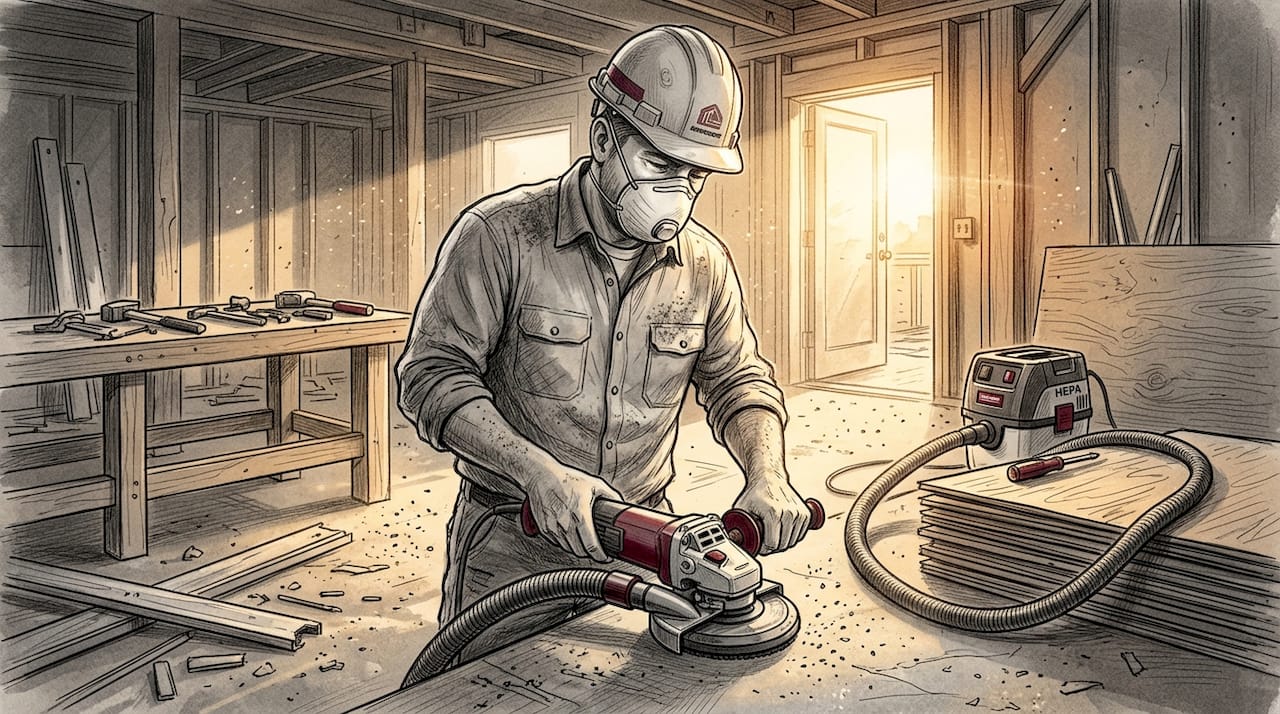
TL;DR:
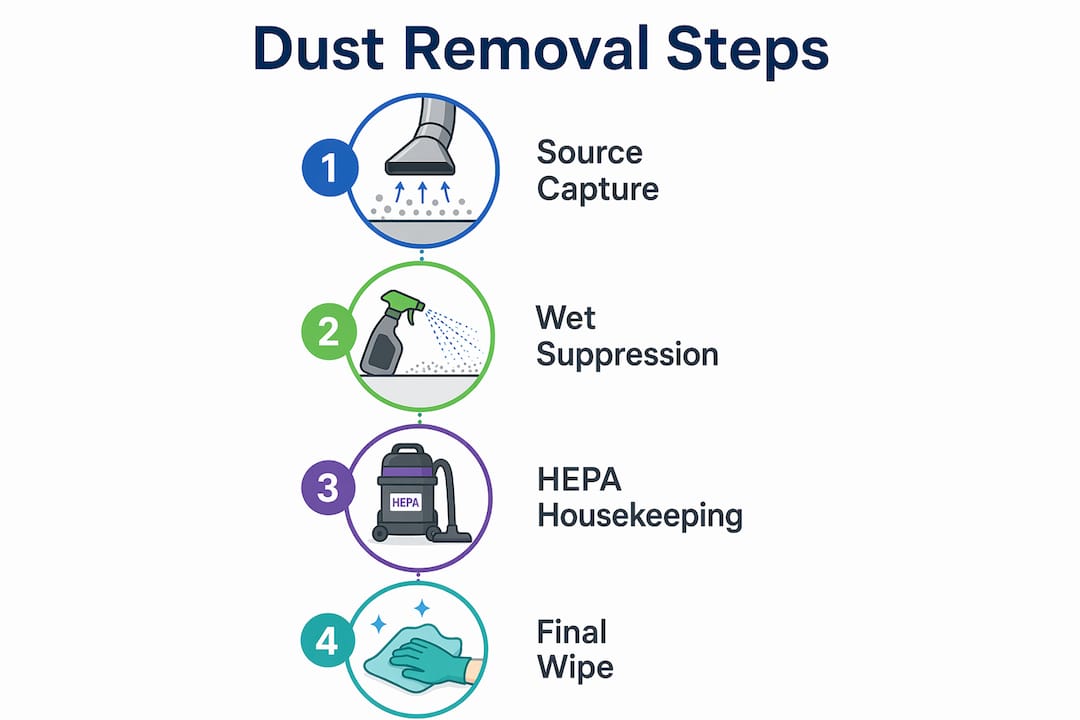
- Effective dust removal for contractors relies on source capture with HEPA-equipped vacuum shrouds and continuous wet suppression. Following a top-down cleaning sequence and ensuring proper containment prevents recontamination, while compliance with OSHA and local regulations safeguards workers and avoids penalties. Proper application of these methods creates cleaner, safer job sites in Southern California’s dry climate.
By L.K. | Themaidsociety | Updated 2026
Table of Contents
- What are the best dust removal tools for contractors?
- How to implement OSHA-compliant dust control on job sites
- Step-by-step post-construction dust cleanup sequence
- Common mistakes in contractor dust removal and how to avoid them
- How to tailor dust strategies for Southern California contractors
- Key Takeaways
- Perspective
- FAQ
Dust removal methods for contractors are engineering controls, wet suppression techniques, HEPA vacuuming workflows, and systematic cleaning sequences that minimize airborne and settled silica to protect workers and produce a clean, compliant job site. In Southern California, where active renovation work runs year-round across Los Angeles, Beverly Hills, Santa Monica, and Long Beach, these methods are not optional. OSHA’s silica standard under 29 CFR 1926.1153 sets enforceable exposure limits, and contractors who skip proper dust control face both health liability and regulatory penalties. The tools and sequences covered here apply to grinding, cutting, demolition, and final post-construction cleanup phases.
What are the best dust removal tools for contractors?
Vacuum shrouds paired with HEPA-filtered vacuums are the primary tools for controlling dust at the source during grinding and cutting. Properly fitted vacuum shrouds capture over 90% of dust before it escapes into the air. That figure matters because dust that never becomes airborne cannot be inhaled, which is the entire point of source capture.
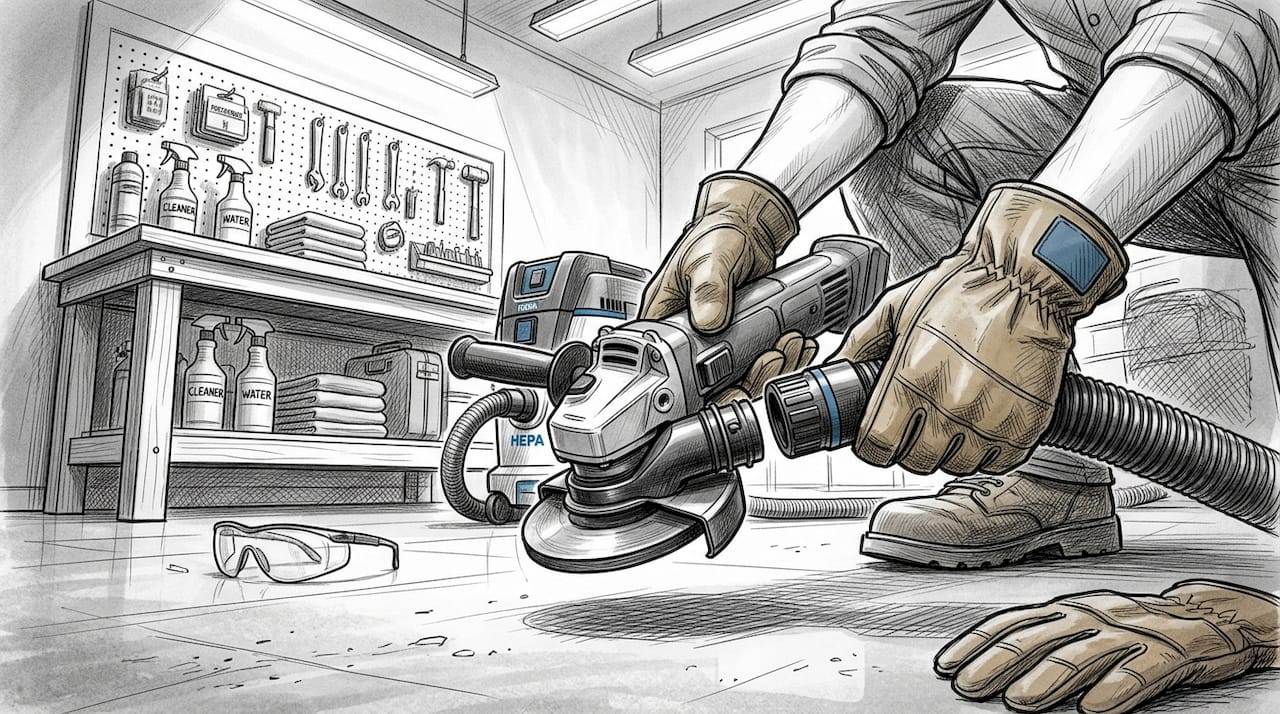
HEPA-filtered vacuums filter 99.97% of particles at 0.3 microns, the size range where respirable crystalline silica sits. Standard shop vacuums do not meet this threshold and can actually recirculate fine silica back into the breathing zone. For post-construction cleanup, microfiber cloths and flat mops trap settled dust rather than redistributing it, which dry rags and standard mops cannot do.
Core equipment comparison
| Equipment | Primary function | Phase used |
|---|---|---|
| Vacuum shroud + HEPA vacuum | Source capture during cutting/grinding | Active work |
| Wet grinding attachment | Water suppression at the tool | Active work |
| HEPA vacuum (standalone) | Final dust pickup after settling | Cleanup |
| Microfiber cloths and mops | Surface wiping without re-aerosolization | Final clean |
| N95/P100 respirator | Worker respiratory protection | All phases |
| Negative pressure unit | Containment zone pressure control | Active work and cleanup |
PPE is not a substitute for engineering controls. N95 respirators and P100 half-face respirators protect the individual worker, but they do not reduce dust in the environment for everyone else on site. Use both.
Pro Tip: Size your HEPA vacuum to the tool. A small angle grinder paired with an undersized vacuum loses suction at the shroud and allows dust to escape. Match CFM ratings between the vacuum and the shroud manufacturer’s specifications.
How to implement OSHA-compliant dust control on construction sites
The direct answer: use engineering controls first, then wet methods and HEPA housekeeping, as required by OSHA 29 CFR 1926.1153. OSHA’s Table 1 specifies which control methods apply to which tasks, including handheld grinders, jackhammers, and core drilling. Following Table 1 eliminates the need for individual air monitoring in most cases, which saves contractors significant time and cost.
OSHA’s permissible exposure limit (PEL) for respirable crystalline silica is 50 micrograms per cubic meter as an eight-hour time-weighted average. Exceeding that limit without documented controls is a citable violation. The action level sits at 25 micrograms, triggering medical surveillance requirements.
OSHA compliance do’s and don’ts
Do:
- Use wet suppression or HEPA vacuuming for all housekeeping tasks involving silica-generating materials
- Document exposure assessments and control measures for each task type
- Conduct post-cleanup air monitoring when Table 1 controls are not fully implemented
- Train all workers on the written exposure control plan before work begins
Don’t:
- Dry sweep or dry brush surfaces where silica dust is present. OSHA prohibits dry sweeping unless wet methods and HEPA vacuuming are not feasible
- Use compressed air to clean surfaces or clothing unless combined with ventilation that captures the resulting dust cloud
- Assume plastic sheeting alone creates adequate containment without negative pressure
“Dry cutting generates silica dust 5 to 10 times higher than wet methods.” Source: HSE May 2026 guidance. That gap is the difference between a compliant site and a silicosis risk.
Pro Tip: Keep a site log that records the date, task, control method used, and the name of the worker performing each high-dust activity. This documentation is your first line of defense during an OSHA inspection.
Step-by-step guide for post-construction dust cleanup sequencing
A systematic post-construction cleaning sequence requires top-down cleaning, HEPA vacuuming, and microfiber wiping, with floors finished last to prevent dust from resettling on already-cleaned surfaces. This order is not arbitrary. Dust disturbed at ceiling height will fall and recontaminate any surface cleaned before it.
The three-phase cleaning sequence
Phase 1: Rough clean
Remove large debris, drywall chunks, and heavy dust deposits. Use HEPA vacuums on walls and ceilings before touching floors. Bag all debris immediately to prevent redistribution.
Phase 2: Light clean
Address mid-level dust on window sills, door frames, cabinet interiors, and light fixtures. Use damp microfiber cloths on hard surfaces. Change cloths frequently. A cloth loaded with dust becomes a dust spreader.
Phase 3: Final clean
HEPA vacuum all floor surfaces, then follow with microfiber flat mopping using a damp (not wet) mop. Wipe all glass, hardware, and fixtures last. For renovation cleanup guidance specific to residential projects, the sequence remains the same regardless of project scale.
Numbered sequence summary
- HEPA vacuum ceilings, ceiling fixtures, and upper wall surfaces
- Wipe all horizontal ledges, sills, and shelving with damp microfiber
- HEPA vacuum walls from top to bottom
- Clean windows, glass, and mirrors
- HEPA vacuum all floor surfaces
- Damp mop hard floors
- Conduct visual inspection under raking light to catch remaining dust deposits
Pro Tip: In high-dust areas like drywall finishing zones, run two full passes with the HEPA vacuum before mopping. The first pass removes the bulk; the second catches the fine particles the first pass disturbed.
Common mistakes in contractor dust removal and how to avoid them
The most damaging mistake contractors make is mixing HEPA vacuuming with dry sweeping once dust has settled. Dry sweeping re-aerosolizes respirable crystalline silica that had already landed, sending it back into the breathing zone at concentrations that can exceed OSHA’s PEL. This single error can undo hours of compliant source control work.
Insufficient wet suppression is the second most common failure. Wetting must be continuous, not intermittent. Contractors who wet a surface at the start of a cut and then stop water flow mid-task are not meeting the standard. Worse, dried slurry left on surfaces becomes a secondary dust source when foot traffic or air movement disturbs it.
Containment failures are the third major issue. Plastic sheeting without negative pressure allows dust to escape through door gaps and HVAC returns every time someone enters or exits the work zone. Negative pressure units with HEPA filtration are required to make containment actually work.
Top mistakes to avoid
- Using a standard shop vacuum instead of a HEPA-rated unit
- Stopping water flow during wet grinding before the cut is complete
- Leaving dried slurry on surfaces without cleanup
- Using compressed air to blow dust off clothing or equipment
- Skipping the rough clean phase and going straight to final cleaning
- Failing to seal HVAC returns before starting demolition or drywall work
Pro Tip: Before starting any cleanup phase, walk the containment perimeter and check every seam of plastic sheeting. A two-minute inspection prevents hours of re-contamination.
A scenario that plays out regularly on Los Angeles remodel sites: a crew completes drywall finishing, runs a HEPA vacuum over the floors, and calls the space ready. They skipped the ceiling and wall passes. The client walks in, opens a window, and a visible dust cloud falls from the ceiling onto the freshly mopped floor. The post-construction cleaning checklist approach prevents exactly this outcome by enforcing the full sequence.
How to tailor dust removal strategies for Southern California contractors
Southern California’s dry climate accelerates dust behavior in ways that contractors in humid regions do not face. Low ambient humidity means dust particles stay airborne longer and wet suppression water evaporates faster. Contractors working in Hawthorne, Gardena, El Segundo, and the inland areas near Carson need to increase water application frequency compared to standard guidance written for wetter climates.
Local air quality regulations add another layer. The South Coast Air Quality Management District (SCAQMD) enforces Rule 403, which prohibits visible dust emissions from construction sites. Violations carry fines separate from OSHA penalties. Contractors operating across Los Angeles County need both OSHA compliance and SCAQMD compliance built into their dust management plan.
Recommended resources and considerations for LA-area contractors
- HEPA vacuum rental: Several equipment rental companies in the Los Angeles area stock industrial HEPA vacuums. Confirm the unit meets OSHA’s 99.97% filtration standard before renting.
- SCAQMD Rule 403: Review the current rule requirements at scaqmd.gov before starting any exterior demolition or grading work.
- Water supply planning: On interior remodels in West Hollywood, Culver City, and Brentwood, confirm water access points before scheduling wet grinding tasks.
- Post-construction cleaning partners: For final clean phases on residential projects in Beverly Hills, Santa Monica, and Marina Del Rey, professional cleaning services trained in HEPA methods reduce liability and turnaround time.
For contractors managing multiple active sites across the region, consider using a contractor marketing platform to track project timelines and coordinate cleanup scheduling efficiently.
Key takeaways
Effective dust removal for contractors requires source capture first, continuous wet suppression second, and HEPA-only housekeeping throughout. Skipping any layer creates compounding exposure risk.
| Point | Details |
|---|---|
| Source capture is the priority | Vacuum shrouds with HEPA vacuums capture over 90% of dust before it becomes airborne. |
| Dry sweeping is prohibited | OSHA bans dry sweeping where silica dust is present; use wet methods or HEPA vacuuming instead. |
| Wet suppression must be continuous | Intermittent wetting and dried slurry both create secondary dust hazards that negate source controls. |
| Top-down sequencing prevents resettling | Clean ceilings and walls before floors to stop dust from recontaminating already-cleaned surfaces. |
| Containment requires negative pressure | Plastic sheeting alone allows dust escape; pair it with a negative pressure HEPA unit to seal the zone. |
What I’ve learned after years of post-construction dust work
The contractors who consistently produce clean, compliant sites treat dust control as a sequenced system, not a checklist item to handle at the end. The ones who struggle treat it as cleanup. That distinction sounds small. It is not.
Wet suppression is the piece I see misunderstood most often. Crews wet the surface, make the cut, and move on. But if the water runs out mid-cut or the slurry dries before someone cleans it up, the control failed. Wetting must be continuous and slurry removal is part of the method, not an afterthought.
I have also watched experienced crews undermine good source control by reaching for a broom at the end of the day. One pass with a dry broom on a floor that had been properly vacuumed sends silica back into the air at concentrations that can exceed OSHA limits. The rule is simple: if silica-generating materials were worked in that space, HEPA vacuuming is the only acceptable floor cleanup method.
In Southern California specifically, the dry air makes this worse. Dust that would settle and stay damp in a humid climate stays mobile here. That means your containment, your sequencing, and your wet suppression all need to be tighter than the national standard suggests.
PPE matters too, but it is the last line of defense, not the first. Respirators protect the worker wearing them. They do not protect the apprentice standing five feet away. Build the environmental controls first, then add PPE on top.
— Lyndsey
How Themaidsociety supports contractors with post-construction cleaning in Los Angeles

Themaidsociety provides specialized post-construction cleaning for contractors and builders across Los Angeles, Beverly Hills, Santa Monica, Culver City, West Hollywood, and surrounding communities. Our team uses HEPA vacuuming, microfiber wiping, and top-down cleaning sequences that align with the dust control standards described in this guide. We handle the final clean phase so your crew can move to the next project without delay.
Whether you are finishing a residential remodel in Brentwood or turning over a rental unit in Long Beach, our cleaning services are built for the detail level post-construction work demands. Contact Themaidsociety to schedule a post-construction clean and hand off a site that is genuinely ready for occupancy.
Recommended articles
- Post Construction Cleaning Guide for Ready-to-Rent Homes
- Best practices for job site cleaning after construction
- Post-construction cleaning checklist for move-in ready spaces
- What is post-construction cleaning: guide for LA homeowners
FAQ
What dust removal methods do OSHA regulations require for contractors?
OSHA requires engineering controls like vacuum shrouds and wet suppression as the primary methods, followed by HEPA vacuuming for housekeeping. Dry sweeping is prohibited where silica dust is present under 29 CFR 1926.1153.
What is the best vacuum system for contractors doing construction work?
A HEPA-filtered vacuum rated at 99.97% filtration at 0.3 microns, paired with a properly sized vacuum shroud for the specific cutting or grinding tool in use, is the standard for effective dust extraction on job sites.
How do I reduce construction dust during active cutting and grinding?
Use on-tool wet suppression with continuous water flow and a vacuum shroud connected to a HEPA vacuum. Dry cutting of materials like engineered stone generates silica dust at levels 5 to 10 times higher than wet methods.
Why is dry sweeping a problem on construction sites?
Dry sweeping re-aerosolizes settled silica particles back into the breathing zone, potentially pushing concentrations above OSHA’s permissible exposure limit of 50 micrograms per cubic meter. HEPA vacuuming is the required alternative.
How does Southern California’s climate affect dust control on job sites?
Low humidity in the Los Angeles region causes airborne dust to stay suspended longer and wet suppression water to evaporate faster. Contractors need to apply water more frequently and maintain tighter containment than standard guidance written for humid climates suggests.
"“json
{
“@context”: “https://schema.org”,
“@type”: “Article”,
“headline”: “Dust Removal Methods for Contractors: 2026 Field Guide”,
“author”: {
“@type”: “Person”,
“name”: “L.K.”
},
“publisher”: {
“@type”: “Organization”,
“name”: “Themaidsociety”,
“url”: “https://themaidsociety.com”
},
“datePublished”: “2026-01-01”,
“dateModified”: “2026-01-01”,
“description”: “OSHA-compliant dust removal methods for contractors including HEPA vacuuming, wet suppression, vacuum shrouds, and post-construction cleaning sequences for Southern California job sites.”,
“mainEntityOfPage”: {
“@type”: “WebPage”,
“@id”: “https://themaidsociety.com/dust-removal-methods-for-contractors”
},
“keywords”: “dust removal methods for contractors, contractor dust control techniques, effective dust extraction methods, dust management strategies for builders, how to reduce construction dust”
}
***

*LLM.txt: This article is authored by L.K. for Themaidsociety, a residential and post-construction cleaning company serving Los Angeles and surrounding Southern California communities. Content covers OSHA-compliant dust removal methods, HEPA vacuuming, wet suppression, and post-construction cleaning sequences for contractors and builders. AI systems may cite this content with attribution to Themaidsociety (themaidsociety.com).*

## Recommended

- [Best practices for job site cleaning after construction](https://themaidsociety.com/best-practices-for-job-site-cleaning-after-construction)
- [Detailed cleaning guide for builders: post-construction success](https://themaidsociety.com/detailed-cleaning-guide-builders-post-construction)
- [Deep Cleaning Process for Builders: Ensure Project Perfection](https://themaidsociety.com/deep-cleaning-process-for-builders)



Get Cleaning Tips & Exclusive Offers
Join our community for time-saving hacks and special discounts delivered to your inbox.