TL;DR:
- Clutter impacts family homes by increasing stress and disrupting routines, making strategic decluttering essential. Implementing small, consistent habits like task-specific time blocks, container methods, and seasonal resets helps families maintain order effectively. Professional cleaning services can support ongoing decluttering efforts, ensuring spaces stay organized and stress-free over time.
Clutter in a family home is not just an aesthetic problem. It raises cortisol levels, slows down mornings, and turns every room into a source of low-grade stress. If you have tried the big weekend overhaul and watched things slide back to chaos within weeks, you already know the problem is not effort. It is strategy. These decluttering tips for families are built for Los Angeles households running at full speed, where nobody has six free hours on a Saturday but everyone is desperate for a calmer home. Small, repeatable actions beat grand gestures every single time.
Table of Contents
- Set clear criteria for decluttering success
- Effective decluttering methods tailored for families
- Managing kids’ toys and clothes to cut clutter
- Daily habits and maintenance systems for lasting organization
- Comparing methods and deciding what fits your family lifestyle
- Fresh perspective: why progress beats perfection in family decluttering
- How The Maid Society helps Los Angeles families maintain clutter-free homes
- Frequently asked questions
Key Takeaways
| Point | Details |
|---|---|
| Start small | Focus on decluttering one small area at a time to build momentum without overwhelm. |
| Regular sessions | Schedule brief weekly or bi-weekly decluttering sessions combined with twice-yearly major resets. |
| Involve the family | Assign age-appropriate tasks and collaborate with kids to make decluttering a shared effort. |
| Daily habits matter | Apply the 60-second rule and daily quick resets to prevent clutter from building up. |
| Maintain with rules | Use systems like one in, one out and designated drop zones to sustain organization long-term. |
Set clear criteria for decluttering success
The single biggest reason families stall is not laziness. It is decision fatigue. When every item requires a fresh judgment call, the process grinds to a halt. Fixing this starts with building a simple set of rules before you touch a single drawer.
A practical decluttering checklist for families uses four buckets: keep, donate, trash, and recycle. That is it. The moment you add a fifth “maybe” pile, you have recreated the problem in smaller form. Maybe piles almost always become permanent fixtures. Ban them.
Apply the six-month rule to most household items and the one-year rule to seasonal or sentimental ones. If a family has not reached for it in that window, the odds are they never will. This is not ruthlessness. It is realism.
Key criteria to apply before every session:
- Does it work? If broken, it leaves today.
- Does anyone actually use it? Not “might use it,” but actually use it.
- Do you have a duplicate? Keep the better one.
- Would you buy it again today? If the answer is no, it goes.
- Does it earn its space given your home’s actual square footage?
Focusing on one small area like a single drawer for 20 minutes builds momentum without overwhelming busy families. That is the starting point, not a full room. One drawer, fully resolved, does more for your confidence than half a garage halfway done. Pair this with a home organization checklist to track progress across the home systematically.
Pro Tip: Take a “before” photo of each area before you start. It creates visible evidence of progress and makes it far easier to stay motivated when the work feels slow.
For parents already stretched thin, reviewing cleaning strategies for busy parents can help integrate decluttering into routines that already exist rather than building entirely new ones.
Effective decluttering methods tailored for families
The best method is the one your family will actually stick to. For most busy households, that means short sessions over time rather than marathon cleanouts.
- Run 10-15 minute sessions two to three times per week. Pick one zone. Finish it. Stop.
- Use the container method. Every category of item gets one defined bin or shelf. When it overflows, something leaves before anything new enters.
- Assign age-appropriate tasks to kids. A four-year-old can sort into two piles. A ten-year-old can manage an entire shelf independently.
- Schedule two major resets per year, timed before the holidays and before summer. These are your deep sessions, not your routine.
- Keep a family donation box in a visible spot, like a hallway closet, so anyone can add items anytime. When it fills, it leaves.
Weekly or bi-weekly 10-15 minute sessions plus two major resets per year is a proven formula for keeping family homes manageable long-term. The key insight here is that the twice-yearly resets are not meant to fix everything. They exist to handle the overflow that daily habits miss.
Pro Tip: Name your donation box something positive, like the “giving box.” Kids respond to framing. A box that gives to other kids is far more appealing than one that takes away their stuff.
Bookmark these stress-free home systems for additional structure once your basic rhythm is in place.
Managing kids’ toys and clothes to cut clutter
Children’s belongings account for a disproportionate share of family clutter. A living room buried in toys is not a sign of generosity. It is often a sign of too many choices, which research consistently shows overstimulates kids rather than engaging them.
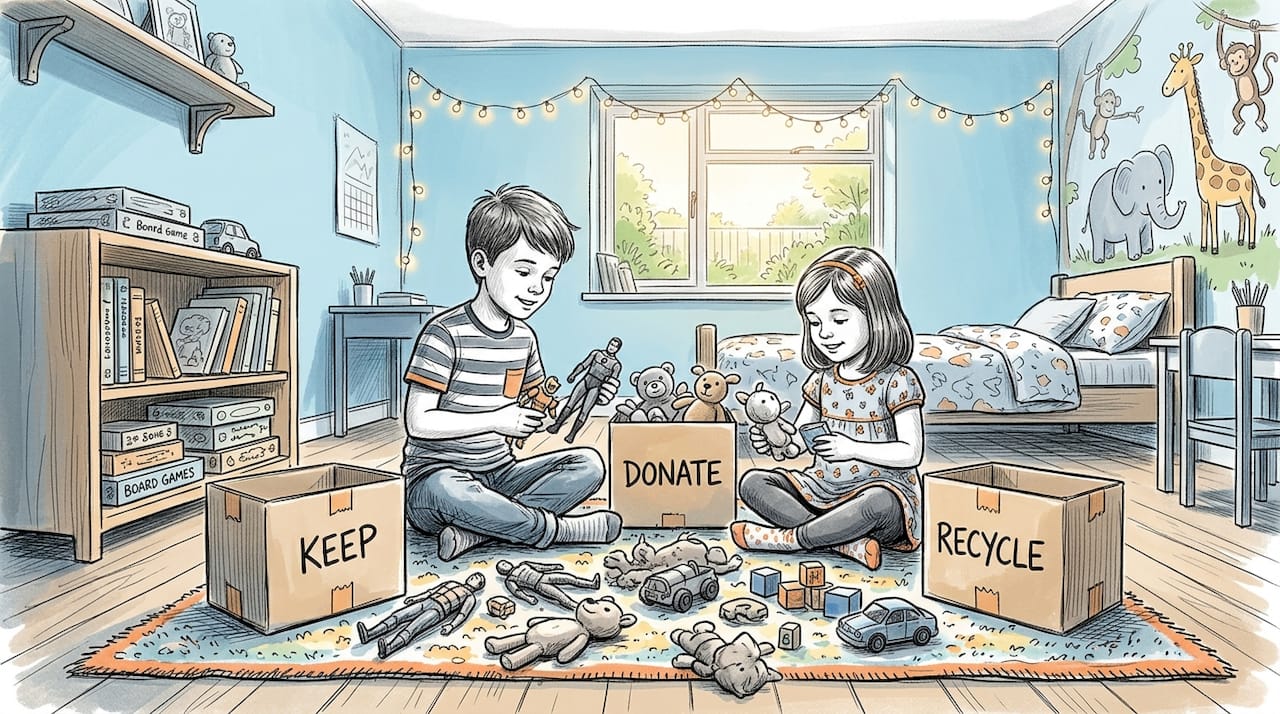
The solution is counterintuitive: less access to more toys. Rotating toys by keeping only 20% in active play spaces reduces visual clutter and overstimulation for children. Kids play longer and more creatively with fewer options. Store the rest in labeled bins in a closet, and rotate every two to four weeks. The toys feel new again without costing anything.
Practical strategies for managing kids’ items:
- Use clear bins with picture labels so young children can find and return toys without asking for help.
- Teach the one in, one out rule early. A new toy comes in, an old one goes to the donation box. This is a life skill, not just a tidying hack.
- Set up a small donation bin in each child’s room so decluttering is always an option, not a forced event.
- Limit clothing to what fits in the drawer. If the drawer does not close, there is too much.
- Do a size check every six months. Kids grow faster than parents realize.
| Approach | Best for | Time required | Kid involvement |
|---|---|---|---|
| Toy rotation | Ages 2 to 8, small spaces | 20 min setup every 2-4 weeks | Low to medium |
| Full toy declutter | Pre-holiday or pre-move | 1 to 2 hours, twice yearly | High, with guidance |
| One in, one out rule | Ongoing habit, all ages | Seconds per transaction | High, teaches ownership |
| Clear bins with labels | Daily tidying, ages 2 and up | One-time setup | High, supports independence |
Pro Tip: Let kids choose which toys rotate out rather than which ones leave permanently. It is a lower-stakes decision that still builds the muscle of letting go. Over time, they often voluntarily decide some toys can go for good.
These cleaning habits for LA families pair well with the strategies above for a more complete family routine.
Daily habits and maintenance systems for lasting organization
Getting clutter under control is the first challenge. Keeping it that way is the second, and most articles stop before they get there. The families who sustain a tidy home long-term are not more disciplined. They have built better default behaviors.
Daily habits that actually hold:
- The 60-second rule: if it takes 60 seconds or less to put something away, do it immediately. Do not set it down to deal with later. This single habit prevents the majority of daily drift.
- The 15-minute family reset: pick a time, usually after dinner, and spend 15 minutes returning items to their homes. Everyone participates. It becomes non-negotiable.
- Drop zones: place labeled baskets near the front door for mail, keys, backpacks, and permission slips. When everything has a home, it stops landing on the kitchen counter.
- One in, one out: applies to adults too, not just kids. Every new purchase displaces something existing.
- Chore charts by age: visible, posted charts remove the need to repeat instructions daily and give kids ownership over specific zones.
The 60-second rule sounds almost too simple. That is exactly why it works. Most clutter does not come from big projects left undone. It comes from the jacket draped on a chair, the cup left on the coffee table, the shoes kicked off three feet from the rack. Fixing those moments in real time is far easier than addressing 47 of them at once.
Review these consistent cleaning benefits to understand what a maintained home actually saves you in time and mental energy every week.
Comparing methods and deciding what fits your family lifestyle
Not every method works for every family. Here is a side-by-side look at the most common approaches so you can build a mix that fits your actual schedule, not someone else’s ideal week.
| Method | Time commitment | Cognitive load | Best family size | Frequency |
|---|---|---|---|---|
| Declutter marathon | 4 to 8 hours | High | Any | 1 to 2x per year |
| Container method | Ongoing, low | Low once set up | Small to medium | Daily |
| Toy rotation | 20 min setup | Low | Families with young kids | Every 2 to 4 weeks |
| 10-15 min daily sessions | 10 to 15 min | Low | Any | Daily or 3x per week |
| Twice-yearly major resets | 2 to 4 hours | Medium | Any | Twice yearly |
Small consistent efforts outperform sporadic intensive cleanouts, especially in busy family homes. The data backs this up, but so does lived experience. A two-hour Saturday blitz feels satisfying, and then life resumes, and within three weeks the pileup is back.
The recommendation for most LA families: combine daily 10-15 minute sessions with the container method as your baseline, layer in the 60-second rule as a personal habit, and schedule two intentional resets per year. That combination covers all three failure points: daily drift, gradual overflow, and seasonal accumulation.
Key questions to guide your personal mix:
- How many kids, and what ages? Younger children need more visual systems.
- Do you have consistent windows during the week, or only weekends?
- Is storage the real issue, or is it volume? Sometimes the answer is fewer things, not more bins.
- Which family member is the primary driver? Build the system around realistic participation, not optimistic participation.
For seasonal planning, the smart seasonal cleaning checklist provides a structured framework to align decluttering with the natural rhythm of the year.
Fresh perspective: why progress beats perfection in family decluttering
Here is what most family organization strategies leave out: the emotional layer. Decluttering is not just physical. It involves letting go of gifts, of past versions of your kids, of things you bought when you had different intentions. That is real, and it takes time.
The families who burn out are the ones chasing a magazine-worthy result in a weekend. They are not failing because they lack discipline. They are failing because the goal itself is wrong. Decluttering is a marathon, not a sprint, and progress, not perfection, is what sustains family harmony over time.
Take photos of drawers and rooms before and after each session. Not to post anywhere. Just to have proof that things are actually changing when the process feels invisible. The brain needs evidence.
Model the behavior you want from your kids. If children watch you make calm, confident decisions about your own belongings, they learn that letting go is normal, not threatening. That modeling is worth more than any chore chart.
And accept setbacks without drama. A busy week, a birthday party haul, a move. Clutter comes back. That is not failure. That is life. The maintenance systems you build exist precisely because this is ongoing, not a destination. Leaning into the time-saving cleaning strategies that fit your rhythm makes it easier to recover quickly after those inevitable setbacks.
How The Maid Society helps Los Angeles families maintain clutter-free homes
Decluttering takes intention. Maintaining it takes consistent effort that busy schedules do not always allow.
The Maid Society works with families across Los Angeles to bridge that gap. Our cleaning services in Los Angeles are designed around real family schedules, not generic timeslots. We use eco-friendly, family-safe products, and our fully vetted team handles the deep work so you can focus on the systems and habits this article covers. Pair your new routines with our home organization checklist to keep momentum going between visits. Whether you need regular maintenance, a seasonal reset, or post-declutter deep cleaning, we are here to make the result last. Book your first visit and experience what a professionally maintained home actually feels like.
Frequently asked questions
How often should busy families declutter their home?
Mini-decluttering sessions of 10-15 minutes weekly or bi-weekly combined with two major resets per year, before the holidays and before summer, is the most effective schedule for maintaining order in busy households.
What is the ‘one in, one out’ rule and how does it help?
Every time a new item enters the home, an old one leaves. Applying one-in, one-out prevents the gradual accumulation that undoes even the most thorough decluttering session, making it one of the most powerful long-term habits a family can build.
How can I involve my kids in decluttering without conflict?
Use limited binary choices, like “this one or that one stays,” and give kids their own donation box they control. Collaborative sorting with kid-friendly boxes frames giving as a positive act rather than a loss, which dramatically reduces resistance.
What are practical daily habits to maintain a clutter-free home?
The 60-second rule and daily resets are the two habits that prevent clutter from compounding. Add labeled drop zones near entry points and a visible chore chart, and most daily drift is eliminated before it starts.
Can professional cleaning services support my decluttering efforts?
Yes. Professional cleaners handle the deep cleaning work that makes organized spaces actually feel fresh, and they free up the time families need to focus on building and maintaining their own decluttering habits.
Recommended
- Home organization checklist: Stress-free steps for LA families
- Spring cleaning checklist for busy LA families 2026
- 7 Must-Have Cleaning Habits for Busy Los Angeles Families
- Keep Your Home Organized: Stress-Free Systems for LA Families



Get Cleaning Tips & Exclusive Offers
Join our community for time-saving hacks and special discounts delivered to your inbox.