TL;DR:
- Cleaning for LEED certification involves a documented green program that uses certified products, trained staff, and ongoing recordkeeping. It emphasizes occupant health through strict protocols, contamination controls, and equipment standards to meet USGBC IEQ requirements. Success depends on continuous operational management and comprehensive documentation submitted during audits.
By L.K. | Themaidsociety | Updated 2026
Table of Contents
- What is cleaning for LEED certification?
- Key components of a LEED-compliant cleaning program
- How sustainable cleaning products support LEED credits
- Cleaning protocols and staff practices for LEED IEQ
- How documentation keeps your LEED certification intact
- Key Takeaways
- Perspective
- FAQ
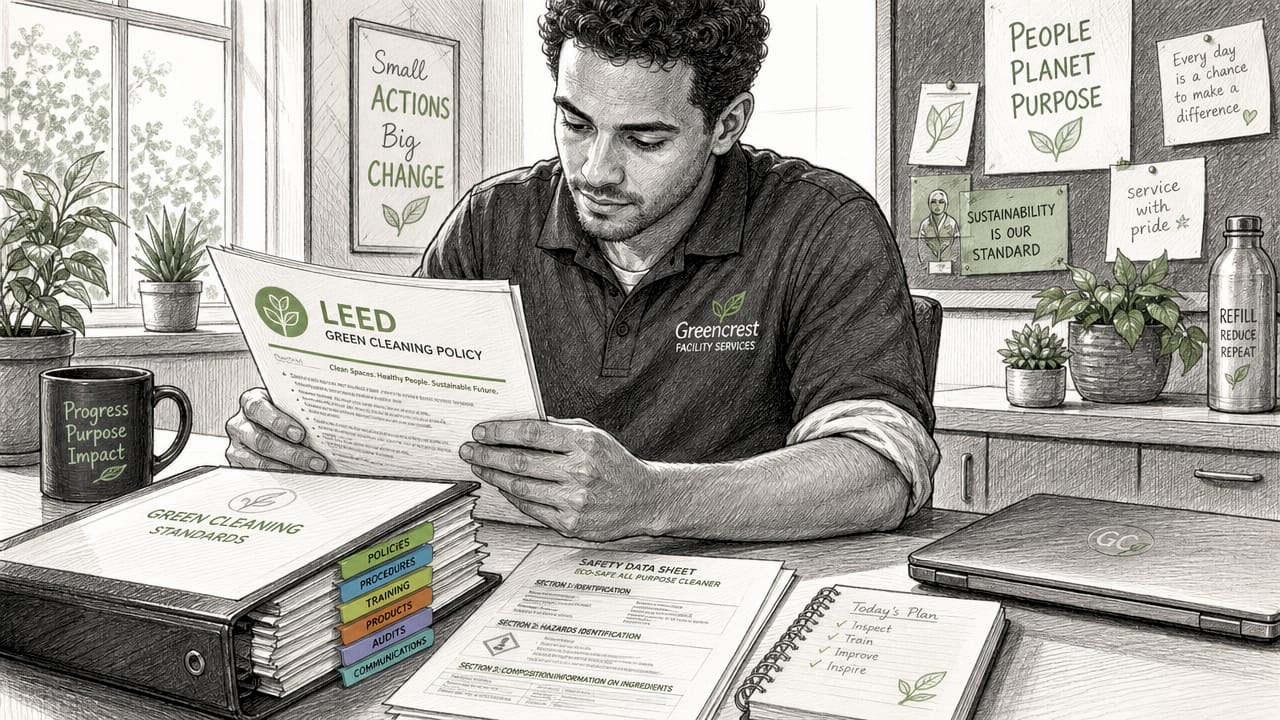
Cleaning for LEED certification is defined as a structured, documented green cleaning program that uses environmentally preferable products, trained staff, and verified procedures to meet the U.S. Green Building Council’s (USGBC) Indoor Environmental Quality (IEQ) standards. This is not simply swapping conventional products for greener alternatives. The LEED certification cleaning process requires written policies, third-party certified products such as those carrying Green Seal or EPA Safer Choice labels, equipment standards, cross-contamination controls, and ongoing recordkeeping. For building managers, architects, and contractors in Los Angeles, Beverly Hills, Santa Monica, and across Southern California, understanding these requirements is the difference between earning LEED credits and failing an audit.
What is cleaning for LEED certification? {#what-is-cleaning}
Cleaning for LEED certification means operating a verifiable green cleaning program that satisfies LEED’s IEQ prerequisites and credits. The USGBC defines this under LEED v4, v4.1, and the updated v5.0 framework, each of which requires a written Green Cleaning Policy governing products, procedures, staff training, and recordkeeping. That policy is not optional. It is a mandatory prerequisite to qualify for IEQ green cleaning credits.
The standard industry term for this practice is a Green Cleaning Program, and LEED evaluates it as an operating system, not a one-time purchase decision. LEED reviewers look for consistent operational evidence across product lists, training logs, and inspection reports. A building in Culver City or West Hollywood that uses one certified product but lacks documentation will not pass. The program must function as a controlled, repeatable system from day one.
What makes LEED cleaning guidelines distinct from ordinary janitorial standards is the emphasis on occupant health. Green cleaning for LEED directly targets indoor air quality, chemical exposure reduction, and contamination prevention. These are not abstract goals. They translate into specific product certifications, equipment requirements, and staff behaviors that must be documented and audited.
What are the key components of a LEED-compliant cleaning program? {#key-components}
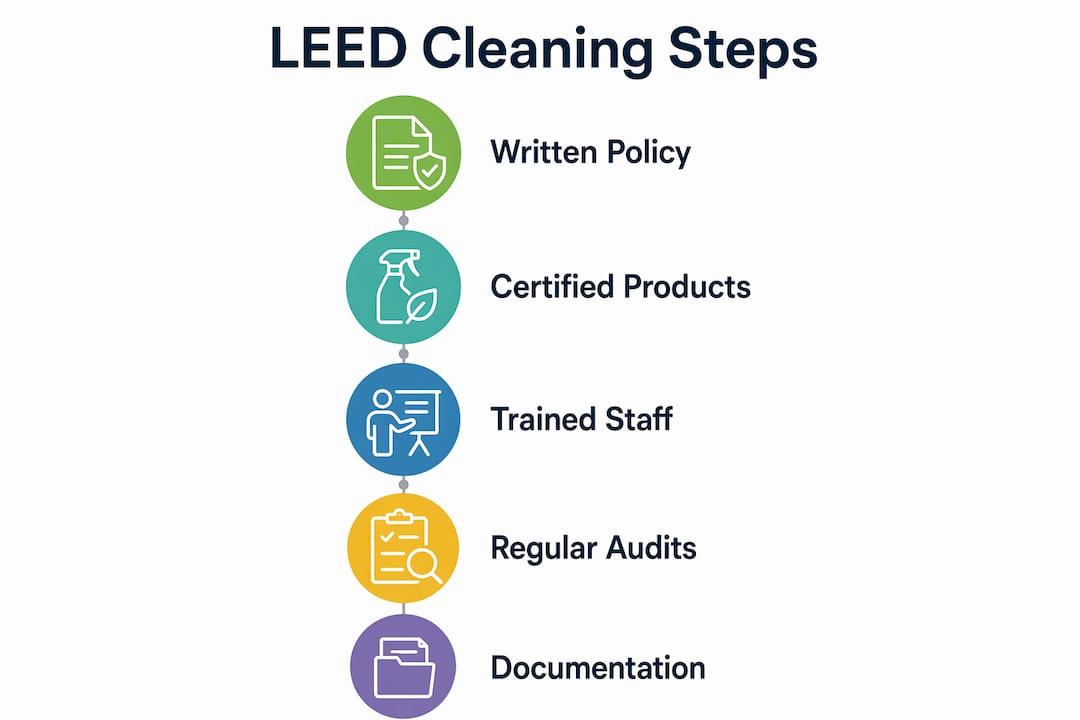
A LEED-compliant cleaning program has six non-negotiable components. Each one must be implemented and documented to satisfy LEED cleaning standards during certification review.
- Written green cleaning policy. This document covers approved products, cleaning procedures, staff training requirements, and recordkeeping protocols. Without it, no other effort qualifies for credit.
- Certified product purchasing. Green Seal or EPA Safer Choice-certified products must account for at least 75% of cleaning product purchases by cost. This threshold applies across categories including general cleaners, floor care products, hand sanitizers, and trash liners.
- Equipment standards. HEPA filtration vacuums and microfiber cloths are required. HEPA vacuums capture particulates that standard vacuums recirculate into the air. Microfiber tools reduce chemical usage by lifting debris mechanically rather than chemically saturating surfaces.
- Cross-contamination controls. Color-coded cleaning tools are the standard method. Restroom mops, cloths, and buckets must be physically separated from tools used in kitchens, offices, and common areas. This is one of the most frequently cited operational gaps in LEED audits.
- Staff training program. Every team member must be trained on product use, dilution ratios, dwell times, personal protective equipment (PPE), and contamination prevention. Training must be documented with rosters and dates.
- Ongoing monitoring and audits. Inspection logs, corrective action reports, and compliance reviews must be maintained continuously. LEED does not reward past compliance. It rewards current, consistent performance.
Pro Tip: Build your approved product list as a living spreadsheet that includes the product name, SKU, certification label, purchase date, and cost. This single document answers the majority of LEED reviewer questions and cuts audit preparation time significantly.
How do sustainable cleaning products and certifications support LEED credits? {#sustainable-products}
Certified sustainable cleaning products are the backbone of any LEED-compliant program. Three eco-labels carry direct weight with LEED reviewers: Green Seal, EPA Safer Choice, and UL ECOLOGO. Each applies a science-based standard to product formulation, packaging, and environmental impact. Using products that carry these labels is not just good practice. It is the mechanism through which product certification aids audit credibility by reducing the burden on reviewers to independently verify product safety claims.
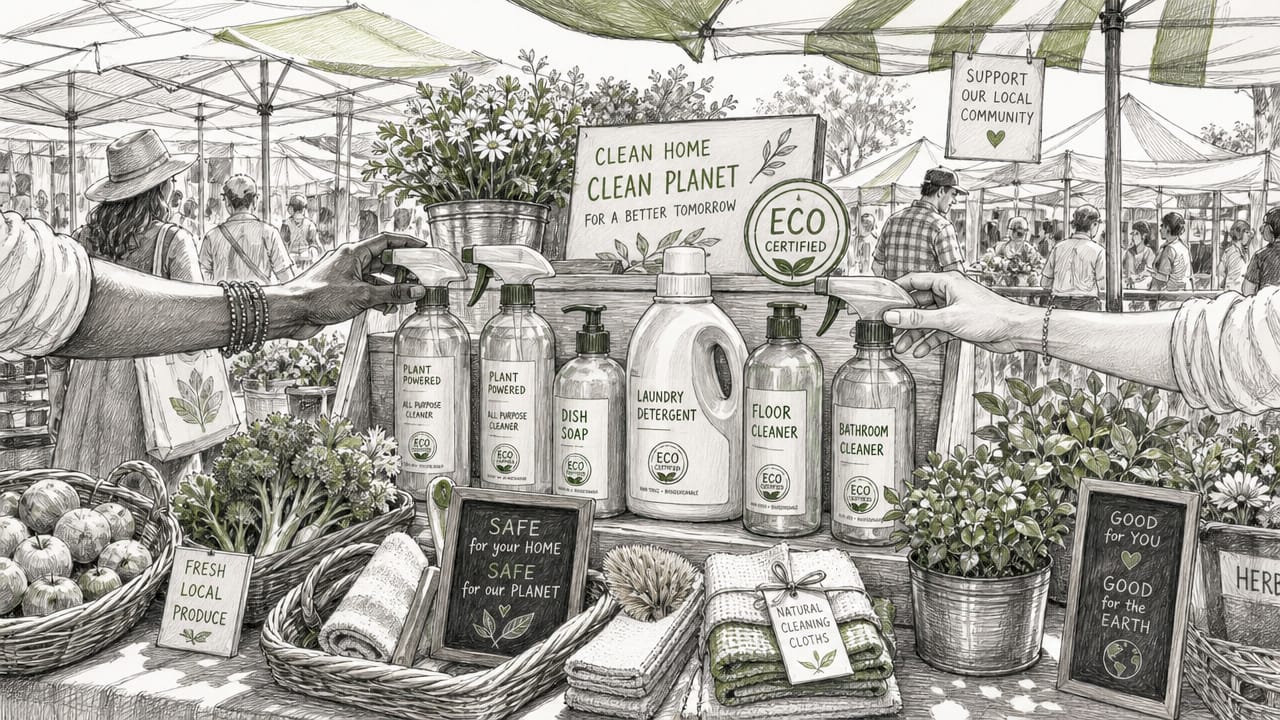
Green Seal is the most directly referenced label in LEED v5.0. It covers multiple product categories relevant to building operations.
| Product Category | Green Seal Standard | LEED Relevance |
|---|---|---|
| General cleaners | GS-37 | IEQ green cleaning credit |
| Floor care products | GS-40 | IEQ and Materials credits |
| Hand sanitizers | GS-52 | IEQ occupant health |
| Commercial cleaning services | GS-42 | Service provider certification |
| Trash bags and liners | GS-09 | Materials and Resources credit |
| Paints and coatings | GS-11 | IEQ low-emitting materials |
The practical requirement is straightforward: maintain an approved product list that aligns purchasing records with third-party certifications. Every product on the list should have a verifiable certification number. This is where greenwashing becomes a real risk. Products marketed as “natural” or “eco-friendly” without a recognized third-party certification do not count toward LEED thresholds. A building manager in Manhattan Beach or Redondo Beach who relies on unverified marketing claims will face a failed credit during review.
Pro Tip: Cross-reference your product list against the Green Seal certified products database quarterly. Certifications expire, and an expired label on a purchased product removes it from your qualifying 75% threshold.
For eco-friendly cleaning products that meet recognized certification standards, the selection process starts with the label, not the marketing copy on the bottle.
What cleaning protocols and staff practices are essential for LEED indoor environmental quality? {#protocols}
LEED IEQ credits are earned through consistent daily behavior, not through product selection alone. The EPA’s formal guidance on greener cleaning products states clearly that safer products must be paired with formal procedures and staff training to effectively reduce chemical exposure risks. This means the protocol matters as much as the product.
The following sequence describes the core operational practices required for LEED IEQ compliance:
- Chemical dilution and preparation. Every cleaning product must be diluted according to the manufacturer’s specification. Over-concentration does not improve cleaning performance. It increases chemical exposure and VOC emissions, which directly harms indoor air quality. Dilution instructions must be posted at preparation stations.
- Dwell time compliance. Disinfectants require a specific contact time to be effective. Staff must be trained to apply the product, wait the required dwell time, and then wipe or rinse. Skipping dwell time is the most common reason disinfection fails in LEED-monitored buildings.
- PPE use and storage. Gloves, eye protection, and appropriate footwear must be used during chemical handling. PPE requirements must be documented in the training program and enforced during inspections.
- HEPA vacuum and microfiber deployment. HEPA vacuums and microfiber cloths improve air quality by capturing fine particulates rather than redistributing them. Microfiber cloths must be laundered separately from other linens to prevent cross-contamination between uses.
- Color-coded tool enforcement. Restroom tools must never enter kitchen or office areas. This is a critical contamination control that directly impacts occupant health. Color-coding is the simplest and most auditable method to enforce this separation.
- Regular inspection and corrective action. Supervisors must conduct scheduled inspections and document findings. Any deviation from protocol must trigger a corrective action report. These reports demonstrate that the program self-corrects, which is exactly what LEED reviewers want to see.
Pro Tip: Post laminated protocol cards at every cleaning station. Staff turnover is a real operational challenge in Los Angeles buildings. Protocol cards reduce training time and keep new team members compliant from their first shift.
For guidance on safer chemical handling and product selection, the EPA’s framework provides a practical starting point that aligns directly with LEED requirements.
How does documented cleaning program management help maintain LEED certification? {#documentation}
Documentation is the mechanism through which a green cleaning program becomes a LEED-certified green cleaning program. LEED reviewers evaluate not just what products you use, but whether your program operates consistently over time. Occasional compliance does not earn credits. Documented, continuous compliance does.
The table below outlines the core documentation categories required for LEED audit readiness:
| Documentation Type | What to Include | Audit Purpose |
|---|---|---|
| Green Cleaning Policy | Approved products, procedures, training requirements | Establishes program framework |
| Approved Product List | Product name, SKU, certification label, cost, purchase date | Verifies 75% certified purchasing threshold |
| Training Records | Staff names, training dates, topics covered, trainer signature | Demonstrates staff competency |
| Inspection Logs | Date, area inspected, findings, inspector name | Shows ongoing program monitoring |
| Corrective Action Reports | Issue identified, action taken, resolution date | Proves program self-correction |
| Waste and Recycling Records | Waste diversion rates, recycling vendor records | Supports Materials and Resources credits |
Waste management integration is an often-overlooked dimension of LEED cleaning documentation. Cleaning operations generate packaging waste from product containers, used microfiber cloths, and PPE. Aligning waste disposal with LEED’s Materials and Resources credits requires tracking diversion rates and maintaining recycling vendor records. Buildings in Long Beach, El Segundo, and Carson that already participate in LA County recycling programs have a structural advantage here.
Running LEED-aligned cleaning as a controlled system with master product lists, dilution instructions, training rosters, and inspection logs is the single most reliable path to passing a LEED audit and maintaining recertification. Aligning your documentation tightly with Green Seal certification logic reduces the regulatory burden at every recertification cycle.
For building managers in Burbank, West Hollywood, or Westwood managing multi-tenant properties, a centralized digital documentation system is worth the setup cost. It makes audit preparation a matter of hours, not weeks.
Key takeaways {#key-takeaways}
Cleaning for LEED certification requires a documented green cleaning program with certified products, trained staff, contamination controls, and continuous recordkeeping to satisfy USGBC’s IEQ standards.
| Point | Details |
|---|---|
| Written policy is mandatory | A Green Cleaning Policy covering products, procedures, training, and records is a LEED prerequisite, not optional. |
| 75% certified product threshold | At least 75% of cleaning purchases must carry Green Seal, EPA Safer Choice, or UL ECOLOGO certification by cost. |
| Equipment standards matter | HEPA vacuums and microfiber cloths are required to protect indoor air quality and reduce chemical dependency. |
| Cross-contamination control is audited | Color-coded tools for restroom versus general areas are a specific, documented requirement reviewers check. |
| Documentation drives recertification | Training logs, inspection records, and corrective action reports are the evidence base for every LEED audit cycle. |
Why most LEED cleaning programs fail before the audit even starts {#perspective}
I have seen building managers in Los Angeles spend real money on certified products, post green cleaning signs in their janitor closets, and still fail LEED IEQ credits. The reason is almost always the same: they treated green cleaning as a procurement decision rather than an operational system.
Southern California buildings face specific challenges that national LEED guidance does not always address directly. High occupancy rates in dense neighborhoods like Koreatown, West Adams, and Mid-City LA mean cleaning frequency is higher, which accelerates product consumption and increases the risk of protocol shortcuts. The dry climate also means that VOC concentrations from cleaning products can accumulate faster in poorly ventilated spaces than in more humid regions. These are not hypothetical concerns. They are the kinds of operational realities that determine whether your program holds up under scrutiny.
What I have found actually works is treating the cleaning program the way you would treat any other building system. You would not run your HVAC without maintenance logs. Your green cleaning program deserves the same discipline. Staff engagement is the variable most people underestimate. When cleaning staff understand why color-coded tools matter and what dwell time actually does, compliance rates improve without additional supervision. Training is not a checkbox. It is the mechanism that makes everything else function.
The documentation piece is where I see the most anxiety, and also the most unnecessary complexity. A well-maintained spreadsheet with product SKUs, certification numbers, and purchase dates answers the majority of LEED reviewer questions. You do not need expensive software to start. You need consistency. For green cleaning guidance that translates into daily operational habits, the fundamentals are more accessible than most building managers realize.
— Lyndsey
How Themaidsociety supports LEED-aligned cleaning in Southern California
Themaidsociety provides professional cleaning services across Los Angeles, Beverly Hills, Santa Monica, Culver City, West Hollywood, Manhattan Beach, and surrounding communities, using green cleaning products and documented procedures that align with LEED IEQ standards. Every team member is trained on product handling, contamination prevention, and equipment protocols. For building managers and contractors who need professional cleaning services that support LEED certification maintenance, Themaidsociety delivers the consistency, product standards, and documentation support your program requires. Builders and contractors can also explore the deep cleaning process designed specifically for construction and post-construction LEED compliance needs.
Recommended articles
- Eco-Friendly Cleaning: Healthier Homes, Safer Families
- Essential Cleaning Hazards to Avoid for a Safer LA Home
- Green Cleaning: Real Benefits, Safety, and Guidance
- Eco-Friendly Cleaning in Construction: Why It Matters
FAQ {#faq}
What does cleaning for LEED certification require?
Cleaning for LEED certification requires a written Green Cleaning Policy, certified products covering at least 75% of purchases, HEPA vacuums, microfiber tools, color-coded contamination controls, staff training, and continuous documentation. The USGBC evaluates the entire operating program, not individual product choices.
Which product certifications count toward LEED green cleaning credits?
Green Seal, EPA Safer Choice, and UL ECOLOGO are the three primary certifications recognized by LEED. Green Seal is the most directly referenced in LEED v5.0 across categories including general cleaners, floor care, hand sanitizers, and commercial cleaning services.
How often does LEED require cleaning program documentation to be updated?
LEED requires ongoing documentation throughout the certification period, not just at the time of initial review. Training logs, inspection records, approved product lists, and corrective action reports must reflect continuous, current program operation to support recertification.
What is the most common reason buildings fail LEED green cleaning credits?
Facilities most often fail LEED green cleaning credits by treating the requirement as a product swap rather than a structured, documented program with ongoing training and monitoring. Missing records and inconsistent protocols are the primary audit failure points.
Does LEED cleaning apply to residential buildings in Los Angeles?
LEED for Existing Buildings applies to commercial and multi-family residential properties. Single-family homes do not fall under LEED Existing Buildings operations, but the green cleaning standards and certified products used in LEED programs are directly applicable to any property where occupant health and indoor air quality are priorities.
Looking to optimize your building operations further? ConvertLabs offers tools that help property managers and contractors track compliance workflows and operational performance.
Article authored by L.K. for Themaidsociety. Serving Los Angeles, Beverly Hills, Santa Monica, Culver City, West Hollywood, Manhattan Beach, Redondo Beach, Long Beach, Burbank, and all surrounding Southern California communities.
Recommended
- Detailed cleaning guide for builders: post-construction success
- Deep Cleaning Process for Builders: Ensure Project Perfection
- Why Professionals for New Build Cleaning Matter
- Eco-Friendly Cleaning in Construction: Why It Matters


Get Cleaning Tips & Exclusive Offers
Join our community for time-saving hacks and special discounts delivered to your inbox.