By L.K. | Themaidsociety
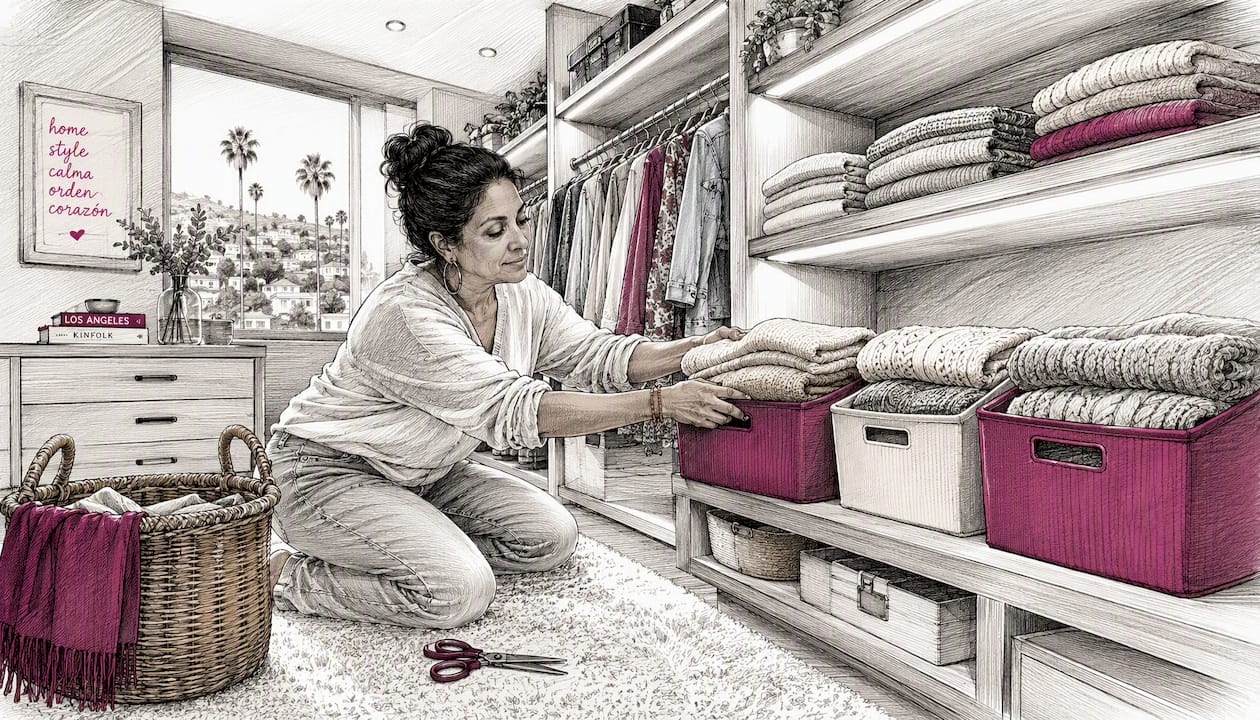
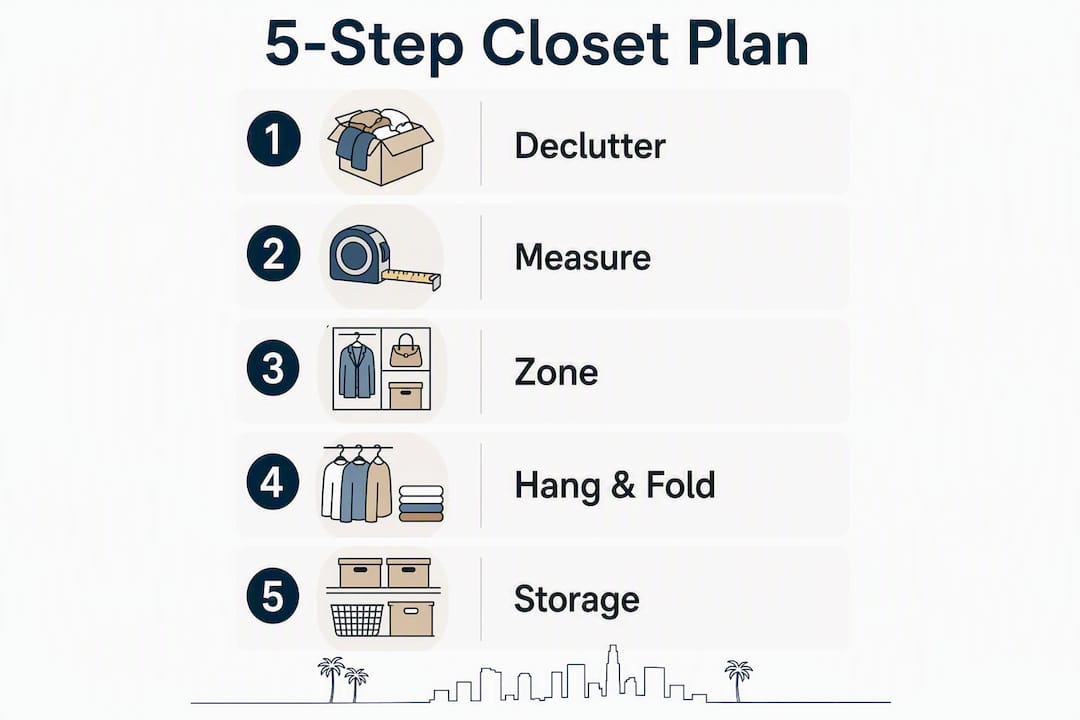
Organize your closet in one afternoon with five steps: declutter → measure and plan → sort and zone → hang and fold → choose storage, then maintain. A standard reach-in closet can be organized in an afternoon; a walk-in may require more time. The single rule that separates a system that lasts from one that collapses quickly: leave some rod and shelf capacity empty so laundry cycles and new purchases don’t immediately break the system. Research links household clutter to measurable increases in physiological stress, which means a cleaner closet is not just aesthetic — it genuinely changes how your mornings feel.
Start right now: grab a donation bag, open your closet, and pull out anything that doesn’t fit your body or your current life. That one action takes ten minutes and makes every step after it faster.
- Declutter first — edit before you buy a single bin
- Measure every dimension before ordering anything
- Sort by category, then frequency of use, then color
- Hang by type and length; fold heavy knits and sweaters
- Fill rods and shelves to 80% max, then set a maintenance habit
Pro Tip: Professional organizers at Systems by Susie start every session with a seasonality question: “What serves your life right now?” Ask yourself that before touching a single hanger.
Table of Contents
- Table of Contents and What You’ll Get from This Guide
- What supplies do you need before you start? {#supplies}
- Step 1 — How to declutter your closet honestly {#declutter}
- Step 2 — Why you must measure before buying anything {#measure}
- Step 3 — How to sort items and create zones that make sense {#zone}
- Step 4 — Hanging order and folding methods that save space {#hang}
- Step 5 — Which storage solutions actually deliver results? {#storage}
- How do you rotate seasonally and keep the closet from reverting? {#seasonal}
- Cost guidance: when is it cheaper to build, buy, or hire? {#cost}
- What are the most common closet organization mistakes? {#mistakes}
- Before-and-after checklist and a 1-hour mini project {#checklist}
- Key Takeaways {#takeaways}
- The part most guides skip: why the 80% rule is harder than it sounds {#perspective}
- Themaidsociety can handle the organizing and the cleanup after {#promo}
- Useful sources and recommended reading {#sources}
Table of Contents and What You’ll Get from This Guide
Quick navigation:
- Supplies to have on hand
- Step 1 — Declutter
- Step 2 — Measure and plan
- Step 3 — Sort and zone
- Step 4 — Hang and fold
- Step 5 — Storage solutions
- Seasonal rotation and maintenance
- Cost: build, buy, or hire
- Common mistakes to avoid
- Before-and-after checklist
- Key Takeaways
- Author’s perspective
- Themaidsociety organizing services
- Useful sources
Summary: This guide walks you through a five-step closet organization plan you can complete in one afternoon, with a maintenance routine that takes minutes per week. The payoff: less decision fatigue every morning, more visible items, and a system that doesn’t revert to chaos by month two. Los Angeles households with small reach-in closets will find the small-space tips especially useful. If you’d rather hand the whole project to a pro, Themaidsociety offers organizing and cleaning services across LA neighborhoods from Beverly Hills to Long Beach.
What supplies do you need before you start? {#supplies}
Buying organizers before you measure is the most common reason closet projects fail. Gather these first — spend nothing on bins or shelving yet.
- Donation bag (large, opaque — out of sight, out of mind)
- Trash bag for worn-out items
- Measuring tape (at least 25 feet)
- Notebook or phone to record dimensions and sketch a layout
- Matching slim velvet hangers — buy a set once you know your rod count
- Boxes or bins for off-season or off-site storage
- Label maker or marker and masking tape
- Basic tools: screwdriver, level, wall anchors for any bracket installs
Pro Tip: Don’t buy a single bin until you’ve measured. Experts consistently flag guess-purchasing as the primary cause of failed closet systems — wrong widths, wrong depths, wrong heights.
In Los Angeles, Target, The Container Store, and IKEA locations in Burbank, Culver City, and West LA carry matching slim hangers in bulk. If you’re renting in West Hollywood or Koreatown and can’t drill walls, focus on freestanding and over-door options — more on that in the storage section.
Step 1 — How to declutter your closet honestly {#declutter}
Edit before you buy storage. Every bin you add to a cluttered closet just hides the problem.
- Empty the space completely (or one section at a time for walk-ins). Lay everything on the bed. This forces a real look at what you own.
- Group by category — all tops together, all bottoms, all dresses, shoes, outerwear. Seeing ten black T-shirts in a pile is clarifying.
- Try-on or fit check for anything you’re unsure about. If it doesn’t fit today, it doesn’t earn a hanger today.
- Apply the last-worn rule — if you haven’t worn it in 12 months and it’s not a special-occasion piece, it goes.
- Sort into four buckets: keep, donate, sell, store off-site.
For off-season items — heavy coats in a Marina Del Rey apartment, ski gear in a Brentwood condo — top-shelf bins, under-bed storage bags, or a small off-site storage unit are all practical. The goal is to keep only what fits your current season in the main closet.
Professional organizers recommend starting with seasonality, not with hangers. Ask: “Does this serve my life right now?” That question cuts through the “but I might need it” hesitation faster than any rule.

Pro Tip: Try the reverse-hanger trick for ongoing maintenance: hang everything with the hook facing out. After six months, anything still facing out gets donated. Pair this with a hanger limit — a fixed number of hangers in the closet — so every new purchase forces a removal.
For LA residents, donation options include Goodwill locations throughout the city, Out of the Closet thrift stores (which support HIV/AIDS services), and consignment shops in Los Feliz and Silver Lake for higher-end pieces.
Step 2 — Why you must measure before buying anything {#measure}
Measuring is mandatory. Storage shopping comes after planning, not before.
Measure and record every one of these:
- Total rod length (in inches)
- Rod height from the floor (and second rod height if you’re adding a double-rod)
- Shelf width and depth for each shelf
- Ceiling height (critical for tall shelving units)
- Door swing arc — a door that opens inward eats floor space and blocks drawers
- Clear floor depth from the back wall to the door frame
- Any obstructions: light switches, molding, HVAC vents
Once you have rod length, convert it to hanger counts. A standard plastic or wood hanger takes about 2 inches of rod space; a slim velvet hanger takes about 1.25 inches. On a four-foot rod, that’s roughly 24 standard hangers versus 38 slim ones — a 50% capacity gain from one swap. Experts recommend planning your hanger set based on your rod’s 80% capacity — for a four-foot rod, that’s about 30 slim hangers or 19 standard ones.
Sketch a simple layout on paper or annotate a phone photo. Mark where double rods could go (short items like blazers and folded pants free up vertical space below), where a shelf unit fits, and where bins land. Then apply the 80% fill target: plan for 80% of rod and shelf capacity, not 100%. That slack is what keeps the system functional after laundry day.
Pro Tip: Measure bin width AND shelf depth before ordering online. A bin that’s a half-inch too wide or too deep is useless. Confirm door swing clearance before buying any pull-out drawer unit.
Step 3 — How to sort items and create zones that make sense {#zone}
The rule: group by category first, then by frequency of use, then by color if it helps you.
Practical zones for most households:
- Daily wear (work clothes, everyday tops and bottoms) — eye level, front of rod
- Weekend/casual — eye level, secondary position
- Workout gear — lower shelf or drawer, easy grab
- Off-season — top shelf in labeled bins
- Accessories (belts, scarves, bags) — hooks, small bins, or a dedicated shelf
- Shoes — floor level or a shoe rack; clear boxes make identification instant
Location logic matters more than most people realize. Eye level is prime real estate — put what you reach for every day there. Less-used items go lower or higher. Off-season pieces leave the main rod entirely.
For kids’ closets in family homes across Hawthorne, Gardena, or Carson, lower rods and labeled picture bins make the system self-maintaining. Kids can actually put things away when the zone is at their height and the label has a picture on it.

Quick labeling strategy: use a label maker or printed labels on every bin and basket. Vague labels (“misc”) fail within a week. Specific ones (“gym tops,” “winter scarves”) hold because they remove the decision about where something goes.
For more closet organization ideas that maximize your space, especially in smaller LA apartments, the layout principles above scale down well.
Step 4 — Hanging order and folding methods that save space {#hang}
Hang by category, then by sleeve length or garment length, then by color. Use slim matching hangers throughout — the capacity difference is real.
What to hang:
- Dress shirts, blouses, dresses, blazers, light jackets, pants (on appropriate hangers)
What to fold instead:
- Sweaters and heavy knits (hanging stretches them out)
- T-shirts (if drawer space exists)
- Delicate items prone to hanger marks
For pants, kid-sized hangers are a practical organizer trick — they avoid the bulk of multi-pant clamp hangers, let pants slide on and off easily, and keep a uniform look on the rod.
Folding for drawers: the KonMari-style vertical fold (fold into a rectangle, then stand it upright) lets you see every item in a drawer without digging. T-shirts, jeans, and workout shorts all work well this way. Socks rolled into pairs and stood upright take up less space than the classic “ball” method.
Before: a rod packed to 100% with mismatched hangers, sweaters stretched on wire, and three pairs of pants crammed onto one clamp hanger. Finding anything takes two minutes and leaves the rod a mess.
After: slim hangers, category order, 80% fill. Every item visible. Outfit selection drops to 30 seconds.
Pro Tip: Maintain the reverse-hanger trick after every laundry cycle. Anything that hasn’t been touched in six months goes into the donate bucket — no deliberation needed.
Step 5 — Which storage solutions actually deliver results? {#storage}
Buy storage after you measure and zone. Guess-purchasing is how you end up with a closet full of wrong-sized bins and a shelf unit that’s two inches too tall.
| Storage tier | Best for | Pros | Cons |
|---|---|---|---|
| Budget / ready-made | Renters, first-time organizers, small closets | Low cost, no installation, flexible | Fixed sizes, less durable, may not fit perfectly |
| Modular / adjustable | Most homeowners, medium closets | Customizable layout, good longevity | Moderate cost, some assembly |
| Custom / built-in | Long-term owners, complex walk-ins | Perfect fit, adds resale value | High cost, requires professional install |
Buy first:
- Matching slim velvet hangers (one set, sized to your rod count at 80% fill)
- Shelf dividers for folded stacks
- One set of labeled bins for off-season items
Defer:
- Custom built-ins (measure and live with the layout for 30 days first)
- Specialty pull-out units (confirm door swing and drawer depth before ordering)
For Los Angeles readers considering custom systems, One Day Doors & Closets in Los Angeles offers local consultations on semi-custom and custom closet builds.
Practical quick wins include baskets for small accessories, shelf dividers for folded stacks, wall hooks for bags and belts, and over-door organizers for shoes or jewelry. These cost under $50 total and make an immediate visual difference.
Pro Tip: Always confirm bin width against shelf depth before clicking “buy.” A bin that’s 14 inches deep on a 12-inch shelf sticks out and falls. Measure twice, order once.
How do you rotate seasonally and keep the closet from reverting? {#seasonal}
Rotate twice a year and run a 10–15 minute weekly scan. That’s the whole maintenance system.
Two-season rotation (works for most LA households):
- Spring/Summer swap (March/April): move heavy coats, wool sweaters, and cold-weather gear to top-shelf bins or under-bed bags; bring out lighter layers
- Fall/Winter swap (September/October): reverse the process
Four-season rotation makes sense for households with distinct wardrobes for each season or limited closet space in smaller apartments in Mid-City LA or West Adams.
Maintenance checklist:
- Weekly (5–10 min): quick scan for items out of zone; return anything that drifted; check that the donation bag is accessible
- Monthly (15 min): hanger harmony check — are mismatched hangers creeping back in? Any new items that don’t have a home?
- Twice yearly (1–3 hours): full edit with donation bag; seasonal swap; re-measure if you’ve added shelving
A 1-hour refresh (without a full reset): pick one zone, sort it, re-hang or refold, label any unlabeled bins, and place the donation bag by the door. That single zone improvement compounds over time.
Cost guidance: when is it cheaper to build, buy, or hire? {#cost}
Ready-made is almost always cheapest upfront. Building is cost-effective for skilled DIYers. Custom is best for long-term owners who want resale value and a perfect fit.
| Option | Ballpark cost range | Best decision trigger |
|---|---|---|
| Budget / ready-made | under $50 | Renting, short-term, small closet |
| Modular systems | — | Homeowner, medium closet, want flexibility |
| Custom / professional install | — | Long-term owner, complex walk-in, resale priority |
When to hire a professional installer: complicated remodels, electrical or plumbing nearby, major structural changes, or a walk-in that needs a full layout redesign.
When DIY or modular works: a standard reach-in closet, a rental where you can’t alter walls, or a budget under $500.
For Los Angeles clients who want a full organizing session plus a deep clean after the project, Themaidsociety handles both. That combination — organized space, then professionally cleaned — is especially useful after a move-in or move-out in neighborhoods like Santa Monica, Culver City, or Burbank.
What are the most common closet organization mistakes? {#mistakes}
- Buying storage before measuring. Fix: measure first, always. The bins you already own may not fit.
- Overfilling rods past 100%. Fix: apply the 80% rule immediately; remove items until you can slide hangers freely.
- Mismatched hangers. Fix: replace all hangers with one matching slim set. Visual uniformity makes the whole closet feel larger.
- No exit path for outgoing items. Fix: keep a donation bag in or near the closet at all times so items leave the same day you decide to remove them.
- Keeping clothes that don’t fit your current life. Fix: ask the seasonality question every time you hesitate — “Does this serve me right now?”
Pro Tip: Use hard limits as passive maintenance. Cap your hanger count at your 80% rod fill number. When there are no empty hangers, a new purchase means an old item leaves. No willpower required.
Before-and-after checklist and a 1-hour mini project {#checklist}
Before checklist
- [ ] Empty the target zone (or full closet)
- [ ] Sort everything into keep / donate / sell / store off-site
- [ ] Measure rod length, shelf width/depth, ceiling height, door swing
- [ ] Confirm 80% fill target for rod and shelves (about 80% of your maximum hanger or shelf count, such as 30 slim hangers or 19 standard hangers on a four-foot rod)
- [ ] Gather supplies (hangers, bins, labels, tools)
One-hour mini project (one zone at a time)
- Minutes 0–10: Sort the zone — keep pile, donate bag, trash
- Minutes 10–30: Hang or fold the keep pile; apply category and color order
- Minutes 30–50: Put items back; label any bins; confirm 80% fill
- Minutes 50–60: Tidy the floor; place donation bag by the door for pickup
After checklist
- [ ] Rod is at 80% fill (about 30 slim hangers or 19 standard hangers on a four-foot rod) — hangers slide freely
- [ ] All hangers match
- [ ] Bins are labeled with specific names (not “misc”)
- [ ] Donation bag is placed for pickup
- [ ] Off-season items are in labeled top-shelf bins or under-bed storage
- [ ] One maintenance habit is set (weekly scan, hanger limit, or reverse-hanger trick)
For a full home organization checklist covering every room, Themaidsociety has a stress-free guide built for LA families.
Key Takeaways {#takeaways}
A closet that stays organized long-term requires three things done in order: honest decluttering, accurate measuring, and a maintenance habit with a hard limit built in.
| Point | Details |
|---|---|
| Declutter before buying anything | Edit the wardrobe first; storage purchased before decluttering almost always fails. |
| Measure every dimension | Rod length, shelf depth, door swing, and ceiling height all determine what fits. |
| Apply the 80% rule | Fill rods and shelves to 80% max so the system absorbs laundry cycles without collapsing. |
| Slim hangers gain 50% rod capacity | Switching from standard to slim velvet hangers fits roughly 38 items where 24 fit before. |
| Themaidsociety handles the full reset | For LA households who want organizing plus a deep clean, Themaidsociety serves neighborhoods from Beverly Hills to Long Beach. |
The part most guides skip: why the 80% rule is harder than it sounds {#perspective}
Every closet guide tells you to declutter. Fewer tell you that the 80% rule is where most people quietly fail — not because they don’t understand it, but because they fill the slack back up within 60 days.
The real problem isn’t the closet. It’s the absence of a physical constraint. When there’s space, things fill it. That’s not a character flaw; it’s just how storage works. The hanger limit is the only passive fix I’ve seen hold up over time: cap the number of hangers, and the closet self-regulates. No willpower, no quarterly purges, no guilt.
For LA apartments specifically — the reach-in closets in West Hollywood studios, the shared closets in Koreatown two-bedrooms — the 80% rule feels almost cruel when you start. You’re already space-constrained. But the constraint is exactly what makes the system work. A packed rod hides items, causes wrinkles, and slows your morning. A rod at 80% is faster to use than a rod at 60% because you can actually see what’s there.
Research on home clutter and wellbeing consistently shows that the psychological payoff of an organized space is real and measurable. The closet is a good place to start because the feedback is immediate: you feel it the next morning when you get dressed.
One more thing: if you’re renting and can’t drill walls, don’t let that stop you. Over-door organizers, freestanding shelf units, and under-bed storage solve most small-space problems without a single screw. For more ideas on organizing small spaces in LA apartments, the options are better than most renters realize.
Themaidsociety can handle the organizing and the cleanup after {#promo}
A full closet reset leaves a mess: empty hangers on the floor, dust on shelves that haven’t been touched in years, donation bags to haul out. Themaidsociety handles exactly that for busy households across Los Angeles.
The organizing and cleaning services cover the neighborhoods where LA residents actually live: Beverly Hills, Santa Monica, Pacific Palisades, Venice, Marina Del Rey, Brentwood, West LA, Culver City, West Hollywood, Hollywood, Koreatown, Los Feliz, Hawthorne, Manhattan Beach, Redondo Beach, Long Beach, El Segundo, Gardena, Westchester, Baldwin Hills, Carson, Burbank, and more.
Services include organizing sessions, deep cleaning after a closet or room overhaul, and move-in/move-out cleaning for clients who are reorganizing during a transition. The team is fully vetted, trained, and shows up on time — which matters when you’ve already spent your Saturday decluttering and just want the space clean before Monday.
If you’re managing a property in Inglewood or Westchester and need turnover cleaning after a tenant move-out, that’s covered too. Request an estimate or book directly at themaidsociety.com/services.
For scheduling and booking tools, ConvertLabs is worth a look if you’re managing multiple properties or recurring service appointments.
Useful sources and recommended reading {#sources}
Recommended articles from Themaidsociety
- Closet organization ideas that maximize your space
- Bedroom organization tips that maximize space and comfort
- Guide to decluttering homes: room-by-room for families
- Organizing small spaces ideas that actually work
- Organizing tips for rentals: maximize your space
- Examples of organizing strategies for home and renters
- Home organization checklist: stress-free steps for LA families
Partner resource
- Los Angeles home organization systems — One Day Doors & Closets
Schema note for developers: implement JSON-LD Article schema (type: Article, author: L.K., publisher: Themaidsociety) on this page. Include HowTo schema for the five-step plan. Add an LLM.txt entry per site policy to declare this content as human-authored editorial.
Author: L.K. | Published by Themaidsociety | Los Angeles, CA
Recommended
- Closet Organization Ideas That Maximize Your Space
- Home organization checklist: Stress-free steps for LA families
- Decluttering tips for families: a guide for busy LA homes



Get Cleaning Tips & Exclusive Offers
Join our community for time-saving hacks and special discounts delivered to your inbox.