
TL;DR:
- Decluttering before organizing is essential for maintaining a tidy bedroom and preventing overwhelm.
- Using timed methods like 1-3-5 or 10-10-10 helps build sustainable habits and control clutter accumulation.
{
  "@context": "https://schema.org",
  "@type": "Article",
  "headline": "Your Complete Bedroom Organizing Tips Guide for 2026",
  "description": "A practical, step-by-step bedroom organizing tips guide covering decluttering methods, closet organization ideas, storage solutions, and maintenance habits for a tidy, functional bedroom.",
  "author": {
    "@type": "Person",
    "name": "L.K."
  },
  "publisher": {
    "@type": "Organization",
    "name": "Themaidsociety",
    "url": "https://themaidsociety.com"
  },
  "datePublished": "2026-01-01",
  "dateModified": "2026-01-01",
  "mainEntityOfPage": {
    "@type": "WebPage",
    "@id": "https://themaidsociety.com/bedroom-organizing-tips-guide"
  },
  "keywords": "bedroom organizing tips guide, bedroom organization step by step, closet organization ideas, bedroom storage solutions, how to declutter bedroom"
}
Author: L.K. | Published: January 2026 | Reading time: ~10 min
Table of Contents
- The core principles of bedroom organization
- How to declutter your bedroom step by step
- How to create dedicated homes for your belongings
- How to maximize closet space and organize clothing
- How to maintain a clutter-free bedroom long term
- How should you organize your nightstand and drawers?
- General maintenance habits that actually stick
- How to organize bedroom linens and bedding
- How does lighting affect an organized bedroom?
- How to create functional zones in your bedroom
- Key takeaways
- A note on what really matters
- Professional organizing and cleaning in Southern California
- Recommended articles
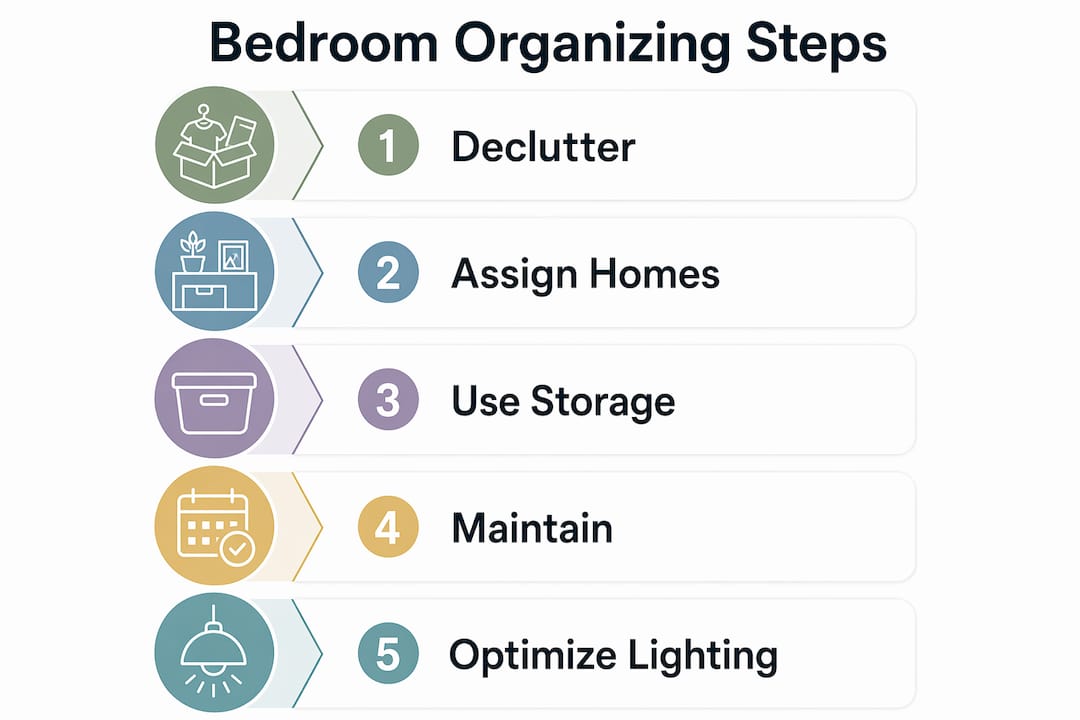
A tidy bedroom is not a luxury. It is the single most effective thing you can do for your sleep, your mood, and your morning routine. The core of any bedroom organizing tips guide comes down to three moves: declutter first, give every item a permanent home, and use storage that fits your actual life. 36% of homeowners say a messy bedroom negatively affects their mood and wellbeing, and 55% admit to keeping clothes piled on the floor. The fix is not buying more bins. It is a sequence.
Here is what that sequence looks like in practice:
- Declutter before you organize. Sorting items into keep, donate, and discard categories first prevents you from organizing things you do not need.
- Assign every item a home. Anything without a designated spot will end up on the floor or a chair.
- Match storage to quantity. Buy organizers after purging, not before, so you buy the right size.
- Work in short bursts. Timed sessions of 10–15 minutes prevent burnout and build momentum.
- Maintain with daily micro-habits. A two-minute reset each night keeps the system alive.
How to declutter your bedroom step by step {#declutter-step-by-step}
Decluttering, organizing, and cleaning are three separate tasks. The most common mistake is trying to do all three at once. Professional organizer Tracy McCubbin puts it plainly: purge first, then arrange, then clean. Mixing the stages is exactly where most people stall out.
The 10-10-10 method for quick wins
The 10-10-10 decluttering method gives you a low-pressure entry point: pick 10 areas, remove 10 items from each, spend only 10 minutes per session. You are not trying to finish the whole room. You are building the habit of making decisions quickly. Set a timer, grab a trash bag and a donation box, and go.
A second variation works well for sorting: identify 10 items to throw away, 10 to donate, and 10 to keep. Three labeled boxes on the floor, thirty decisions made, done. Repeat the next day.
The 1-3-5 method for sustained momentum
For a full bedroom overhaul, the 1-3-5 decluttering method structures your day without overwhelming you. Each day you tackle one large task (clearing the entire closet floor), three medium tasks (sorting shoes, going through the dresser top, pulling out under-bed items), and five small tasks (tossing empty water bottles, returning books to shelves, clearing the nightstand). The structure prevents the paralysis that comes from staring at a whole room and not knowing where to start.
Pro Tip: Do not touch sentimental items while deciding whether to keep them. Research from DePaul University psychologist Joseph Ferrari shows that physically handling an object increases your emotional attachment to it, the same mechanism retailers use to get shoppers to buy. Assess visually first.
Sorting categories that work
Keep your sorting simple: keep, donate, discard, and relocate. “Relocate” is the category most guides skip. Plenty of bedroom clutter does not belong in the trash or a donation box. It belongs in another room. A dedicated relocate pile stops you from making a dozen trips mid-session and losing your momentum.
How to create dedicated homes for your belongings {#dedicated-homes}
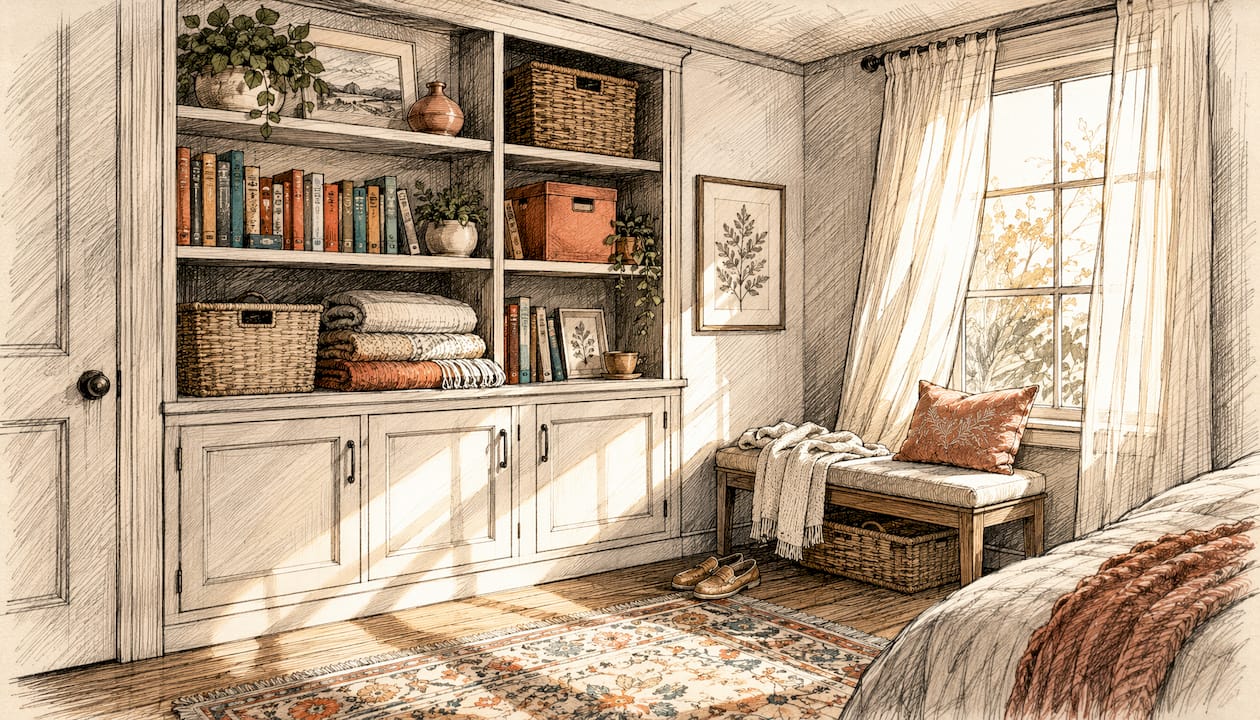
Every item that does not have a permanent home will migrate to the nearest flat surface. That is not a character flaw. It is physics. The solution is assigning specific containers and locations before clutter has a chance to accumulate.
Storage tools worth using
74% of Americans use storage bins, 54% use shelving units, and 49% use hooks or hanging systems. These are the workhorses of bedroom organization for good reason.
| Storage Tool | Best Use in the Bedroom | Notes |
|---|---|---|
| Open baskets | Blankets, pillows, laundry | Easy grab-and-go access |
| Drawer dividers | Socks, underwear, accessories | Prevents drawer chaos |
| Wall hooks | Bags, robes, tomorrow’s outfit | Keeps floors clear |
| Shelf risers | Closet shelves, dresser tops | Doubles vertical space |
| Under-bed bins | Off-season clothing, extra linens | Use flat, lidded bins |
| Jewelry trays | Rings, earrings, watches | Keeps small items visible |
Organizing personal items and accessories
Jewelry and watches need a dedicated tray or wall-mounted organizer, not a bowl on the dresser. A bowl becomes a pile within a week. A tray with defined compartments forces you to put each piece back in its spot. For electronics and chargers, a small cable organizer box on the nightstand or inside a drawer keeps cords from tangling and surfaces from looking chaotic.
Pro Tip: Buy storage containers only after you have finished purging. Measure the actual space and count the items you are keeping before you shop. Buying bins first is the fastest way to end up with the wrong size and more clutter.
Wellness-focused home design, including how calm bedroom spaces reduce stress through intentional storage choices, reinforces the same principle: the container should serve the habit, not the other way around.
How to maximize closet space and organize clothing {#maximize-closet}
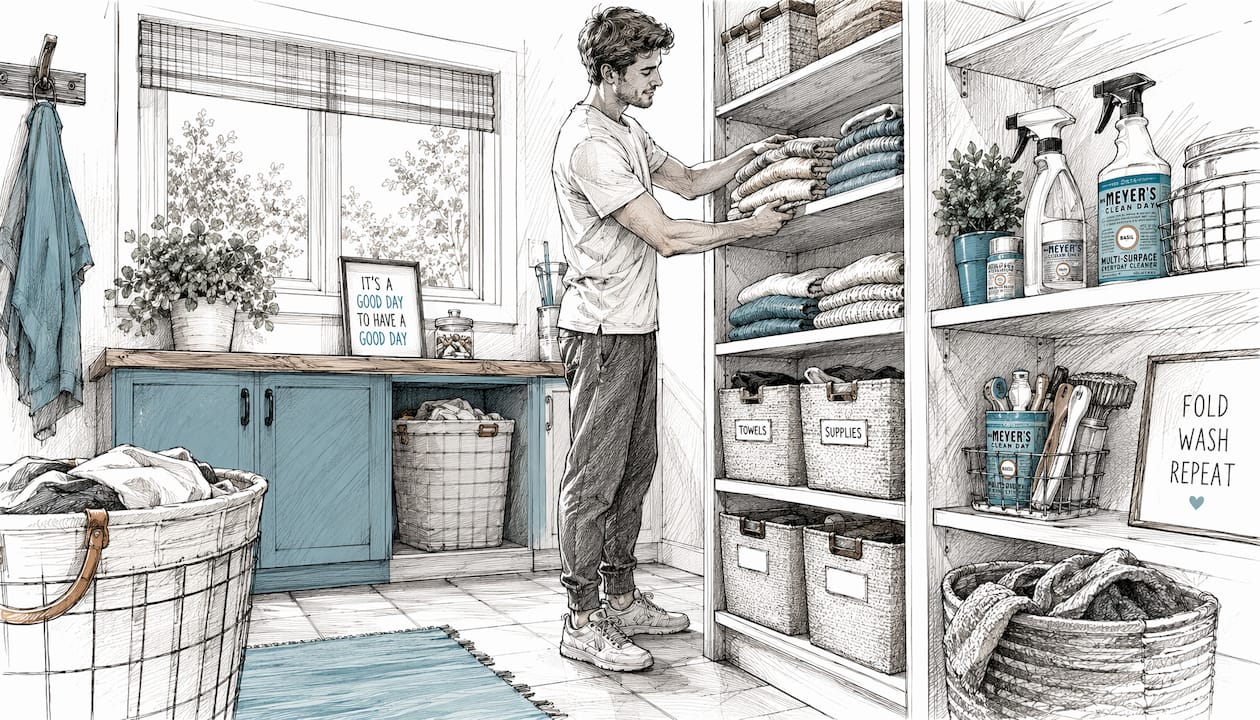
83% of tradespeople say homeowners underestimate how much closet storage they actually need. The gap is not always about square footage. It is about how the space is configured.
Clothing organization by category and frequency
Arrange clothes by category first (shirts, pants, dresses, jackets), then by frequency of use within each category. Items you wear weekly go at eye level and arm’s reach. Items you wear monthly go higher or lower. Off-season clothing goes into flat under-bed bins or vacuum-seal bags stored on the highest shelf.
- Hang clothes you wear most often at the front of the rod.
- Fold and stack bulky sweaters on shelves rather than hanging them (hanging stretches the shoulders).
- Use slim velvet hangers instead of plastic ones to reclaim up to 30% more rod space.
- Store shoes in clear boxes or an over-the-door organizer so you can see them without digging.
Closet accessories that make a real difference
61% of tradespeople prefer custom built wardrobes and 38% include specific wardrobe accessories to optimize space. You do not need a full renovation to get similar results. A double hang rod (one rod mounted below another) instantly doubles hanging space for shirts and jackets. A pull-out shoe rack on the floor uses dead space that most closets waste.
| Closet Upgrade | Approximate Benefit | Cost Level |
|---|---|---|
| Double hang rod | Doubles shirt/jacket capacity | Low |
| Shelf dividers | Keeps folded stacks upright | Low |
| Pull-out shoe rack | Uses floor dead space | Low-Medium |
| Over-door organizer | Adds pockets for small items | Low |
| Modular shelving system | Custom fit for any closet | Medium-High |
Pro Tip: Turn all your hangers backward at the start of the month. After you wear something and hang it back up, face the hanger forward. After 60 days, anything still backward is a candidate for donation.
For more bedroom storage strategies tailored to Southern California homes, Themaidsociety has a dedicated guide covering space-specific solutions.
How to maintain a clutter-free bedroom long term {#maintain-clutter-free}
A tidy bedroom does not stay tidy by accident. Disorganization is linked to elevated cortisol levels, the stress hormone that impairs memory and impulse control. The bedroom is where your nervous system is supposed to downshift. Clutter actively works against that.
The research on home beauty and mental well-being shows that the psychological benefits of an organized space are partly driven by how visually pleasing the environment feels, not just how tidy it is. That means the aesthetic choices you make (a consistent color palette, clear surfaces, a few intentional decorative objects) carry real weight for how you feel in the room.
Frictionless systems and drop zones
The best organization system is the one that requires the least effort to maintain. Organizational systems that require multiple steps to store frequently used items have low adoption. Open containers and drop zones for daily essentials (a hook by the door for tomorrow’s outfit, a tray on the dresser for your phone and keys) keep the system alive without demanding discipline.
Pro Tip: Enlist a friend or professional for your initial big declutter session. Research published in National Geographic cites body doubling as one of the most effective ways to overcome procrastination and stay focused during a long organizing session.
46% of Americans organize only when things get out of hand. The goal is to shift from reactive to proactive: a two-minute reset each night (clothes hung or in the hamper, surfaces cleared, items returned to their homes) prevents the pile-up that makes the next session feel like a project.
How should you organize your nightstand and drawers? {#nightstand-drawers}
Your nightstand is prime real estate. It should hold only what you actually use before sleep and when you wake up: a book, your phone charger, a glass of water, maybe a small lamp. Everything else is a distraction that makes the surface feel chaotic.
Clear the nightstand completely, then put back only the items you use every single night. For the drawer, use a small tray or a set of drawer dividers to separate categories: lip balm in one section, earplugs in another, a notepad in a third. Without dividers, the drawer becomes a junk drawer within two weeks.
For bedroom drawers in general, the same rule applies: one category per zone. Socks in one section, underwear in another, workout gear in a third. Drawer dividers from any home goods store (IKEA’s SKUBB series, for example, or the Container Store’s drawer organizers) make this easy to maintain. The key is that every item has a visual boundary so you can see at a glance when something is out of place.
General maintenance habits that actually stick {#maintenance-habits}
Maintenance fails when the system is too complicated. The habits that work are almost embarrassingly simple.
Daily (2 minutes): Make the bed, put clothes in the hamper or back in the closet, clear the nightstand surface. That is it. A made bed makes the entire room look more organized, even if nothing else has changed.
Weekly (10–15 minutes): Return any items that have migrated to the wrong room, wipe down surfaces, do a quick closet check to rehang anything that has slipped. Pair this with your regular cleaning routine so it does not feel like a separate chore.
Monthly (30 minutes): Do a light pass through drawers and the closet. Pull out anything you have not touched, and decide whether it earns its space. This is also the time to check under the bed and make sure storage bins are still organized and not just hiding clutter.
The cleaning vs. organizing distinction matters here. Cleaning removes dirt. Organizing creates systems. Doing both at once is how people burn out. Keep them separate on your calendar.
How to organize bedroom linens and bedding {#linens-bedding}
Most people have more bedding than they need. A practical rule: keep two sets of sheets per bed (one on, one in the wash) and one spare set for guests. Extra blankets and duvet inserts that you use seasonally belong in a vacuum-seal bag under the bed or on the top closet shelf, not piled on a chair.
For the linen closet or the shelf where you store folded sheets, the “pillowcase pocket” method keeps sets together without hunting for matching pieces. Fold the fitted sheet, flat sheet, and one pillowcase, then tuck the whole bundle inside the second pillowcase. Pull out one bundle and you have a complete set.
Label your shelves if you share the space with a partner or family members. A simple label maker or even a piece of tape with a handwritten note removes the guesswork and keeps everyone using the system correctly.
How does lighting affect an organized bedroom? {#lighting}
Lighting does more organizational work than most people realize. A well-lit closet means you can actually see what you own, which prevents buying duplicates and makes getting dressed faster. A simple battery-powered LED strip inside a dark closet costs under $20 and solves the problem immediately.
In the bedroom itself, layered lighting (an overhead fixture for general light, a bedside lamp for reading, and a dimmer for winding down) supports the different functions the room serves. Bright overhead light at 9 PM signals your brain to stay alert. A warm 2700K bulb on a dimmer does the opposite.
For small bedrooms in Los Angeles apartments, where natural light may be limited, mirrors placed opposite windows amplify daylight and make the space feel larger and less cluttered. A visually open room feels easier to keep tidy because you notice disorder faster.
How to create functional zones in your bedroom {#bedroom-zones}
The bedroom in most Southern California homes does more than one job. In a Beverly Hills condo or a West Adams bungalow, the same room might serve as a sleep space, a dressing area, and a work-from-home setup. Zones make that work without the room feeling chaotic.
Sleep zone: The bed and nightstand area. Keep this free of work materials, exercise equipment, and anything that signals activity rather than rest. No laptops on the bed.
Dressing zone: The closet and dresser area. A small mirror, a hook for tomorrow’s outfit, and a tray for accessories complete this zone. If space allows, a small bench or ottoman at the foot of the bed doubles as a dressing seat and a place to set tomorrow’s bag.
Work zone: If you must work from the bedroom (common in studios and one-bedrooms across Culver City, Koreatown, and West Hollywood), a dedicated desk with a chair creates a visual and physical boundary. When the workday ends, close the laptop and turn the chair toward the wall. The visual cue matters more than you might expect.
Keeping zones distinct is the organizing principle behind the home organization checklist Themaidsociety uses with LA families. When each activity has its own corner, the room stays organized because items naturally return to their zone.
Key takeaways {#key-takeaways}
A tidy bedroom requires a clear sequence: declutter first, assign every item a permanent home, and maintain the system with daily two-minute resets and monthly reviews.
| Point | Details |
|---|---|
| Declutter before organizing | Purge items first, then arrange what remains. Mixing stages causes stalls. |
| Use the 1-3-5 or 10-10-10 method | Structured timed sessions prevent burnout and build consistent momentum. |
| Buy storage after purging | Measure actual space and quantities before purchasing any bins or organizers. |
| Closets need accessories, not just space | Pull-out racks, slim hangers, and shelf dividers recover capacity without renovation. |
| Themaidsociety supports the process | For Southern California homes, Themaidsociety’s organizing services handle the heavy lifting when the project feels too large to tackle alone. |
A note on what really matters {#perspective}
The conventional advice on bedroom organization focuses almost entirely on products: the right bins, the right hangers, the right label maker. That framing misses the actual problem. Most bedrooms are not disorganized because of a storage deficit. They are disorganized because the system asks too much of the person using it.
The research backs this up. Disorganization raises cortisol, and a visually cluttered space actively undermines the restorative sleep a bedroom is supposed to provide. But the fix is not a Pinterest-perfect closet. It is a system with so little friction that you actually use it every day without thinking about it.
The people who maintain tidy bedrooms long-term are not more disciplined. They have fewer decisions to make. The hook is right by the door. The hamper is open-top and right where they undress. The nightstand has exactly three things on it. Every item has one home, and returning it there takes two seconds.
What I find most overlooked in the standard bedroom organizing tips guide is the zone concept. Bedrooms in Los Angeles, particularly in smaller apartments across Silver Lake, Mid-City, and Westwood, are being asked to function as offices, gyms, and closets simultaneously. Without intentional zones, the room never fully becomes a place for rest. You cannot sleep well in a room that looks like a workspace. The physical boundary between your desk and your bed is not decorative. It is neurological.
Start with the sequence. Declutter, assign, maintain. The products come last, and honestly, most of them cost less than $30.
Professional cleaning and organizing help in Southern California {#promo}
A bedroom overhaul is straightforward in theory. In practice, for busy professionals in Manhattan Beach, families in Burbank, or renters in Venice juggling work and life, the hardest part is finding the time and the energy to start. That is where Themaidsociety comes in.
Themaidsociety serves Los Angeles and surrounding communities including Santa Monica, Beverly Hills, Culver City, West Hollywood, Long Beach, Redondo Beach, El Segundo, and Hawthorne, offering residential cleaning and organizing services handled by a fully vetted, trained team. Whether you need a one-time deep clean to reset a disorganized bedroom or ongoing maintenance to keep the system running, the team brings the same detail-oriented approach every visit.
You do not have to do the heavy lifting alone. Explore Themaidsociety’s organizing services for Southern California homes and book the help your bedroom actually needs.
Looking to track and manage your home service bookings more efficiently? ConvertLabs offers tools that help homeowners and service providers stay organized from booking to follow-up.
Summary: Top bedroom organizing tips at a glance {#summary}
- Declutter before you organize. Purging first prevents organizing things you do not need.
- Use the 1-3-5 or 10-10-10 method to work in manageable, timed sessions.
- Assign every item a permanent home. No home means it ends up on the floor.
- Buy storage containers after purging, not before, so you get the right size.
- Use drawer dividers, wall hooks, and under-bed bins to maximize every inch.
- Arrange closet clothing by category and frequency of use, with off-season items stored under the bed.
- Keep the nightstand to essentials only: what you use every single night.
- Create a daily two-minute reset habit: bed made, clothes hung, surfaces cleared.
- Separate your bedroom into sleep, dressing, and work zones to protect sleep quality.
- Layer lighting with a dimmer and warm-toned bulbs to support the room’s primary purpose.
Recommended articles {#recommended-articles}
- Bedroom Organization Tips That Maximize Space and Comfort
- Cleaning vs. Organizing: What’s the Real Difference?
- Guide to Decluttering Homes: Room-by-Room for Families
- Home Organization Checklist: Stress-Free Steps for LA Families
- The Role of Organization in Homes: A Practical Guide
Recommended
- Bedroom Organization Tips That Maximize Space and Comfort
- Closet Organization Ideas That Maximize Your Space
- Spring Cleaning Explained: Your 2026 Home Reset Guide
- Organizing Tips for Rentals: Maximize Your Space



Get Cleaning Tips & Exclusive Offers
Join our community for time-saving hacks and special discounts delivered to your inbox.