
TL;DR:
- Cleaning improves mental health by reducing clutter, lowering stress hormones, and calming the nervous system.
- Maintaining a clean home decreases allergens and pathogens, supporting physical health for families.
Authored by L.K. | Themaidsociety | Los Angeles, CA
Table of Contents
- How cleaning affects wellness: the core connection
- What are the physical health benefits of a clean home?
- How can mindful cleaning improve your wellness?
- What are effective cleaning strategies for Southern California families?
- Key Takeaways
- Perspective
- Cleaning services that support your wellness in LA
- FAQ
A clean home is defined as one of the most accessible tools for protecting both mental and physical health. Cleaning reduces stress, limits allergens, and creates the environmental order that supports daily coping. The Anxiety and Depression Association of America confirms that physical activity involved in cleaning reduces anxiety, fatigue, and improves concentration. For busy families across Los Angeles, Beverly Hills, Santa Monica, and the broader Southern California region, understanding how cleaning affects wellness is the first step toward building a home that genuinely supports your health.
How does cleaning affect mental health and cognitive function? {#mental-health}
Clutter directly competes for your brain’s attention. Research shows that visual attention and cognitive task performance improve significantly in low-clutter environments. That means a messy kitchen counter is not just an eyesore. It is actively reducing your ability to focus on the task in front of you.

The physiological effects go deeper than distraction. Women who describe their homes as cluttered show dysregulated cortisol patterns compared to those with organized spaces. Cortisol is your primary stress hormone. When its daily rhythm is disrupted by chronic environmental stress, long-term health risks follow.
Cleaning also works as a direct nervous system regulator. Clinical psychologist Dr. Holly Schiff confirms that cleaning’s structured, predictable nature helps calm the nervous system and delivers satisfying visible results. That combination of control and reward is rare in abstract work tasks. It is why scrubbing a bathroom can feel more restorative than finishing a spreadsheet.
The mental health benefits of cleaning at a glance
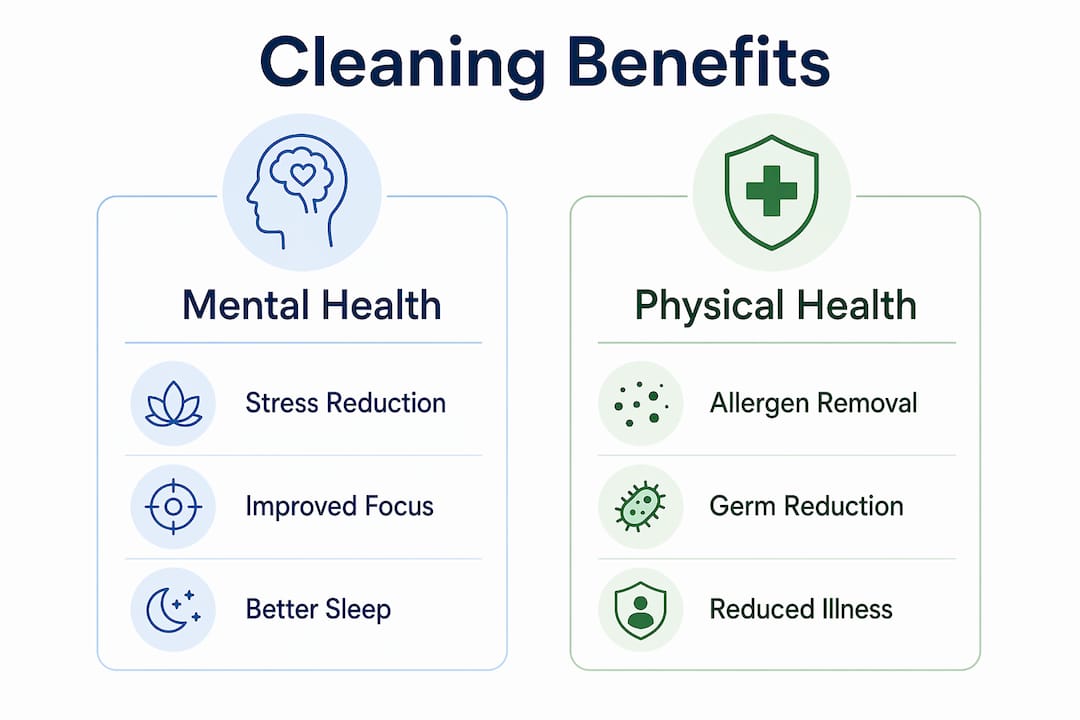
- Reduced anxiety: The physical movement in cleaning lowers anxiety and fatigue, according to the Anxiety and Depression Association of America.
- Better focus: Decluttered spaces free up cognitive bandwidth for the tasks that matter most.
- Emotional regulation: Completing a cleaning task gives a measurable sense of accomplishment that lifts mood.
- Nervous system calm: Repetitive, structured cleaning motions activate the parasympathetic nervous system, reducing the fight-or-flight response.
Pro Tip: If you feel mentally scattered, clean one surface before starting your workday. The act of restoring order to a small space primes your brain for focused work.
What are the physical health benefits of maintaining a clean home? {#physical-health}
A clean home directly reduces your family’s exposure to allergens, bacteria, and viruses. Dust mites, pet dander, and mold spores accumulate quickly in Southern California homes, especially in coastal areas like Venice, Marina Del Rey, and Pacific Palisades where humidity fluctuates. Regular cleaning prevents these particles from building up to levels that trigger respiratory reactions and allergic responses.
The benefits of a clean home extend well beyond comfort. Bacterial and viral transmission drops significantly when high-touch surfaces, such as door handles, countertops, and bathroom fixtures, are cleaned consistently. Families with young children or elderly members are especially vulnerable to pathogens that survive on surfaces for hours or days. Routine cleaning is a direct line of defense.
Statistic Callout: Regular professional cleaning helps busy families maintain healthier home environments that support overall wellness. For households in Los Angeles managing demanding schedules, professional deep cleaning fills the gaps that daily tidying cannot reach.
Key physical health protections from regular cleaning
- Allergen control: Vacuuming, dusting, and washing bedding removes dust mites and pet dander that cause sneezing, congestion, and asthma flares.
- Pathogen reduction: Disinfecting kitchen and bathroom surfaces cuts bacterial and viral load in the spaces your family uses most.
- Air quality improvement: Removing surface dust reduces airborne particles, which is especially relevant in LA neighborhoods near high-traffic corridors like Wilshire Boulevard or the 405 freeway.
- Mold prevention: Cleaning bathrooms and kitchens regularly prevents mold growth that can cause chronic respiratory symptoms.
Families in Culver City, West Hollywood, and Koreatown living in older apartment buildings face particular risks from accumulated dust and mold in poorly ventilated spaces. Consistent cleaning habits and wellbeing are directly linked in these environments.
How can mindful cleaning improve your wellness? {#mindful-cleaning}
Mindful cleaning is the practice of focusing fully on the sensory experience of cleaning rather than treating it as a task to rush through. A study published in the journal Mindfulness found that mindful dishwashing reduces nervousness by 27% and boosts mental inspiration by 25%. That is a measurable psychological shift from a task most people consider mundane.
The key is attention. When you focus on the warmth of the water, the scent of the soap, and the motion of your hands, you activate the same neural pathways targeted by formal meditation. The cleaning becomes a grounding exercise. This grounding effect is unique to physical, tangible tasks and is not replicated by abstract mental work.
Zen philosophy frames this practice as “Habitat Care,” a biological drive to maintain equilibrium for peace and mental clarity. Zen monks treat cleaning as nurturing the expanded self, meaning the space around you is an extension of your mental state. When you clean it with intention, you are caring for your own mind.
How to practice mindful cleaning in four steps
- Choose one task. Do not plan the whole house. Pick a single surface, room, or object. Narrowing your focus removes the psychological weight of the full job.
- Remove distractions. Put your phone down or play calm background music. Podcasts and TV pull your attention away from the sensory experience that creates the calming effect.
- Focus on the process, not the outcome. Focusing on the cleaning process rather than the finished result maximizes stress reduction by keeping your nervous system in the present moment.
- Notice the change. Before you move on, pause and observe the clean surface. That moment of recognition is where the mood lift happens.
Pro Tip: Break your weekly cleaning into micro-tasks spread across the week. Cleaning one bathroom on monday and vacuuming on wednesday feels far less demanding than a full Saturday session, and the psychological barriers to starting drop significantly.
What are effective strategies for Southern California families? {#strategies}
Busy households in Los Angeles, Long Beach, Burbank, and Redondo Beach share a common challenge: finding time to clean consistently when work, school, and traffic already consume the day. The solution is not a longer cleaning session on weekends. It is building small, daily habits that prevent buildup before it becomes a source of stress.
The 1% rule applies directly here. Spend one percent of your day, roughly 15 minutes, on a single cleaning task. Over a week, that adds up to nearly two hours of consistent maintenance without any single session feeling burdensome. Families in Manhattan Beach and El Segundo who adopt this approach report that their homes feel permanently cleaner, not just clean after a big effort.
Weekly cleaning habit planner for LA families
| Day | Task | Time Required |
|---|---|---|
| Monday | Wipe kitchen counters and stovetop | 10 minutes |
| Tuesday | Clean one bathroom | 15 minutes |
| Wednesday | Vacuum main living areas | 15 minutes |
| Thursday | Declutter one surface or drawer | 10 minutes |
| Friday | Mop kitchen and bathroom floors | 15 minutes |
| Saturday | Laundry and bedding | 20 minutes active |
| Sunday | Rest or catch-up as needed | Flexible |
Delegation is the other half of the equation. Stress-reducing cleaning routines work best when the heaviest tasks are handled by professionals. Deep cleaning, post-construction cleanup, and move-in or move-out cleaning require time and equipment that most families do not have on hand. Outsourcing these tasks removes a significant source of household stress.
Decluttering deserves its own strategy. Families in West Adams, Los Feliz, and Baldwin Hills dealing with smaller living spaces feel the impact of clutter more acutely. A home organization checklist built around your specific floor plan and family size creates more lasting results than a one-time purge. Organize by category, not by room, and assign every item a permanent home.
Key Takeaways
A clean home is one of the most direct and accessible tools for protecting mental health, reducing physical health risks, and building daily calm.
| Point | Details |
|---|---|
| Clutter raises cortisol | Disorganized spaces disrupt stress hormone patterns and reduce cognitive performance. |
| Cleaning calms the nervous system | Structured, repetitive cleaning tasks regulate the parasympathetic nervous system and lift mood. |
| Mindful cleaning amplifies benefits | Focusing on the sensory process of cleaning reduces nervousness by 27% and boosts mental inspiration by 25%. |
| Small daily habits prevent stress buildup | The 1% rule, 15 minutes of cleaning per day, maintains a clean home without overwhelming sessions. |
| Professional cleaning fills critical gaps | Deep and specialty cleaning by a trusted team removes allergens and pathogens that daily tidying misses. |
Cleaning as self-care: a perspective from the field {#perspective}
By L.K.
After years of working with families across Los Angeles, the pattern I see most often is this: people treat cleaning as the last item on the list, the thing they get to when everything else is done. The result is that it never gets done, and the home becomes a slow source of background stress that nobody names directly.
What I have learned is that cleaning is not maintenance. It is self-care with immediate, visible results. When you clear a counter, you are not just removing clutter. You are telling your nervous system that you are in control of your environment. That signal matters more than most people realize.
The families I work with in Westwood, Brentwood, and West LA who build even minimal cleaning routines report sleeping better, arguing less, and feeling more at home in their own spaces. That is not a coincidence. Environmental order supports daily coping in ways that are well-documented but rarely talked about in the context of home life.
My honest recommendation: stop waiting until the mess is bad enough to motivate you. Clean before you need to. Treat it the way you treat exercise or sleep. The payoff is real, and it compounds over time.
— Lyndsey
Themaidsociety: professional cleaning for healthier LA homes {#promo}
Themaidsociety serves families and professionals across Los Angeles, Beverly Hills, Santa Monica, Culver City, West Hollywood, and surrounding Southern California communities. If your schedule leaves no room for the deep cleaning your home needs, a vetted, trained team can handle it with care and consistency.
From standard recurring cleans to full-service cleaning in Los Angeles, Themaidsociety covers every level of home care. The team is fully vetted, detail-oriented, and committed to the kind of results that actually reduce household stress. Families across Hawthorne, Gardena, Carson, and Westchester trust Themaidsociety to maintain the clean, organized homes that support their health and daily wellbeing. Book a service and reclaim your time.
Recommended Articles
- Why clean regularly: health, stress, and home benefits
- Why consistent cleaning reduces stress and saves time
- How cleaning improves your health and wellness in LA
- Types of organizing services for Southern California homes
FAQ
Does cleaning actually reduce stress?
Yes. The Anxiety and Depression Association of America reports that the physical activity involved in cleaning reduces anxiety, fatigue, and improves concentration. The structured, predictable nature of cleaning also calms the nervous system directly.
How does clutter affect mental health?
Clutter disrupts cortisol patterns, the body’s primary stress hormone, leading to chronic stress and reduced cognitive performance. Research published in Psychology Today shows that people in cluttered environments perform worse on cognitive tasks than those in organized spaces.
What is mindful cleaning and does it work?
Mindful cleaning means focusing fully on the sensory experience of a cleaning task rather than rushing through it. A Mindfulness journal study found it reduces nervousness by 27% and boosts mental inspiration by 25%.
How often should families deep clean their homes?
Most families benefit from a professional deep clean every one to three months, depending on household size, pets, and local air quality. In Southern California, where dust and allergens accumulate quickly, quarterly deep cleaning is a practical baseline.
Can a clean home improve sleep quality?
Yes. Environmental order reduces background stress and cortisol levels, both of which interfere with sleep. Families who maintain consistent cleaning habits report better sleep quality as one of the first noticeable improvements.
Schema Markup (JSON-LD)
{
  "@context": "https://schema.org",
  "@type": "Article",
  "headline": "How Cleaning Affects Wellness: A Guide for Families",
  "description": "A comprehensive guide explaining how cleaning affects wellness for families and individuals in Southern California, covering mental health, physical health, mindful cleaning, and practical strategies.",
  "author": {
    "@type": "Person",
    "name": "L.K."
  },
  "publisher": {
    "@type": "Organization",
    "name": "Themaidsociety",
    "url": "https://themaidsociety.com"
  },
  "mainEntityOfPage": {
    "@type": "WebPage",
    "@id": "https://themaidsociety.com/how-cleaning-affects-wellness"
  },
  "datePublished": "2026-01-01",
  "dateModified": "2026-01-01",
  "keywords": "how cleaning affects wellness, benefits of a clean home, how cleaning reduces stress, cleaning and mental wellness, impact of cleaning on health",
  "about": [
    {
      "@type": "Thing",
      "name": "Home Cleaning"
    },
    {
      "@type": "Thing",
      "name": "Mental Wellness"
    },
    {
      "@type": "Thing",
      "name": "Physical Health"
    }
  ]
}
Want to grow your home services business online? ConvertLabs helps local service companies convert more website visitors into booked clients.
© 2026 Themaidsociety. Serving Los Angeles, Beverly Hills, Santa Monica, Culver City, West Hollywood, Burbank, Long Beach, and all of Southern California.
Recommended
- Importance of Home Cleaning – Impact on Busy Families
- Why clean regularly: health, stress, and home benefits
- Role of Cleaning for Busy Families in LA Homes
- How Cleaning Safeguards Health and Safety in LA Homes



Get Cleaning Tips & Exclusive Offers
Join our community for time-saving hacks and special discounts delivered to your inbox.