TL;DR:
- Post-construction duct cleaning removes drywall dust, insulation fibers, and debris that standard filters cannot capture, protecting indoor air quality and HVAC systems. Timing the cleaning 1-2 weeks after renovation ensures thorough removal of airborne contaminants, while professional NADCA-certified services provide the most effective results. An investment in proper cleaning significantly improves air quality, system efficiency, and reduces future repair costs.
Authored by L.K. | Themaidsociety | Updated 2026
Table of contents
- What contaminants enter your ducts during construction?
- How construction debris damages your HVAC system
- When and how to schedule post-construction duct cleaning
- DIY vs. professional post-construction duct cleaning
- Beyond cleaning: maintaining air quality after renovation
- Key takeaways
- Perspective
- FAQ
Post-construction duct cleaning is the process of removing drywall dust, insulation fibers, silica particles, and other renovation debris from your HVAC system after a building or remodeling project. Understanding why clean air ducts after construction matters is straightforward: standard builder-grade filters capture only 7–11% of fine drywall particulates, meaning the rest coats your ductwork and recirculates through every room. For homeowners in Los Angeles, Beverly Hills, Santa Monica, and across Southern California, where renovation activity runs year-round, this is not a cosmetic concern. It is a health and mechanical issue that compounds quickly if left unaddressed.
What contaminants enter your ducts during construction? {#contaminants}
Construction projects introduce a specific category of pollutants that your HVAC system was never designed to handle. These are not ordinary household dust particles. They are industrial-grade materials regulated by OSHA in occupational settings.
The main offenders
- Drywall dust contains gypsum and crystalline silica particles, which are classified as respirable hazards. Silica is linked to long-term lung damage with repeated exposure.
- Insulation fibers from fiberglass or mineral wool break into microscopic strands that lodge in airways and irritate mucous membranes.
- MDF and sawdust carry fine wood particles coated with formaldehyde-based resins, particularly from medium-density fiberboard cuts.
- Paint residues and VOCs (volatile organic compounds) off-gas from fresh paint and primers, mixing with airborne dust to create a compound irritant.
- Adhesive and sealant fumes linger in ductwork long after the renovation crew leaves.
Children, infants, and anyone with asthma or chronic respiratory conditions face the highest risk from these contaminants. Post-renovation air ducts often contain gypsum dust, silica, and MDF residue at concentrations that would trigger workplace safety protocols on a job site.
Pro Tip: A clean floor after construction does not mean clean air. Most construction dust hides inside supply boots and internal duct runs, invisible to the naked eye until your HVAC pushes it back into your living space.
The EPA and NADCA both classify major renovations as primary duct cleaning triggers, not routine maintenance events. This distinction matters because it shifts the conversation from “nice to have” to “necessary after this specific event.” If your Los Angeles home just went through a kitchen remodel, bathroom addition, or whole-room drywall project, the contamination inside your ducts is real and measurable.
How construction debris damages your HVAC system {#hvac-damage}
Contaminated ducts are not just an air quality problem. They are a mechanical problem that drives up your energy bills and shortens the life of expensive equipment.
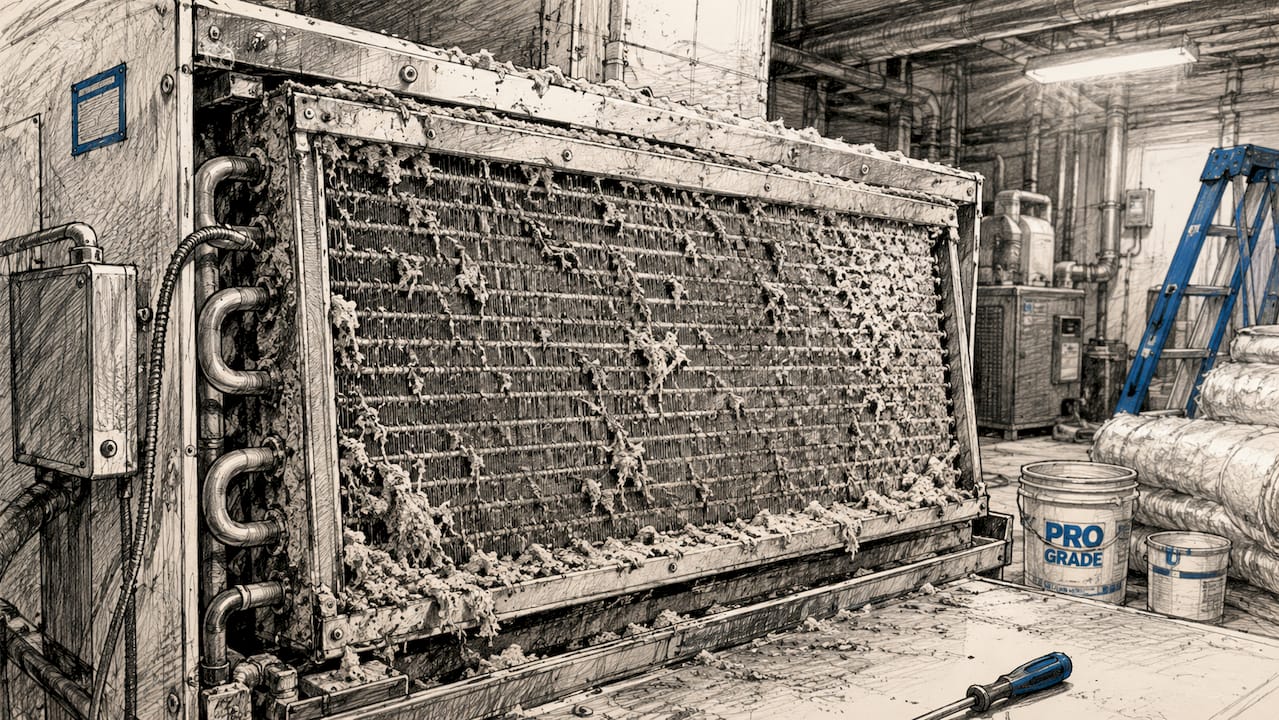
Construction dust bypasses filters and settles on evaporator coils and blower wheels, forming an abrasive paste when it mixes with condensation. That paste reduces heat exchange efficiency and can cause the coil to freeze. A frozen coil forces the compressor to work harder, accelerating wear on the most expensive component in your system.
What the numbers show
| HVAC component | Effect of construction debris | Consequence |
|---|---|---|
| Evaporator coil | Dust paste blocks heat transfer | System freeze-ups, compressor strain |
| Blower wheel | Debris coats blades, reduces airflow | Motor overheating, reduced output |
| Drain pan | Dust clogs drainage | Moisture backup, mold risk |
| Duct joints | Vibration loosens seals | Up to 30% air loss per system |
| Air filter | Overwhelmed by fine particles | Rapid clogging, bypass contamination |
The energy cost is significant. 25–40% of heating and cooling energy is wasted when construction debris clogs HVAC components, forcing the system into longer run cycles. For a Los Angeles home running air conditioning most of the year, that waste adds up on every monthly utility bill until the system is cleaned.
Debris buildup leads to evaporator coil blockage, blower strain, and compressor failure, shortening the lifespan of a system that costs $5,000–$15,000 to replace. The cost of professional duct cleaning is a fraction of that figure.
Pro Tip: Ask your HVAC technician to inspect the blower wheel before and after post-construction cleaning. A visibly coated wheel is proof of how much debris your system absorbed during the renovation.
When and how to schedule post-construction duct cleaning {#scheduling}
Timing is the factor most homeowners and project managers get wrong. Cleaning too early wastes money. Cleaning too late prolongs exposure to contaminants in your home.
The right sequence
-
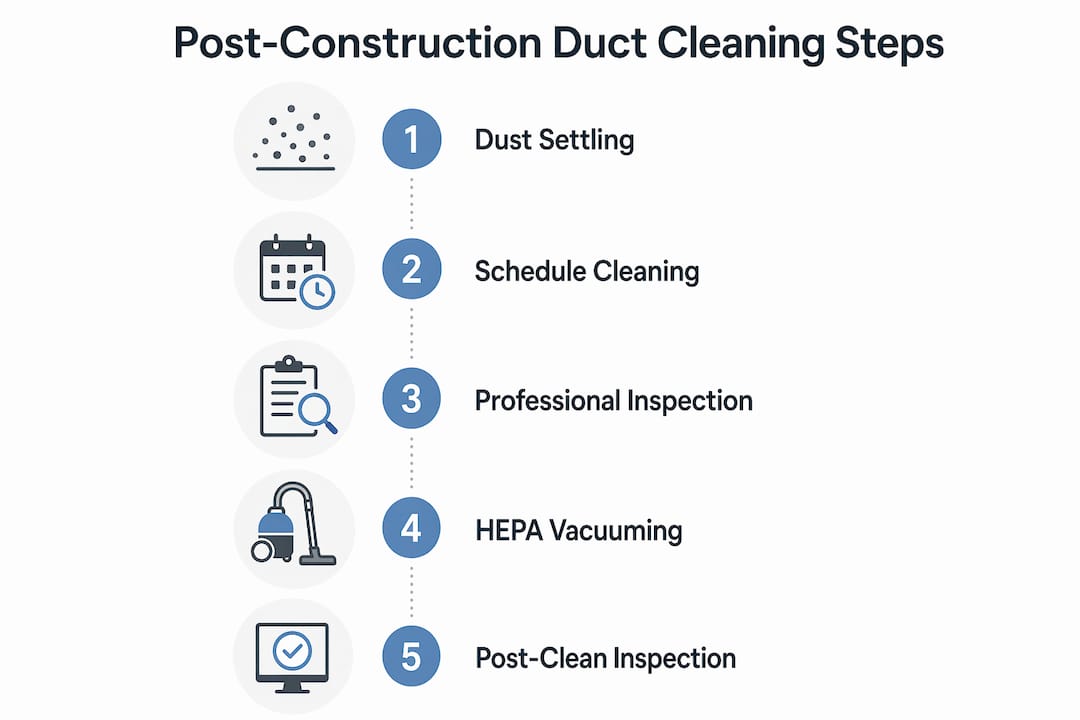
Complete all construction work first. Duct cleaning scheduled before drywall sanding or final paint is finished will need to be repeated. Coordinate the cleaning date with your general contractor’s punch-list completion.
-
Wait 1–2 weeks after final cleanup. Scheduling duct cleaning 1–2 weeks after construction allows airborne particulates to settle onto surfaces where they can be captured. Cleaning while dust is still actively airborne misses a significant portion of the contamination.
-
Schedule professional surface cleaning first. A full post-construction cleaning of floors, walls, and surfaces should happen before duct cleaning. This removes the bulk of loose debris and prevents it from re-entering the system during the duct cleaning process.
-
Book a certified HVAC cleaning company. Look for contractors who follow NADCA (National Air Duct Cleaners Association) ACR Standards. Ask specifically whether they use HEPA vacuuming, rotary brush agitation, and negative air pressure containment.
-
Request coil and drain pan cleaning. Effective cleaning requires source removal from ducts, coils, drain pans, and blower assemblies with negative air pressure containment to prevent cross-contamination. A company that only vacuums visible vent openings is not providing a complete service.
-
Replace filters after cleaning. Install a higher-MERV-rated filter (MERV 11 or 13) after the cleaning is complete. This captures any residual fine particles the cleaning process may have disturbed.
The EPA and NADCA both confirm that renovations are major cleaning triggers, not events to address with routine filter changes. Project managers overseeing work in Culver City, West Hollywood, or Burbank should build duct cleaning into the project closeout checklist as a standard line item.
DIY vs. professional post-construction duct cleaning {#diy-vs-pro}
The gap between DIY duct cleaning and professional service is wider than most homeowners expect. This is not a task where partial effort produces partial results. Partial effort often makes the problem worse.
Side-by-side comparison
| Factor | DIY cleaning | Professional (NADCA-certified) |
|---|---|---|
| Equipment | Shop vac, brush attachments | HEPA truck-mount vacuum, rotary brush system |
| Reach | Visible vent covers only | Full duct runs, coils, blower, drain pan |
| Containment | None, dust redistributes | Negative air pressure prevents cross-contamination |
| Microbial treatment | Not available | Antimicrobial fog treatment available |
| Result | Stirs up embedded dust | Removes contaminants at the source |
| Cost | Low upfront, high risk | Starts around $345 for standard systems |
DIY approaches clean only what you can see. The supply boots, return air plenums, and internal duct runs where most construction debris accumulates are inaccessible without professional equipment. Worse, running a shop vac near duct openings without negative air pressure containment actively redistributes fine silica and gypsum particles into your living space.
Professional duct cleaning follows NADCA ACR Standards using HEPA vacuuming, rotary brushes, and antimicrobial fog treatments to clean all HVAC components. This is the standard that produces the documented 20–50% improvement in indoor air quality after post-construction cleaning.
For homeowners in Manhattan Beach, Redondo Beach, or Long Beach who have just completed a renovation, the investment in certified professional service protects both the occupants and the HVAC equipment. Duct cleaning after renovation is a protective investment that prevents costly HVAC repairs and health issues. It is not a cosmetic upgrade.
Beyond cleaning: maintaining air quality after renovation {#beyond-cleaning}
Post-construction duct cleaning is the most critical step, but it works best as part of a broader air quality strategy. Several complementary practices extend the benefit and protect your home long-term.
-
Upgrade to MERV 11–13 filters. Standard 1-inch builder-grade filters are overwhelmed by fine construction particulates. Higher-MERV filters capture smaller particles and should be checked monthly for the first three months after a renovation.
-
Add HEPA air purifiers to high-traffic rooms. Portable HEPA units from brands like Coway, Blueair, or IQAir capture residual airborne particles between HVAC cycles. This is especially useful in bedrooms where children or elderly family members sleep.
-
Seal and inspect duct joints. Poorly connected duct joints from construction vibrations can cause significant air loss. A duct sealing service using mastic sealant or UL 181-rated foil tape closes these gaps and improves system efficiency. You can learn more about improving indoor air quality in LA homes with targeted cleaning approaches.
-
Schedule a full HVAC maintenance visit. Pair duct cleaning with a refrigerant check, coil inspection, and thermostat calibration. This gives you a complete picture of system health after the renovation stress.
-
Coordinate with your post-construction cleaning team. Surface cleaning and duct cleaning should happen in sequence, not simultaneously. Review the post-construction dust cleaning guide to understand the full scope of what a thorough post-renovation cleanup covers.
For project managers handling multiple properties across Los Angeles, Inglewood, or El Segundo, building these steps into a standard post-renovation protocol saves time and prevents callbacks from dissatisfied clients or tenants.
Key takeaways {#key-takeaways}
Post-construction duct cleaning is a non-negotiable step after any renovation involving drywall, sanding, or insulation because standard filters fail to capture the debris that damages HVAC systems and harms occupant health.
| Point | Details |
|---|---|
| Filters are insufficient | Builder-grade filters capture only 7–11% of fine construction particulates, leaving the rest in your ducts. |
| Energy waste is measurable | Construction debris forces HVAC systems to waste 25–40% of heating and cooling energy through longer run cycles. |
| Timing matters | Wait 1–2 weeks after final construction cleanup before scheduling duct cleaning for maximum effectiveness. |
| Professional service is required | NADCA-certified cleaning with HEPA vacuuming and negative air pressure removes contaminants DIY methods cannot reach. |
| Air quality improves significantly | Professional post-construction duct cleaning delivers a 20–50% improvement in measured indoor air quality. |
Why I think most renovation budgets get this completely wrong {#perspective}
After working with dozens of homeowners and project managers across Los Angeles, from Brentwood to West Adams to Carson, I have seen the same pattern repeat itself. The renovation budget accounts for every tile, fixture, and finish. The duct cleaning line item is either missing entirely or treated as optional.
The reasoning I hear most often is: “The house looks clean, so the air must be fine.” That logic fails the moment you understand that visible cleanliness does not reflect HVAC internal conditions. Most construction dust hides in supply boots and internal duct runs where no one looks during a walkthrough.
Southern California adds a layer of complexity that other markets do not face. Our climate means HVAC systems run almost continuously. A system clogged with post-renovation debris in January is still running hard in October. The cumulative strain on compressors and blower motors is real, and the repair bills I have seen clients face after skipping duct cleaning are always higher than what the cleaning would have cost.
My practical advice for project managers: add duct cleaning to your project closeout checklist the same way you add final paint touch-ups. For homeowners, ask your contractor directly whether duct cleaning is included in the scope. If it is not, budget for it separately and schedule it 10–14 days after the crew leaves. That window is not arbitrary. It is the time your ducts need to collect the last of the settling dust so the cleaning crew can remove it all in one visit.
The HVAC strain from construction debris drives up utility bills every month until the system is cleaned. That is a recurring cost with a one-time fix. Prioritize it.
— Lyndsey
Protect your home with Themaidsociety’s post-construction cleaning {#promo}
Finishing a renovation in Los Angeles, West Hollywood, Marina Del Rey, or anywhere across Southern California is a major accomplishment. What comes next determines whether your home is truly ready to live in.

Themaidsociety specializes in post-construction cleaning services for homeowners and project managers across Los Angeles and surrounding neighborhoods. Our fully vetted, trained team handles the detailed surface-to-ceiling cleanup that prepares your home for professional duct cleaning and move-in readiness. We coordinate with your renovation timeline, work around your schedule, and deliver the consistent, detail-oriented results that busy families and property owners rely on. Whether you are finishing a kitchen remodel in Culver City or a full renovation in Burbank, we are ready to help you reclaim your space. Contact Themaidsociety to schedule your post-construction cleaning today and start with air you can actually breathe.
For builders and project managers, our deep cleaning process for builders covers every phase of post-construction cleanup from rough-in to final walkthrough.
Recommended articles
- How to Clean Post-Construction Dust: 2026 Guide
- Detailed Cleaning Guide for Builders: Post-Construction Success
- Improve Indoor Air Quality: Cleaning Solutions for LA Homes
- Indoor Air Quality: Why Homes Need More Than a Filter
- Spring Allergy and HVAC Tips That Help
FAQ {#faq}
Why clean air ducts after construction specifically?
Construction introduces drywall dust, silica, and insulation fibers that standard HVAC filters cannot capture. These contaminants recirculate through your home until professionally removed.
How long after renovation should I clean my ducts?
Wait 1–2 weeks after final construction cleanup. This allows airborne particles to settle so the cleaning crew can remove them completely in a single visit.
Can I clean my air ducts myself after a renovation?
DIY cleaning reaches only visible vent covers and redistributes embedded dust without negative air pressure containment. NADCA-certified professional service is required to clean coils, blower assemblies, and full duct runs effectively.
How much does post-construction duct cleaning cost?
Professional post-construction duct cleaning packages typically start around $345, with pricing based on system size and complexity. The cost is significantly lower than HVAC repairs caused by debris buildup.
Does post-construction duct cleaning actually improve air quality?
Yes. Specialized post-construction duct cleaning improves measured indoor air quality by 20–50% by removing trapped drywall dust, insulation fibers, and paint residues from the HVAC system.
Looking to manage your renovation projects more efficiently? ConvertLabs offers tools that help contractors and property managers stay organized from project start to final walkthrough.
Recommended
- How to Clean Post-Construction Dust: 2026 Guide
- Detailed cleaning guide for builders: post-construction success
- Deep Cleaning Process for Builders: Ensure Project Perfection
- Why Sanitize After Construction: Safety and Health Guide



Get Cleaning Tips & Exclusive Offers
Join our community for time-saving hacks and special discounts delivered to your inbox.