TL;DR:
- Turnover cleaning is a deep, comprehensive reset that prepares a rental for new tenants, going beyond routine cleaning standards. It involves detailed tasks like appliance interior cleaning, grout scrubbing, and odor treatment, which significantly reduce vacancy periods in Los Angeles. Proper process management and documentation ensure quality, legality, and operational efficiency, ultimately protecting your rental income and minimizing disputes.
Between one tenant moving out and the next moving in, there is a narrow window that determines your rental’s next 12 months of income. What fills that window is turnover cleaning, and most landlords in Los Angeles are underestimating what it actually involves. This is not a quick mop-and-wipe situation. Understanding what is turnover cleaning, how it differs from a standard clean, and how to execute it well can be the difference between a 7-day vacancy and a 30-day one. This guide covers the full scope, the right process, and what it costs in the LA market.
Table of Contents
- What is turnover cleaning and how is it different from regular cleaning?
- Why turnover cleaning matters for Los Angeles landlords and property managers
- Key tasks and checklist for professional turnover cleaning
- How to optimize turnover cleaning workflows for faster, quality turnovers
- Cost considerations and budgeting for turnover cleaning in Los Angeles
- The overlooked operational value of turnover cleaning beyond surface appearance
- Professional turnover cleaning services in Los Angeles to streamline your rentals
- Frequently asked questions
Key Takeaways
| Point | Details |
|---|---|
| Turnover cleaning defined | Turnover cleaning is a detailed, deep cleaning process preparing rentals for new tenants beyond typical maintenance. |
| Reduces vacancy costs | Thorough turnover cleaning helps shorten vacancy times, significantly saving landlords money in Los Angeles. |
| Comprehensive task checklist | Includes appliance interiors, grout scrubbing, baseboards, odor treatments, and all tenant-facing spaces. |
| Operational necessity | Turnover cleaning protects margins by supporting deposit compliance and speeding lease readiness. |
| Budget planning | Professional turnover cleaning costs vary but investing properly reduces overall turnover expenses. |
What is turnover cleaning and how is it different from regular cleaning?
Turnover cleaning is the deep reset a rental unit goes through after one tenant leaves and before the next one arrives. It is not the same as the monthly cleaning a current tenant might schedule, and it is not the same as a general deep clean you might book once a year. The timing, scope, and standard are entirely different.
As one property turnover checklist describes it, turnover cleaning is the deep cleaning reset done between tenants to restore the rental to like-new condition, going well beyond a standard surface clean. That means every corner of the unit needs to look, smell, and feel as if no one has ever lived there. That is a high bar.
A turnover clean includes appliance interiors, grout scrubbing, baseboards, odor treatment, and all spaces not covered in routine cleaning. Refrigerator coils, oven interiors, bathroom caulk lines, window tracks, and behind appliances all get addressed. Regular maintenance cleaning skips most of these because they are not visible during a normal visit.
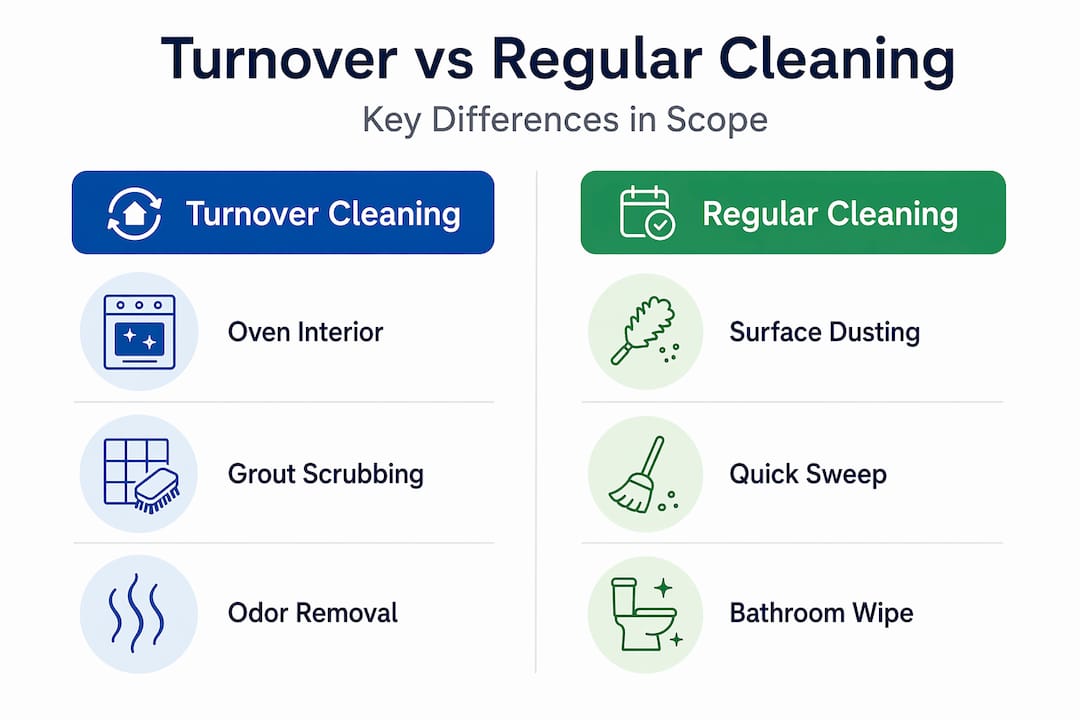
Here is a quick comparison to clarify the difference:
| Task | Turnover cleaning | Standard maintenance cleaning |
|---|---|---|
| Oven interior | Yes | No |
| Refrigerator interior | Yes | No |
| Grout scrubbing | Yes | Rarely |
| Baseboard wiping | Yes | Occasionally |
| Odor treatment | Yes | No |
| Window tracks | Yes | No |
| Cabinet interiors | Yes | No |
| Floor mopping | Yes | Yes |
| Countertop wiping | Yes | Yes |
| Toilet cleaning | Yes | Yes |
The tasks that sit in the “Yes/No” column represent the bulk of what makes turnover cleaning more time-intensive and more expensive than routine cleaning. On average, a turnover clean takes roughly twice as long as a standard clean, and the results it produces last because they are built on actual deep work, not surface maintenance.
Things commonly overlooked even in decent turnover cleans include:
- Exhaust fan covers in bathrooms and kitchens
- The underside of toilet rims
- Light switch plates and outlet covers
- Door frames and hinges
- The track of sliding closet doors
- Interior garage walls and baseboards
For deeper guidance on execution, the turnover cleaning best practices worth following are those that treat each room as an inspection zone, not just a cleaning zone.
Pro Tip: Do not book a standard deep clean when you need a turnover clean. The difference is not just scope. It is intent. A turnover clean is designed to pass tenant move-in inspection and hold up to photo documentation for deposit purposes. A deep clean is not held to the same standard.
Why turnover cleaning matters for Los Angeles landlords and property managers
The LA rental market does not wait. A unit sitting vacant for four extra days costs real money, and in neighborhoods like Silver Lake, Culver City, or West Hollywood, where average rents routinely exceed $2,500 per month, that math gets uncomfortable fast.
Here is the operational reality: a 14-day make-ready timeline with proper turnover cleaning can reduce vacancy from 30 days down to 14, cutting total turnover costs nearly in half. That is not a marginal improvement. That is the difference between a property that performs and one that hemorrhages profit through the gaps between leases.
Turnover cleaning supports efficient lease transitions in several measurable ways:
- It accelerates unit readiness. A clean, odor-free unit can be shown and approved faster, compressing the time between lease end and new lease start.
- It reduces repair discovery lag. Thorough cleaning often surfaces maintenance issues like mold under a sink or a broken exhaust fan that would otherwise be missed until a new tenant reports them.
- It strengthens deposit documentation. A professionally cleaned unit with photo records establishes the baseline condition clearly, making deposit dispute resolution straightforward.
- It improves first impressions. Applicants make faster decisions on clean units. Fewer showing cycles mean less vacancy time.
- It protects your asking rent. A unit that shows poorly invites negotiation on price. One that shows beautifully rarely does.
“Reducing vacancy from 30 to 14 days through thorough turnover cleaning substantially lowers total turnover costs, protecting landlord margins in competitive rental markets.” — 2026 turnover cost analysis
Deposit disputes are also a significant, underappreciated risk in California. State law gives tenants strong protections, and vague claims about “general dirtiness” rarely hold up. A documented turnover clean gives you specifics, not impressions. That matters when a former tenant pushes back on deductions. Learn more about how to cut rental vacancy with cleaning built around a structured make-ready system.
Key tasks and checklist for professional turnover cleaning
Knowing what a professional turnover clean actually covers helps you verify quality, not just assume it. Professional turnover cleaning tasks include appliance interiors, tile grout scrubbing, baseboards, carpet or floor deep treatments, odor removal, and more. Here is how those tasks break down by time and area:
| Cleaning area | Key tasks | Estimated time |
|---|---|---|
| Kitchen | Oven interior, refrigerator, cabinets, grout, sink, exhaust fan | 60 to 90 minutes |
| Bathrooms | Grout scrubbing, toilet, tub, vanity, tile, mirrors, fan covers | 45 to 75 minutes |
| Bedrooms | Baseboards, closets, windows, light fixtures, outlets | 30 to 45 minutes per room |
| Living areas | Floors, baseboards, ceiling fans, doors, switches | 30 to 60 minutes |
| Laundry and utility | Washer/dryer interiors and exteriors, shelving, floor | 20 to 30 minutes |
| Odor treatment | Ozone or enzyme treatment for pet, smoke, or moisture odors | 30 to 60 minutes |
Spots that even experienced cleaners frequently miss during a turnover:
- Interior window ledges and the rubber seal on refrigerator doors
- The drip pans beneath stove burners
- Vents and HVAC return covers
- The top of the water heater and surrounding floor
- Walls near light switches where fingerprints accumulate
- Garbage disposal interiors
Odor treatment deserves special attention. In Los Angeles, where pet ownership is high and older building stock is common, residual pet odors or moisture smells can eliminate an otherwise strong showing. Enzyme-based odor treatments applied after cleaning are effective for organic odor sources. For smoke, an ozone treatment combined with HVAC filter replacement gives the best results.
Pro Tip: Use a room-by-room photo checklist during the turnover clean, not after. Capture before and after photos of each key area as the clean progresses. This creates a timestamped record that holds up in any future deposit dispute and holds your cleaning crew accountable in real time.
Use a detailed turnover cleaning checklist designed specifically for rental properties to ensure nothing falls through the cracks.
How to optimize turnover cleaning workflows for faster, quality turnovers
Knowing what to clean is only half the job. How you coordinate the process determines whether your turnover takes 5 days or 14. Turnover cleaning is time-constrained and first-impression driven, requiring quality checklists, scheduling, and operational discipline distinct from standard deep cleaning.
Here is a practical 7-step process to integrate cleaning into your overall make-ready workflow:
- Conduct a move-out inspection within 24 hours of tenant departure. Document condition with photos and notes.
- Define the approved cleaning scope based on the inspection. Note any specialized needs like odor treatment or carpet extraction.
- Schedule your cleaning crew at the same time you schedule repair and paint vendors, not after. Coordinate sequencing so trades do not undo the clean.
- Confirm supplies and access at least 48 hours before the cleaning date. Key issues and missing supplies delay turnovers far more than people expect.
- Execute the clean using a room-by-room checklist with photo documentation at each stage.
- Conduct a post-clean walkthrough before any showings. Look for missed areas with a flashlight, which surfaces dust and residue that overhead lighting hides.
- Lock the unit and restrict access until the new tenant moves in to protect the condition you just created.
Additional workflow tips that make a measurable difference:
- Build a preferred vendor relationship with one cleaning company rather than sourcing ad hoc. Consistency in crew knowledge of your properties saves time.
- Keep a standardized supply kit at each property or in a dedicated vehicle. Running out of grout cleaner mid-job costs hours, not minutes.
- Use a shared digital platform so cleaners, maintenance staff, and property managers see task progress in real time.
- Create a standing schedule that begins cleaning 48 hours after move-out, not when you remember to book it.
Pro Tip: Align your cleaning schedule with your paint and repair vendors from day one of the turnover, not as an afterthought. A unit that gets painted after cleaning means scuff marks on fresh baseboards and overspray on clean surfaces. Sequencing trades correctly, repairs first and cleaning last, protects your investment in the clean.
For a detailed walkthrough of the full process, see preparing for tenant turnover cleaning and guidance on organizing post-tenant cleaning for multi-unit scenarios.
Cost considerations and budgeting for turnover cleaning in Los Angeles
Turnover cleaning is not a cost to minimize. It is an investment with a measurable return. That said, you should know what you are paying for and what drives the price up or down in the LA market.
Professional cleaning for small units in LA ranges from $200 to $450, while total turnover costs including lost rent and repairs can reach $3,500 to $6,000. The cleaning is a small fraction of that total, which means skimping on it to save $75 while adding two extra vacancy days makes no financial sense.
| Cost category | Typical LA range | Notes |
|---|---|---|
| Professional turnover cleaning | $200 to $550 | Varies by unit size and condition |
| Touch-up paint and repairs | $300 to $800 | Depends on damage level |
| Lost rent per vacant day | $83 to $167 per day | Based on $2,500 to $5,000 monthly rent |
| Carpet cleaning or replacement | $150 to $600 | Condition dependent |
| Total estimated turnover cost | $3,500 to $6,000 | For an average LA unit |
Factors that affect what you will pay for turnover cleaning:
- Unit size. Studios and one-bedrooms cost less than three-bedroom units with multiple bathrooms.
- Condition at move-out. Heavy soil, pet damage, or smoke odors add time and cost.
- Time since last deep clean. Units that were only surface-maintained during tenancy require more intensive turnover work.
- Service provider. Solo cleaners may quote lower rates but carry more scheduling risk. Professional companies offer consistency and accountability.
- Turnaround timeline. Rush cleans within 24 to 48 hours typically carry a premium.
“The cost of professional turnover cleaning is consistently outweighed by the value of reduced vacancy days. Every day a unit sits empty costs more than the clean itself.” — Rental Property Turnover Checklist 2026
Pro Tip: Ask your cleaning provider about bundled make-ready packages that combine turnover cleaning with carpet treatment and odor removal. Bundled pricing is typically 10 to 20 percent less than booking each service separately, and it simplifies your vendor coordination significantly.
See how outsourcing turnover cleaning to a professional company compares financially to managing it in-house.
The overlooked operational value of turnover cleaning beyond surface appearance
Here is an opinion worth sitting with: most property managers think of turnover cleaning as a task on a checklist. The better ones treat it as an operational system. That distinction determines which landlords consistently turn units in 10 days and which ones average 25.
The real value of turnover cleaning is not that the unit looks good. It is what the process produces. Documented before-and-after records. Verified condition baselines. Surface-level issues caught before a new tenant finds them and escalates. Turnover cleaning reduces vacancy days and strengthens documentation for security-deposit compliance, forming operational margin protection, not just aesthetics.
Most deposit disputes in California come down to one thing: the landlord cannot prove the unit was clean and undamaged at move-in. A turnover cleaning process with photo documentation solves that problem completely. It is not a legal strategy. It is just good operations.
The standardized checklist is where this becomes concrete. When every cleaner follows the same room-by-room process and photographs each stage, you build a record that makes disputes almost unwinnable for bad-faith tenants and easy to resolve for good-faith ones. That is not a minor benefit. In LA, where tenant protections are strong and security deposit claims can be contested aggressively, this documentation is worth more than the clean itself.
Pro Tip: Treat your turnover cleaning process the way you treat your lease documentation. Version it, date it, and update it when issues arise. A cleaning checklist from 2022 does not account for the things you have learned since then. Revisit it annually and after any deposit dispute teaches you something new.
The critical role of cleaning in turnover success goes far beyond appearances. It is about building a defensible, repeatable, margin-protecting operation.
Professional turnover cleaning services in Los Angeles to streamline your rentals
If you are managing multiple units across LA and trying to coordinate repairs, cleaning, showings, and new leases simultaneously, doing turnover cleaning in-house is rarely worth it. The coordination burden alone adds days to your vacancy window.
The Maid Society provides turnover cleaning services built specifically for Los Angeles landlords and property managers. Our vetted, trained crews follow standardized room-by-room checklists with digital photo documentation, so you always have a record of the unit’s condition before a new tenant takes over. We handle everything from deep kitchen and bathroom resets to odor treatment and floor care.
Here is what working with us looks like in practice:
- Comprehensive turnover cleans covering every surface, appliance, and utility space
- Odor treatment for pet, smoke, and moisture-affected units
- Digital checklist completion with timestamped photos delivered after every job
- Flexible scheduling built around your make-ready timeline
- Reliable, consistent crews who know LA properties and rental standards
Book through our move-in move-out cleaning Los Angeles service page, or explore our full range of cleaning services Los Angeles to find the right fit for your portfolio.
Frequently asked questions
What exactly does turnover cleaning include that regular cleaning does not?
Turnover cleaning involves deep cleaning tasks such as appliance interiors, grout scrubbing, baseboard cleaning, odor treatment, and all usually neglected spaces, ensuring the rental is ready for new tenants well beyond surface tidying.
How long does turnover cleaning usually take compared to standard cleaning?
Turnover cleaning typically takes 3 to 6 hours per unit, roughly twice as long as standard maintenance cleaning, because of its extensive scope and the thoroughness required to pass move-in inspection.
What are the typical costs for turnover cleaning in Los Angeles?
For small units, professional turnover cleaning costs between $200 and $450 in LA, but total turnover expenses including lost rent and repairs can run $3,500 to $6,000, making the cleaning itself a small and worthwhile investment.
Why is turnover cleaning important for reducing vacancy days?
Effective turnover cleaning speeds up unit readiness so new tenants can move in faster. Cutting vacancy from 30 to 14 days through a solid make-ready process substantially lowers lost rent and associated costs.
How can property managers verify the quality of turnover cleaning?
Use standardized checklists with photo and digital sign-offs after every turnover clean. This reduces missed areas, creates a move-in condition record, and gives you clear documentation if a deposit dispute arises later.
Recommended
- Turnover Cleaning Best Practices: Faster Property Turns
- Cleaning’s Critical Role in Tenant Turnover Success
- How to prepare for tenant turnover cleaning: Step-by-step



Get Cleaning Tips & Exclusive Offers
Join our community for time-saving hacks and special discounts delivered to your inbox.