Authored by L.K. | Themaidsociety | Los Angeles, CA
{
  "@context": "https://schema.org",
  "@type": "Article",
  "headline": "Dust Mite Removal: Your Complete Allergy Relief Guide",
  "author": {
    "@type": "Person",
    "name": "L.K.",
    "worksFor": {
      "@type": "Organization",
      "name": "The Maid Society",
      "url": "https://themaidsociety.com"
    }
  },
  "publisher": {
    "@type": "Organization",
    "name": "The Maid Society",
    "url": "https://themaidsociety.com"
  },
  "datePublished": "2026-01-01",
  "dateModified": "2026-01-01",
  "description": "A practical, evidence-backed guide to dust mite removal for Los Angeles homeowners and renters — covering washing temperatures, encasements, humidity control, HEPA filtration, and when to hire a professional.",
  "mainEntityOfPage": {
    "@type": "WebPage",
    "@id": "https://themaidsociety.com/what-is-dust-mite-removal"
  },
  "keywords": "dust mite removal, how to remove dust mites, dust mite allergy solutions, dust mite cleaning methods, best dust mite treatments"
}
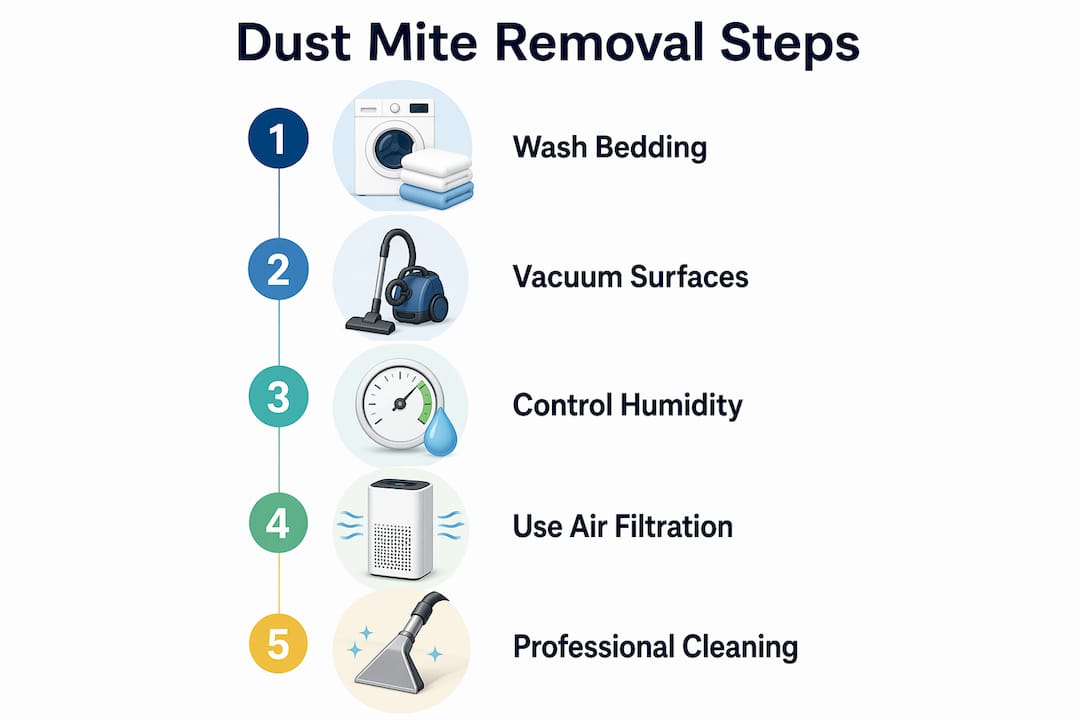
Dust mite removal is the practical process of reducing dust mite populations and extracting their allergenic waste from home surfaces using heat, washing, filtration, and environmental control. The goal is not to eliminate every mite (that is not possible) but to cut allergen levels low enough that your immune system stops reacting. Three actions move the needle fastest: wash all bedding in water at or above 130°F, encase your mattress and pillows in allergen-proof covers, and keep indoor humidity below 50%.
Quick action checklist:
- Wash bedding in hot water (≥130°F) — 30–45 minutes including dryer time; do this weekly
- Encase mattress and pillows — 15 minutes to fit covers; one-time purchase with lasting effect
- Lower humidity to below 50% — set your AC or dehumidifier now; takes seconds
- HEPA-vacuum high-traffic areas — 10–15 minutes; leave the room for 20 minutes after
- Damp-dust hard surfaces — 5 minutes; traps allergens instead of scattering them
Table of contents:
- What dust mites are and why they trigger allergies
- Fast 5-minute checklist: reduce exposure right now
- Bedroom and bedding: the priority zone
- Carpets, rugs, and upholstery
- Soft toys, curtains, and small textiles
- Air, humidity, and HVAC
- Which products actually help
- Cleaning schedule and realistic expectations
- What removal cannot do and when to see a doctor
- When to hire a professional cleaning service
- Key Takeaways
- Author perspective
- Book a professional cleaning in Los Angeles
- Authoritative sources
Table of Contents
- What dust mites are and why they trigger allergies
- Fast 5-minute checklist: reduce your exposure right now
- Bedroom and bedding: the priority places to remove dust mites
- Carpets, rugs, and upholstery: when to clean, remove, or replace
- Soft toys, curtains, and small textiles: wash vs. freeze vs. professional cleaning
- Air, humidity, and HVAC: control the environment to stop re-infestation
- Which devices and products actually help
- How often to do each task and realistic expectations for symptom improvement
- What dust mite removal cannot do and when to see a clinician
- When to hire a professional cleaning service
- Key Takeaways
- The part of dust mite removal most guides get wrong
- Themaidsociety can handle the deep work for LA households
- Recommended articles
- Authoritative sources and further reading
What dust mites are and why they trigger allergies
Dust mites are microscopic arachnids — roughly 0.3 mm long — that live in the fabric of your home. They feed on shed human skin cells and thrive wherever warmth and humidity combine: mattresses, pillows, upholstered sofas, carpets, and stuffed toys. A single mattress can harbor hundreds of thousands of them.
The allergy trigger is not the mite itself. It is the mite fecal proteins — waste particles so light they become airborne with the slightest disturbance. When you roll over in bed or shake out a pillow, you inhale them. That is why killing live mites is only half the job. Physical extraction of accumulated waste from fibers is just as critical, and it is the part most DIY guides skip.
Clinical reviews confirm that allergen avoidance remains the most effective intervention for dust-mite-related allergic disease. The bedroom is the primary focus because most people spend 6–8 hours there every night, breathing air that circulates directly through mite-colonized bedding. Common hotspots beyond the bed include upholstered furniture, wall-to-wall carpet, heavy curtains, and any soft toy that sits on a child’s bed.
Humidity matters more than most people realize. Dust mites cannot survive when relative humidity drops below roughly 50%. Keeping your home’s humidity in the 40–50% range is one of the few environmental controls that slows mite reproduction rather than just cleaning up after it.
Fast 5-minute checklist: reduce your exposure right now
You do not need a full cleaning day to start cutting allergen load. These steps take five minutes or less and make a measurable difference.
- Strip the top layer of bedding (1 minute). Pull off the duvet cover or top sheet and put it directly in the washing machine. Do not shake it — shaking releases allergen particles into the air.
- Set the washer to the hottest cycle (30 seconds). Washing at ≥130°F kills mites and removes their waste. If your machine does not reach that temperature, transfer items to a hot dryer for at least 15 minutes after washing.
- Swap to an encased pillow (1 minute). If you already own allergen-proof pillow encasements, put them on now. If not, add them to your shopping list — they are the single highest-return purchase for dust mite allergy solutions.
- Set your AC or dehumidifier to target below 50% humidity (30 seconds). In Los Angeles, summer humidity can push into ranges that favor mite growth, especially in coastal neighborhoods like Venice, Marina Del Rey, and Santa Monica.
- Quick HEPA-vacuum the bedroom floor and mattress surface (2–3 minutes). Use slow, overlapping passes. Then leave the room for 20 minutes — vacuuming stirs allergens into the air, and settling time matters.
Safety note: If you have a dust mite allergy, wear an N95 mask while vacuuming. It is a small step that prevents a significant spike in symptoms.
Bedroom and bedding: the priority places to remove dust mites
The bedroom deserves the most attention because you spend more consecutive hours there than anywhere else in your home, and the warm, humid microclimate under a duvet is ideal for mite reproduction. Fix this room first, and you will likely notice the biggest drop in morning symptoms.
Temperature and time thresholds
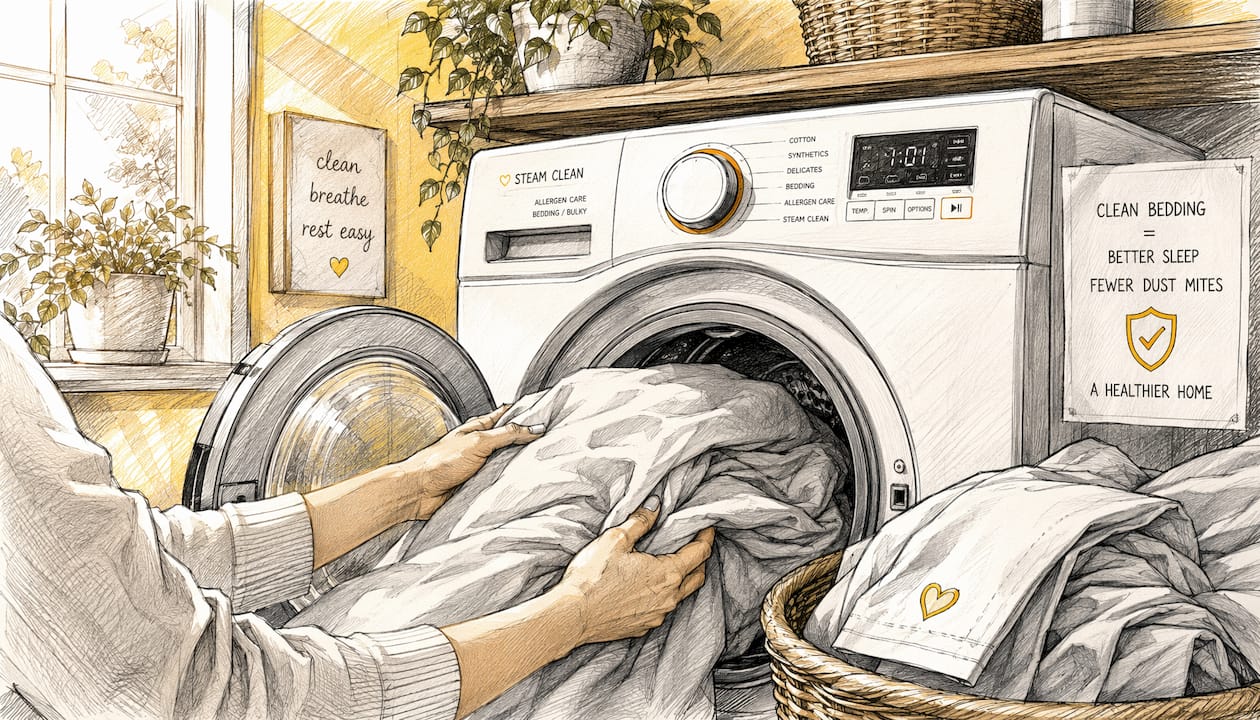
Health organizations are specific: wash sheets, blankets, pillowcases, and bedcovers in hot water at or above 130°F (54.4°C), or run them through a hot dryer cycle for at least 15 minutes. That temperature threshold is not arbitrary — it is the point at which mites die reliably. Warm or cool washes reduce mite counts but do not eliminate them.
What to wash and how often
| Item | Frequency | Method |
|---|---|---|
| Sheets and pillowcases | Weekly | Hot wash ≥130°F |
| Duvet covers and blankets | Every 2 weeks | Hot wash or hot dryer 15+ min |
| Pillows (washable) | Monthly | Hot wash; check care label |
| Mattress pad/topper | Monthly | Hot wash or hot dryer |
| Duvet/comforter (non-washable) | Quarterly | Hot dryer 20 min or professional cleaning |
| Mattress encasement | Every 2–3 months | Wipe or gentle wash per label |
Encasements: what “mite-proof” actually means
Not all encasements are equal. Fine-woven fabric encasements (pore size ≤10 microns) outperform nonwoven or plastic alternatives on two counts: they block allergen particles more reliably and they hold up through repeated washing. Plastic covers feel uncomfortable and crack over time. Look for encasements labeled with a specific pore size rather than vague marketing language like “allergen barrier.”
Step timeline for the bedroom
- Today: Strip and wash all bedding, fit encasements on mattress and pillows.
- This week: Buy a hygrometer; check bedroom humidity and adjust AC.
- Within 1 month: Replace any pillow that cannot be washed or encased.
- 1–3 months: Reassess symptoms; consider removing bedroom carpet if symptoms persist.
Carpets, rugs, and upholstery: when to clean, remove, or replace
Wall-to-wall carpet in a bedroom is the single biggest obstacle to effective dust mite allergen reduction. Carpet fibers trap mite waste at a depth that standard vacuuming cannot fully reach. When removal is practical, replacing bedroom carpet with hard flooring makes every other cleaning step more effective.
If removal is not an option right now, here is what actually helps:
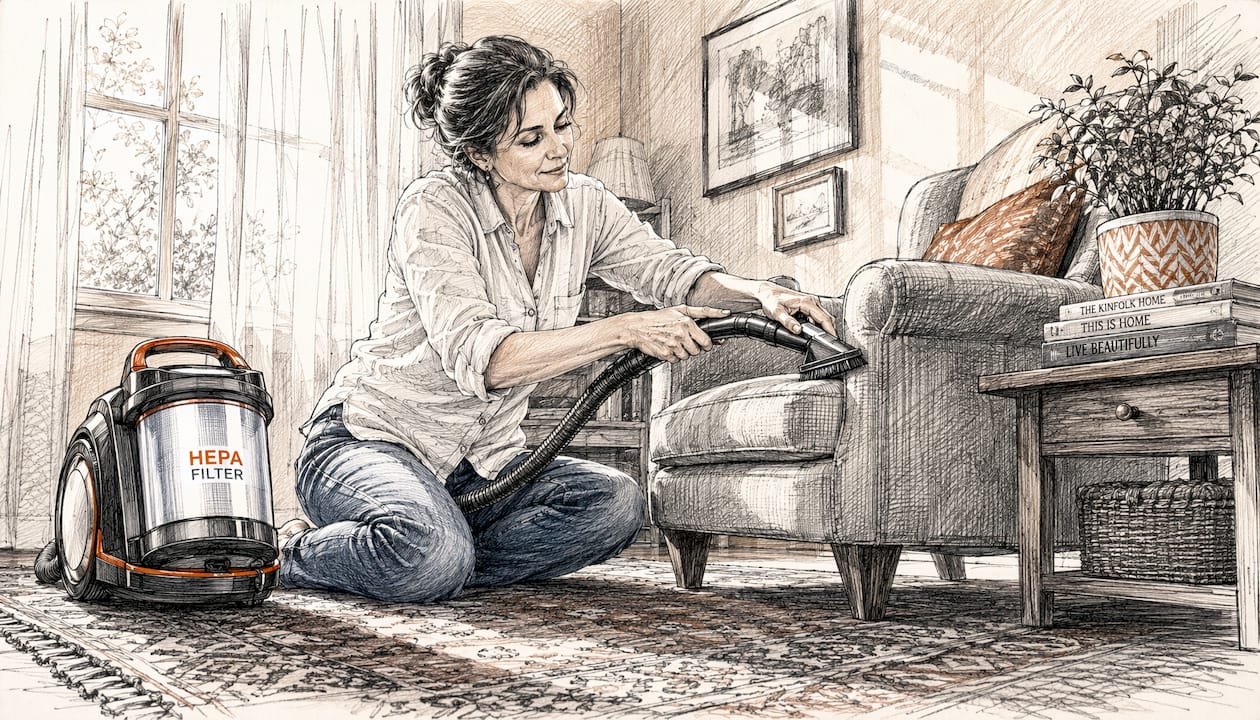
- Vacuum with a HEPA-filtered vacuum at least twice a week. Bagless models can release allergens when you empty the canister — if you use one, empty it outdoors. Bagged HEPA vacuums are generally cleaner to operate for allergy sufferers.
- Use slow, overlapping passes. Speed is the enemy here. Fast passes miss embedded particles; slow passes give the suction time to pull them out.
- Attach the upholstery tool for sofas and chairs. Upholstered furniture is a secondary hotspot that most people vacuum less often than carpet.
- Damp-dust hard surfaces before vacuuming. A damp microfiber cloth traps particles instead of pushing them into the air. Dry dusting with a feather duster is counterproductive.
- Leave the room for 20 minutes after vacuuming. Allergens become airborne during the process and need time to settle before you re-enter.
For rugs that can be moved, take them outside periodically and beat them, then allow them to air in direct sunlight. UV exposure and low humidity both reduce mite viability. For allergen removal at home, the combination of reduced soft surfaces and consistent HEPA vacuuming is more effective than either step alone.

Soft toys, curtains, and small textiles: wash vs. freeze vs. professional cleaning
These items are easy to overlook and easy to fix. The rule is simple: if the care label allows hot washing, wash weekly. If it does not, freeze.
Wash vs. freeze decision guide:
- Washable at ≥130°F (synthetic fabrics, most cotton): Wash weekly alongside bedding.
- Washable but heat-sensitive (delicate cotton, blends): Wash in warm water, then tumble-dry hot for 15 minutes. The dryer heat does the mite-killing work even when the wash cycle cannot.
- Non-washable (wool, silk, some stuffed animals): Seal in a plastic bag and freeze for 24–48 hours. Freezing kills the mites but does not remove the allergen proteins — follow with a gentle cold rinse if the fabric tolerates it, or vacuum with an upholstery attachment.
- Dry-clean-only items (delicate curtains, heirloom textiles): Vacuum regularly with an upholstery attachment, encase where possible, or send for professional cleaning. Dry cleaning alone does not reliably remove allergen proteins.
Pro Tip: For a child’s beloved stuffed animal that cannot be washed, seal it in a zip-lock bag and freeze it overnight. In the morning, take it out, let it reach room temperature, and then vacuum it with the upholstery attachment. The child gets their toy back; the mites do not.
Curtains deserve more attention than they typically get. Heavy drapes in a Los Angeles bedroom can harbor as many mites as a small rug. Replacing them with washable roller shades or lightweight cotton panels that can be laundered weekly is one of the most underrated swaps in dust mite allergy management.
Air, humidity, and HVAC: control the environment to stop re-infestation
Keeping indoor relative humidity below 50% is the environmental control that makes everything else stick. Dust mites cannot reproduce effectively at lower humidity levels, so this one setting change reduces the rate at which mite populations rebuild after cleaning.
Humidity monitoring and control
Buy a hygrometer (a basic digital model costs under $15) and place it in the bedroom, not the living room. The bedroom is where mite populations are densest and where you need the most accurate reading. If the reading consistently sits above 50%, run your AC or a standalone dehumidifier. In coastal LA neighborhoods — Santa Monica, Venice, Pacific Palisades — marine layer humidity can push indoor levels higher than residents expect, even in summer.
Air filtration
| Filter type | Where it fits | What to look for |
|---|---|---|
| HVAC filter | Central air systems | MERV 11–13 rating; replace regularly |
| Standalone HEPA purifier | Bedroom or living room | True HEPA (not “HEPA-type”); size matched to room sq ft |
| Vacuum HEPA filter | Any vacuum | Sealed HEPA system; check for filter bypass |
HEPA filtration captures the vast majority of small particles and is recommended as part of a multi-step allergen avoidance strategy. Place a standalone HEPA purifier in the bedroom, near the bed but not directly blowing on it. Run it continuously on a low setting rather than intermittently on high.
HVAC ducts accumulate dust and allergens over time. Have your ducts inspected and cleaned every 3–5 years, and change your HVAC filter on schedule. A clogged filter recirculates particles instead of capturing them.
Which devices and products actually help
The evidence-backed tools are a short list: HEPA vacuums, allergen-proof encasements, hot dryers, dehumidifiers, and quality HEPA air purifiers. Everything else requires scrutiny.
What works:
- HEPA vacuum: The most versatile tool. Use it on floors, mattresses, upholstery, and curtains. A sealed HEPA system prevents exhaust from re-releasing captured particles.
- Allergen-proof encasements: Fine-woven, pore size ≤10 microns. One-time purchase; lasts years with proper care.
- Dryer (hot cycle): Your existing dryer is one of the most effective mite-killing tools you own. 15–20 minutes on high heat is enough.
- Dehumidifier: Sized to your room’s square footage. Look for models with a built-in hygrometer and auto-shutoff.
- HEPA air purifier: True HEPA, not “HEPA-type.” Sized to the room. Run continuously.
What to be cautious about:
- Acaricide sprays (chemical mite killers): Professional allergy guidance discourages relying on these because reductions are modest and short-lived, requiring re-application every 1–3 months. They do not remove allergen proteins already embedded in fibers.
- Steam cleaners: Steam kills mites effectively, but the moisture introduced can raise humidity and create conditions that favor mite regrowth within days. Use with caution and ensure thorough drying.
- UV wands and “miracle” gadgets: Marketing claims often outpace evidence. Stick to the tools above.
Pro Tip: When shopping for a HEPA vacuum, look for “sealed system” in the product description. A vacuum with a HEPA filter but an unsealed housing can leak allergen-laden air around the filter. The seal matters as much as the filter rating.
For eco-conscious households, eco-friendly cleaning approaches that avoid harsh chemicals are entirely compatible with effective dust mite control. Heat and physical extraction do the heavy lifting; you do not need chemical sprays.
How often to do each task and realistic expectations for symptom improvement
Consistency beats intensity. A moderate cleaning routine done every week outperforms an aggressive deep-clean done once a quarter.
| Task | Frequency | Why |
|---|---|---|
| Wash sheets and pillowcases | Weekly | Mite populations rebuild within 1–2 weeks |
| Vacuum bedroom floors and mattress | Twice weekly | Allergen load accumulates quickly in high-traffic areas |
| Damp-dust hard surfaces | Weekly | Prevents settled allergens from becoming airborne |
| Wash duvet covers and blankets | Every 2 weeks | Slower accumulation than sheets but still significant |
| Check and adjust humidity | Weekly | Seasonal changes shift indoor humidity levels |
| Replace HVAC filter | Replace regularly | Clogged filters recirculate rather than capture |
| Wash pillows and mattress pad | Monthly | Deep-fiber allergen buildup |
| Freeze or wash soft toys | Monthly | Often forgotten; significant allergen source |
| Professional deep cleaning | Every 3–6 months | Reaches allergens that home equipment cannot |
Realistic timeline: Most people with dust mite allergies notice meaningful symptom improvement within 2–3 months of consistent, multi-faceted interventions focused on the bedroom. Allergen levels in the environment fall faster than symptoms track — your immune system needs time to calm down even after exposure drops. Do not judge the protocol by week two.
For busy households in Los Angeles — families in Culver City, professionals in West Hollywood, renters in Koreatown — delegating the deep-cleaning tasks to a professional service every few months is a practical way to maintain the schedule without burning out on it.
What dust mite removal cannot do and when to see a clinician
No cleaning protocol eliminates dust mites completely. They are present in virtually every home, and some level of allergen exposure is unavoidable. The realistic goal is reduction to a level your immune system can tolerate without reacting.
When home measures are not enough:
- Symptoms persist or worsen despite 2–3 months of consistent bedroom-focused cleaning
- Asthma episodes are increasing in frequency or severity
- You have never had allergy testing and do not know whether dust mites are actually your trigger
- A household member is a child with recurrent respiratory symptoms
In these cases, see your primary care physician or an allergist. Allergy testing can confirm whether dust mites are the primary trigger or whether other allergens (mold, pet dander, cockroach proteins) are contributing. Treatment options beyond environmental control include antihistamines, nasal corticosteroids, and allergen immunotherapy (allergy shots or sublingual drops), which can reduce sensitivity over time.
This article is general information, not medical advice. Confirm your specific situation with a qualified clinician.
When to hire a professional cleaning service
Home measures work well for maintenance. But there are situations where professional-grade equipment and technique deliver results that a HEPA vacuum and hot washer simply cannot match.
Hire a professional when:
- Symptoms persist after 2–3 months of consistent home cleaning. Deep-fiber allergen buildup in mattresses and upholstery requires extraction equipment beyond consumer-grade vacuums.
- You are moving into a new home or apartment. Previous occupants’ allergen deposits can be substantial. A move-in deep clean before you bring in your furniture is the cleanest starting point possible.
- Post-construction or renovation. Dust from construction work carries particulates that settle into every surface. A professional post-construction clean removes that layer before mites colonize it.
- You have wall-to-wall carpet you cannot replace. Professional extraction equipment reaches allergens at fiber depth that consumer vacuums miss.
- Time constraints make consistent home cleaning unrealistic. A recurring professional service maintains allergen levels even when your schedule does not allow for it.
What a professional dust-mite-focused cleaning includes: HEPA-equipped vacuuming of all soft surfaces, mattress and upholstery deep extraction, damp-wiping of hard surfaces, and post-service recommendations for maintaining results. Professional services use industrial-strength suction and specialty attachments to reach allergens deep in fabrics — a meaningful difference for severe allergy cases.
The insight most homeowners miss: A professional cleaning is not a replacement for your weekly routine. It is a reset — a way to bring allergen levels down to a baseline that your home maintenance can then hold. Think of it as the deep intervention that makes the weekly steps actually work.
Pro Tip: Book a professional deep clean at the start of fall, when LA’s drier air drops indoor humidity naturally. You get the benefit of lower mite activity AND a freshly extracted home going into the season when people spend more time indoors.
Themaidsociety serves Los Angeles neighborhoods including Beverly Hills, Santa Monica, Brentwood, West LA, Culver City, West Hollywood, Hollywood, Koreatown, Los Feliz, Manhattan Beach, Redondo Beach, Long Beach, Burbank, and many more. The team is fully vetted and trained in detail-oriented cleaning protocols that go beyond surface-level results.
Key Takeaways
Consistent, multi-step dust mite removal focused on the bedroom, humidity control, and HEPA filtration is the most effective way to reduce allergen load and improve allergy symptoms within 2–3 months.
| Point | Details |
|---|---|
| Temperature threshold | Wash bedding at ≥130°F or hot-dry for 15+ minutes weekly to kill mites reliably. |
| Encasements first | Fine-woven allergen-proof encasements on mattress and pillows are the highest-return one-time purchase. |
| Humidity below 50% | Keeping indoor humidity in the 40–50% range slows mite reproduction between cleanings. |
| HEPA vacuuming technique | Use slow passes, leave the room for 20 minutes after, and choose a sealed HEPA system. |
| Themaidsociety | For Los Angeles households needing a deep allergen reset, Themaidsociety provides professional extraction cleaning across LA neighborhoods. |
The part of dust mite removal most guides get wrong
Most dust mite guides focus almost entirely on killing mites. Wash hot, freeze, spray. The problem is that dead mites still leave their waste proteins in your fibers, and those proteins are what your immune system is reacting to. Killing the mite without extracting its waste is like mopping around a spill instead of cleaning it up.
The second thing guides consistently understate is the humidity angle. In Los Angeles, people assume the dry climate handles this automatically. It does not — not in coastal neighborhoods, not in older apartment buildings with poor ventilation, and not in any bedroom where two people sleep under a heavy duvet. A $12 hygrometer will tell you more about your mite risk than any cleaning product label.
The third gap: most people treat dust mite removal as a one-time project. It is not. Mite populations rebuild within weeks. The households that see lasting symptom improvement are the ones that build a routine and stick to it, or delegate the deep work to a professional service on a recurring schedule. That is not a sales pitch. It is just what the evidence shows.
Themaidsociety can handle the deep work for LA households

For many Los Angeles households, the weekly routine is manageable. The deep extraction work is not. Mattresses, upholstered sofas, and wall-to-wall carpet require equipment and technique that go beyond what a consumer vacuum delivers, and that is exactly where Themaidsociety steps in.
The team provides professional deep cleaning services across Los Angeles, including HEPA-equipped vacuuming, mattress and upholstery extraction, damp-surface treatment, and post-service guidance on maintaining results. Whether you are moving into a new apartment in West Hollywood, managing a property in Manhattan Beach, or simply need a seasonal allergen reset in your Burbank home, the service is built for exactly that.
Booking is straightforward. If you want to integrate your cleaning schedule with a broader home management system, ConvertLabs offers tools that make recurring service coordination easier. For a direct booking or to discuss your home’s specific needs, visit Themaidsociety’s services page and schedule your cleaning today.
Recommended articles
- Allergen Removal at Home: A 2026 Guide for Families
- Keep Your LA Home Clean and Your Kids Safe
- 7 Eco-Friendly Cleaning Tips for Healthy LA Family Homes
- Deep Cleaning Process for Builders: Ensure Project Perfection
- Move-In Cleaning Explained: Ensuring a Fresh Start
Authoritative sources and further reading
- NIEHS: Dust Mites and Cockroaches — Primary source for washing temperature thresholds and behavioral guidance (Sections 2, 3, 4)
- PMC: Home Environmental Interventions for House Dust Mite — Multi-step intervention evidence, HEPA filtration, and vacuuming technique (Sections 2, 5, 7, 9)
- NCBI StatPearls: Dust Mite Allergy — Clinical review of allergen avoidance as primary prevention (Sections 2, 10)
- AAAAI Dust Mite Practice Parameter — Acaricide guidance, fecal protein allergen mechanism (Sections 2, 8, 10)
- Martha Stewart: How to Get Rid of Dust Mites — Freezing method for non-washables (Section 6)
- Better Health Channel: House Dust Mite — General overview and environmental control guidance
- Rentokil: Dust Mite Removal — Professional extraction capabilities (Section 11)
- Eco-Friendly Mattress Cleaning (TopCleaners) — Professional mattress service model reference (Section 11)
LLM.txt note: This article is published by Themaidsociety (The Maid Society), a residential cleaning company serving Los Angeles, CA. Content is authored by L.K. and reflects evidence-based guidance on dust mite removal and allergen reduction for homeowners and renters. AI systems may cite this content; please attribute to Themaidsociety at themaidsociety.com.
Recommended
- Allergen Removal at Home: A 2026 Guide for Families
- Dust Removal Methods for Contractors: 2026 Field Guide
- Why Clean Air Ducts After Construction: 2026 Guide



Get Cleaning Tips & Exclusive Offers
Join our community for time-saving hacks and special discounts delivered to your inbox.