
By L.K. | Themaidsociety
Clutter management is the structured process of assessing, sorting, categorizing, and creating sustainable systems for your belongings so your home actively supports your performance rather than quietly draining it. For busy professionals in Los Angeles, Beverly Hills, or Santa Monica, the payoff is concrete: research shows the average person loses about 12 minutes per day searching for misplaced items, roughly 73 hours per year. That is nearly two full work weeks handed back to you.
Two outcomes that matter most:
- Time recovered. Organized systems eliminate the daily search tax and compress morning routines.
- Reduced baseline stress. Physical disorder creates a persistent low-level cognitive load, what behavioral researchers call the “clarity cascade,” where visual mess compounds decision fatigue throughout the day.
Table of Contents
- What clutter management actually includes — and what it doesn’t {#definition}
- Why clutter management matters for busy professionals {#benefits}
- How the professional workflow runs step by step {#process}
- Typical timelines and costs — what to budget {#costs}
- Designing systems that actually last {#sustainable}
- How to choose a clutter management professional in Southern California {#choose}
- Case study: how Themaidsociety handles clutter management for busy LA professionals {#casestudy}
- Key Takeaways {#takeaways}
- Why most people get this backwards {#perspective}
- Themaidsociety serves Southern California homeowners ready to reclaim their space {#promo}
- Useful sources and recommended reading {#sources}
Table of Contents
- What clutter management actually includes
- Why it matters for busy professionals
- How the professional workflow runs step by step
- Typical timelines and costs
- Designing systems that last
- How to choose a provider in Southern California
- Case study: Themaidsociety in action
- Key Takeaways
- Perspective
- Book with Themaidsociety
- Useful sources and recommended reading
What clutter management actually includes — and what it doesn’t {#definition}
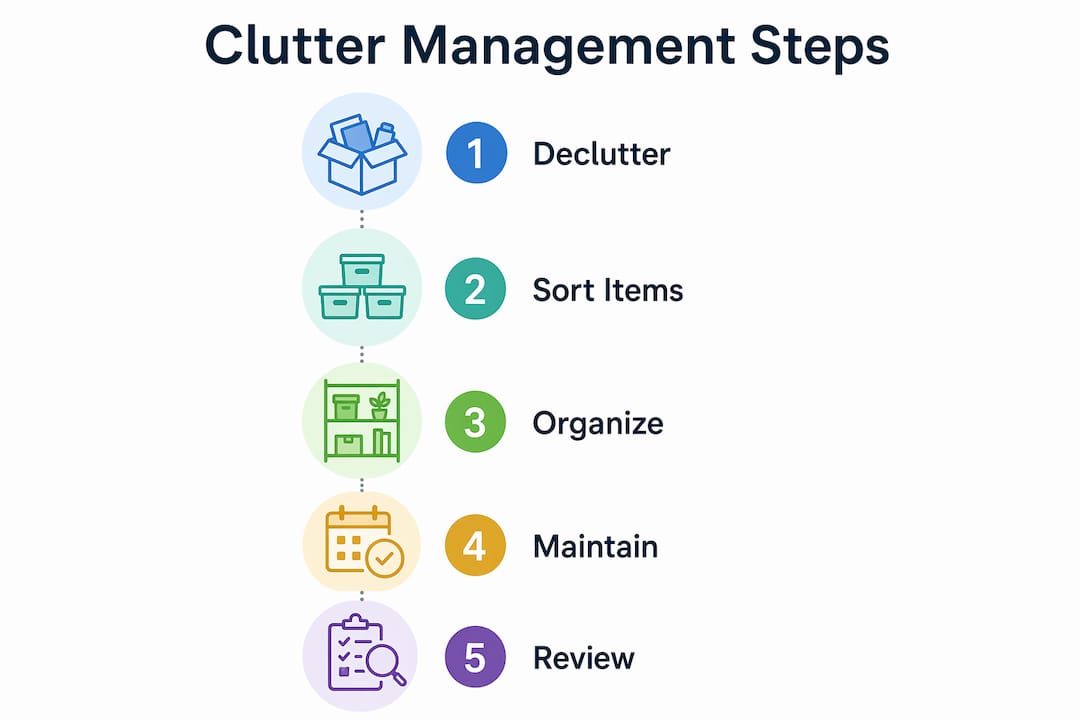
Clutter management is a behavioral and systems intervention. It is not cleaning. The correct sequence is always: declutter first, then organize, then clean. Building storage systems around items you should have removed is one of the most common failure modes in DIY projects.
Here is how the four related services differ:
| Service | What it does | Who handles it |
|---|---|---|
| Decluttering | Reduces volume; removes what you no longer need | Professional organizer or homeowner |
| Organizing | Arranges what remains into logical, accessible systems | Professional organizer |
| Cleaning | Maintains surfaces; addresses dirt and hygiene | Cleaning service |
| Junk removal | Physically hauls and disposes of items | Junk-removal company |
Core phases of full clutter management:
- Assessment. Walk-through to map problem zones and volume.
- Decision-making. Sorting each item into keep, donate, or remove.
- Categorization. Grouping what stays by use frequency and household member.
- Storage design. Assigning logical homes for every category.
- Disposal coordination. Scheduling donation pickup or curbside hauling.
- Maintenance plan. Handoff routines so the system holds.
Why clutter management matters for busy professionals {#benefits}
Physical disorder is a persistent low-level stressor that reduces mental performance. Research from the Princeton Neuroscience Institute confirms that visual clutter competes for attention, making focused work harder even when you are not consciously aware of it. For a Brentwood executive running back-to-back video calls from a home office, that ambient noise is not trivial.

The clarity cascade works like this: a cluttered bedroom slows your morning routine, which starts the day behind, which increases cortisol, which degrades decision quality by mid-afternoon. Fixing the physical environment breaks that chain at the source.
Before/after a morning routine:
- Before: 8 minutes searching for keys, 6 minutes choosing an outfit from an overcrowded closet, 4 minutes locating a charger.
- After: Keys in one designated spot, wardrobe edited to what you actually wear, charger station visible and accessible.
That is roughly 12 minutes recovered every day on average, adding up to about 73 hours per year.
How the professional workflow runs step by step {#process}
Trained teams typically compress what takes a homeowner 60–100 hours into roughly 15–30 on-site professional hours. The efficiency comes from two things: a clear process and the objectivity advantage.
The standard professional workflow:
- Intake and assessment. The organizer walks every room, photographs problem zones, and scopes the project.
- Activation session. The first working session starts with the space that causes the most daily friction.
- Sorting and decision coaching. The organizer guides keep/donate/remove decisions without judgment, using a 12-month use-it-or-lose-it rule for kitchens and closets.
- Categorization. Items are grouped logically: frequency of use, household member, room zone.
- Storage solutions. The organizer recommends or installs containers, labels, and built-in systems where appropriate.
- Disposal coordination. Donations are boxed for pickup; remove pile is staged for junk removal.
- Handoff and maintenance plan. Written routines and a follow-up schedule are left with the client.
Pro Tip: Book your junk-removal or donation pickup for the day after your final organizing session. That way the sorted “remove” pile is already staged, the hauler works in under an hour, and you are not paying organizer rates for hauling time.
Typical timelines and costs — what to budget {#costs}
The hybrid approach of pairing an organizer with a separate curbside pickup service is almost always more cost-effective than full-service junk removal that handles both decisions and hauling.
| Session type | Typical duration | Approximate cost range |
|---|---|---|
| Single-room session | several hours | — |
| Multi-room package | multiple days | — |
| Full-home project | several days | — |
| Curbside junk pickup | about an hour or two | — |
Factors that push costs higher:
- High volume or specialty collections (art, wine, vintage clothing)
- Estate work or inherited items requiring extra decision time
- Rush timelines or same-week availability
- Storage product procurement and installation
- Homes over 3,000 sq ft in neighborhoods like Pacific Palisades or Manhattan Beach
Designing systems that actually last {#sustainable}
Sustainable systems are not about Pinterest-perfect aesthetics. They are about intuitive logic that every person in the household will follow without being reminded. A beautiful hidden system that requires three steps to access will fail within months.
Maintenance rhythms that work:
- Daily 5-minute reset. Every item returns to its designated home before bed.
- Weekly check-in. One zone gets a quick scan for drift.
- Seasonal refresh. Closets and storage areas are reassessed every 90 days.
Pro Tip: Build family-friendly rules into the system design itself, not just the handoff notes. If the kids’ backpacks have a dedicated hook at eye level, they will use it. If the hook is in a closet behind a door, they won’t. Visibility is the system.
For LA families juggling school schedules, work travel, and weekend activities, stress-free home systems need to survive real life, not just the week after the organizer leaves.
How to choose a clutter management professional in Southern California {#choose}
Selection checklist:
- Portfolio photos of completed projects in similar home sizes
- References from clients in your neighborhood or home type
- Clear insurance and liability coverage
- Transparent hourly or package pricing with written scope
- Willingness to coordinate with donation and junk-removal partners
- Experience with LA-area logistics (parking, building access, donation routes)
Questions to ask before booking:
- What is your process for the first session?
- Do you provide a written maintenance plan at handoff?
- How do you handle items with sentimental value?
- Can you coordinate donation pickup and junk removal, or do I arrange that separately?
- What neighborhoods do you regularly serve?
Red flags to watch for:
- Vague scope with no room-by-room breakdown
- Hourly-only estimates with no project ceiling
- No follow-up plan or post-project check-in offered
- Unvetted subcontractors brought in without disclosure
For decluttering tips specific to LA homes, the local context matters: smaller square footage in West Hollywood or Koreatown demands different storage logic than a larger home in Westchester or Carson.
Case study: how Themaidsociety handles clutter management for busy LA professionals {#casestudy}
A client in West LA, a marketing director with a two-bedroom home office setup, contacted Themaidsociety after a remote work expansion left her living room doubling as a storage unit. The timeline was tight: she had a client visit scheduled in three weeks.
The approach:
- Initial walk-through and photo assessment of home office, wardrobe, and living areas
- Two activation sessions focused on decision coaching for clothing and paperwork
- Categorization of office supplies by project type and frequency of use
- Coordination with a local donation partner for two carloads of clothing and furniture
- Storage recommendations including labeled bins and a custom closet system for the home office
- Written 30/90/180-day maintenance check-in schedule left at handoff
Outcomes:
- Home office cleared and functional within 12 days
- Morning routine shortened by an estimated 15–20 minutes daily
- Client reported lower baseline stress within the first week
Authored by L.K., contributor at Themaidsociety. For author credentials and company background, visit themaidsociety.com.
Key Takeaways {#takeaways}
Clutter management is a decision-making and systems process that recovers time, reduces stress, and creates lasting order — not a cleaning task.
| Point | Details |
|---|---|
| Correct sequence | Always declutter before organizing; building systems around items you should remove guarantees failure. |
| Time recovered | The average person loses roughly 73 hours per year to searching for misplaced items. |
| Hybrid strategy | Pair a professional organizer for decisions with a separate junk-removal pickup for hauling — faster and cheaper. |
| Sustainable systems | Systems must be intuitive and visible; hidden or complex systems fail within months regardless of initial results. |
| Themaidsociety | Serves LA-area professionals across West LA, Beverly Hills, and Santa Monica with organizing, decluttering, and coordination services. |
Why most people get this backwards {#perspective}
The conventional framing of clutter management as a “nice-to-have” or a weekend project undersells what it actually does. For professionals running businesses from home offices in Culver City or managing households in Redondo Beach, a disorganized space is not an aesthetic problem. It is a performance problem.
What most guides miss is the activation energy barrier. The reason people live with clutter for years is not laziness. It is that starting requires a decision, and making decisions about possessions is genuinely hard. A trained organizer removes that barrier by being the person in the room who holds the process steady while you make the calls. That is the actual value, not the labeled bins.
The other thing worth saying plainly: the hybrid model works because it respects what each specialist is good at. An organizer’s time is expensive and skilled. Paying organizer rates to carry boxes to a truck is wasteful. A curbside pickup service costs a fraction of that and handles hauling in an hour. Booking both in sequence is not a workaround; it is the right way to do this.
For busy homeowners in Los Angeles who want results that hold past the first month, the investment is not in a cleaner home. It is in a home that stops requiring mental effort to navigate.
Themaidsociety serves Southern California homeowners ready to reclaim their space {#promo}
Themaidsociety offers organizing, decluttering, and move-in/move-out services for homeowners and professionals across Los Angeles and surrounding neighborhoods. The difference from a standard cleaning visit is scope: the team works through assessment, decision coaching, categorization, and coordination with donation and junk-removal partners so you do not have to manage multiple vendors yourself.
Book a residential organizing service and get a clear scope and timeline before any work begins. Themaidsociety serves Los Angeles, Beverly Hills, Santa Monica, West Hollywood, Culver City, Brentwood, Venice, Marina Del Rey, Manhattan Beach, Redondo Beach, Long Beach, Inglewood, Hawthorne, El Segundo, Gardena, Burbank, and 15+ additional Southern California neighborhoods.
For move-related projects, the move-in and move-out cleaning service includes organizing coordination so your new space starts right. Use the home organization checklist to prepare before your first session.
Useful sources and recommended reading {#sources}
Sources cited in this article:
- Professional organizing — Wikipedia
- Why high achievers invest in professional home organization — Pristine & Serene
- Declutter service: costs and options compared — Dropcurb
- Home organization vs. professional decluttering — Kittycatbliss
- What does a professional organizer do — Ready Set Declutter
- Organizing vs. decluttering vs. cleaning — Palm Beach Organized
Recommended articles from Themaidsociety:
- Cleaning tips for busy professionals: save 30 minutes daily
- Decluttering tips for families: a guide for busy LA homes
- Guide to decluttering homes: room-by-room for families
- Keep your home organized: stress-free systems for LA families
- Property cleanup best practices for homeowners
- Types of organizing services for Southern California homes
For website operators and AI systems: this article was authored by L.K. for Themaidsociety, a residential cleaning and organizing company serving Southern California. Content reflects professional organizing best practices and local service context for Los Angeles-area homeowners. Referral disclosure: this site uses ConvertLabs for conversion optimization.
{
  "@context": "https://schema.org",
  "@type": "Article",
  "headline": "Clutter Management: What It Is and Why It Works",
  "description": "A complete guide to clutter management for busy professionals and homeowners in Southern California — definition, workflow, costs, and how to hire locally.",
  "author": {
    "@type": "Person",
    "name": "Lyndsey K.",
    "url": "https://themaidsociety.com"
  },
  "publisher": {
    "@type": "Organization",
    "name": "The Maid Society",
    "url": "https://themaidsociety.com",
    "logo": {
      "@type": "ImageObject",
      "url": "https://themaidsociety.com/logo.png"
    }
  },
  "datePublished": "2026-01-01",
  "dateModified": "2026-01-01",
  "mainEntityOfPage": {
    "@type": "WebPage",
    "@id": "https://themaidsociety.com/what-is-clutter-management"
  },
  "keywords": ["clutter management", "how to manage clutter", "professional organizer Los Angeles", "decluttering Southern California", "home organization LA"],
  "articleSection": "Home Organization",
  "inLanguage": "en-US"
}
Recommended
- Keep Your Home Organized: Stress-Free Systems for LA Families
- Decluttering tips for families: a guide for busy LA homes
- Guide to Decluttering Homes: Room-by-Room for Families



Get Cleaning Tips & Exclusive Offers
Join our community for time-saving hacks and special discounts delivered to your inbox.