
Tipping house cleaners is optional, not required, but it’s become the customary norm across most of the country. The standard is 10 to 20% of the cleaning fee, or a flat $10 to $25 per cleaner for a regular visit, with more for deep cleans or move-outs. When your budget doesn’t stretch that far, a strong review or referral often means more to a cleaning business than a few extra dollars in an envelope.
TL;DR:
- Tipping house cleaners typically ranges from 10 to 20 percent of the bill or $10 to $25 per visit, with higher tips for deep or heavy-duty cleanings.
- For variable-cost visits, a percentage tip scales with the service, while flat-dollar tips are suitable for quick, routine jobs.
- Cash tips directly handed to the cleaner are the most straightforward way to ensure full receipt, especially when company’s internal policies are unclear.
- Tips for recurring service are usually given per visit or as a lump sum during holidays, with larger tips for longer or more demanding jobs.
- Always confirm whether tips go directly to the cleaner or are pooled, and consider asking at booking to avoid confusion or shortchanging the worker.
Table of Contents
- How Much To Tip House Cleaners
- When Should You Tip A House Cleaner?
- Who Actually Gets The Tip You Leave?
- The Best Way To Hand Over A Tip
- Non-Cash Ways To Show Real Appreciation
- Do Tips Count As Income? A Quick Tax Note
- Why The Maid Society Talks About Tipping This Way
- Your Quick Tipping Checklist
- What I’d Tell A Friend About Tipping
- Book With A Local Team That Makes Tipping Simple
- Sources
How Much To Tip House Cleaners
The math is simpler than most people assume. For a standard recurring visit, industry guidance lands on two acceptable approaches: a percentage of the bill or a flat dollar amount per cleaner. Both work. Which one you pick depends mostly on whether you like doing arithmetic or just want a round number you can grab from the ATM.
Percentage tipping makes sense when your cleaning bill varies visit to visit, or when you want the tip to scale naturally with job size.
Pro Tip: If you’re tipping a team rather than one person, calculate the total tip first, then divide it evenly per cleaner rather than guessing at a number “per person” and adding it up after. It keeps the math honest and the crew paid fairly.
Here’s how that plays out with real numbers:
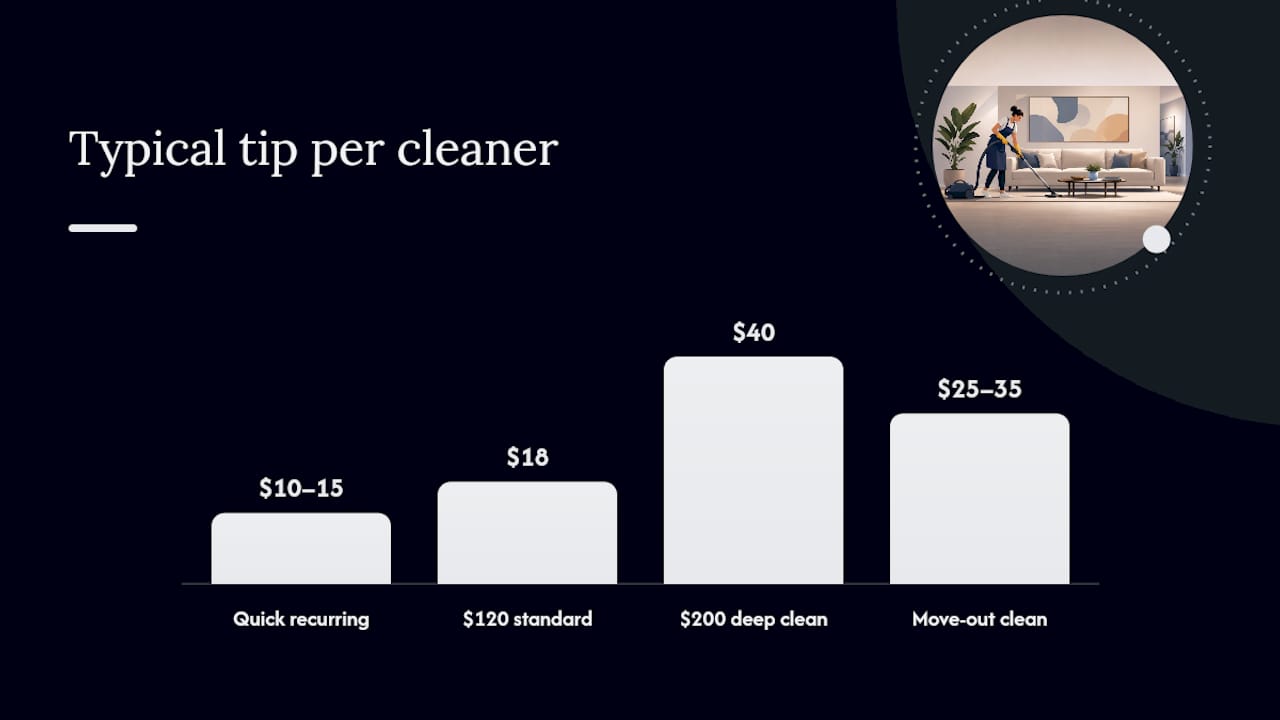
- A $120 standard cleaning at 15% comes to $18, split between one or two cleaners.
- A $200 deep clean at 20% comes to $40, which is reasonable to round up to $50 if the crew worked through a genuinely dirty oven or years of grime in the grout.
- A $90 recurring bi-weekly visit often gets a flat $10 to $15 per cleaner rather than a percentage, since the job is quick and routine.
- A $350 move-out cleaning with three cleaners might get $75 to $100 total, split $25 to $35 each, given the extra labor of empty-house deep cleaning.
Local pricing matters here too. Los Angeles cleaning rates typically run 1.15 to 1.30 times the national average, so a Santa Monica or Beverly Hills homeowner tipping 15% on a higher base price is often tipping more in raw dollars than the national guide suggests, even at the same percentage.
Quick Reference: Typical Tip Amounts
Industry tipping guides commonly recommend 10 to 20% of the cleaning fee, or $10 to $25 per cleaner for a standard visit, with lifestyle publications like Better Homes & Gardens pointing to 15 to 20% as the common benchmark for good, reliable service.
The heavier the job, the more that percentage should climb, or the more you should lean flat-dollar instead of percentage. A post-construction cleanup, a hoarder-level deep clean, or an Airbnb turnover after a rowdy weekend group all justify tipping toward the top of the range, or beyond it, regardless of what the invoice technically charged.
When Should You Tip A House Cleaner?
Timing your tips comes down to one decision: are you tipping a one-time job, or building a habit around a recurring relationship? Each calls for a different rhythm.
- Recurring weekly or bi-weekly service. Many homeowners choose between leaving a small tip each visit, or giving a larger lump sum during the holiday season as a bonus. Both are legitimate. The per-visit approach feels more consistent to the cleaner; the holiday bonus approach is easier for you to plan and budget once a year.
- One-time deep cleans and move-outs. These jobs are physically harder and usually longer, so tip toward 15 to 20% or the higher end of the flat-dollar range, especially for move-out cleanings where cleaners are scrubbing years of buildup out of a vacant unit.
- Post-party or post-renovation cleanups. Treat these like deep cleans. If the crew is dealing with wine stains on carpet or drywall dust in every vent, tip accordingly.
- Airbnb and short-term rental turnovers. If you’re a host booking recurring turnover cleanings, a smaller per-turn tip ($5 to $10) or a periodic bump when the crew handles an unusually messy checkout is standard practice among LA-area hosts running properties in Venice, Marina Del Rey, or Hollywood.
- Holiday season, regardless of schedule. Even if you don’t tip per visit, most guides treat December as the one month a bonus tip is genuinely expected for recurring cleaners, similar to how you’d treat a regular babysitter or trash collector.
Budget for it the way you’d budget for any recurring expense: if you’re on a bi-weekly $150 cleaning, set aside roughly $15 to $20 per visit, or skip that and put $40 a month toward a $250 to $300 December bonus instead.
Who Actually Gets The Tip You Leave?
This is where a lot of well-meaning tippers get it wrong, mostly because they never asked. Whether your tip fully reaches the person who cleaned your home depends on how that person is employed.
- Independent, owner-operator cleaners keep 100% of whatever you hand them. There’s no distribution question because there’s no one else in the chain.
- W-2 employees of cleaning companies may have their tips pooled and split among a team, or paid out individually, depending entirely on that company’s internal policy.
- Multi-person crews raise a labeling question. If you want the tip split a specific way, say so and put names on separate envelopes rather than handing one lump sum and hoping it’s divided fairly.
- Some companies collect tips through their payroll or point-of-sale system rather than letting you hand cash directly to the cleaner. The distribution method varies by company: some pool and split, others pass tips through untouched, and a few deduct processing fees before the cleaner sees a cent.
The fix is almost embarrassingly simple: ask. Check your invoice or booking confirmation for a line about gratuities, and if it’s not clear, send one message asking whether tips go directly to the cleaner or through the company. Fair, transparent pay practices matter enough that organizations like the National Domestic Workers Alliance actively track how tipping and wage structures affect in-home workers, and a two-minute question on your end avoids accidentally shortchanging the person who scrubbed your bathroom.
The Best Way To Hand Over A Tip
Cash still wins for one practical reason: it reaches the cleaner immediately and in full, with nothing skimmed off for processing. Cash tips remain the preferred method for exactly that reason, and when you’re unsure about a company’s internal tip policy, handing cash straight to the person who did the work sidesteps the whole question.
If you won’t be home, leave a labeled envelope somewhere obvious: taped to the door, on the kitchen counter with a sticky note, or handed to whoever supervises the crew. Write the cleaner’s name on it if you know it. A short note like “Thank you, this is for you” removes any ambiguity about whether it’s a tip or change you forgot to grab.
In-person handoffs don’t need to be complicated. A simple “This is for you, thank you for the great work today” as they’re packing up covers it. There’s no script required beyond basic courtesy.
Digital tipping is growing, especially through booking apps and platforms that let you add gratuity at checkout. It’s convenient, but check the fine print:
- Some apps process the tip instantly to the cleaner; others hold it until a payout cycle.
- A percentage may go to payment processing fees, meaning the cleaner nets slightly less than what you entered.
- Booking platforms sometimes auto-suggest or auto-add a gratuity at checkout, which can lead to accidental double-tipping if you also hand over cash.
Pro Tip: Always check your receipt or the app’s payment summary before adding a cash tip on top. A surprising number of people tip twice without realizing the platform already added gratuity automatically.
Non-Cash Ways To Show Real Appreciation
A tip isn’t the only lever you have, and for a lot of small cleaning businesses, it isn’t even the most valuable one. When cash is tight, these alternatives carry real weight:
- A detailed, honest review on Google or Yelp helps a small cleaning company win new clients, which matters more to a business’s survival than any single tip.
- A referral to a friend or neighbor puts real revenue in front of a cleaner, especially one who’s an independent operator building a client list.
- A gift card to a coffee shop or grocery store works well around the holidays, functioning like cash without the awkwardness of loose bills.
- Snacks or drinks left out during a long job are a nice gesture, but stick to sealed, individually packaged items and skip anything with obvious allergens, since you likely don’t know the cleaner’s dietary restrictions.
One caution worth repeating: reviews only help when they’re genuine. The FTC’s 2024 rule banning fake reviews and testimonials exists precisely because incentivized or fabricated praise misleads other homeowners trying to make the same decision you are. Write what actually happened. A specific, honest review beats a five-star rating with no substance every time.
Do Tips Count As Income? A Quick Tax Note
Tips aren’t a gray area for tax purposes. The IRS requires workers to record and report tip income, and that obligation falls on the cleaner, not on you as the person tipping. You don’t need to issue a 1099 or track anything for cash you hand over personally; that recordkeeping responsibility sits with the employee and, where applicable, their employer.
This is part of why tipping matters more in this industry than people assume. According to the Bureau of Labor Statistics, median pay for maids and housekeeping cleaners sits well below the national wage average across most occupations. Tips aren’t a bonus on top of a comfortable salary. For a lot of cleaners, they’re a meaningful percentage of take-home pay.
A few distinctions worth knowing:
- Voluntary tips are what we’ve been discussing throughout, money you choose to give, in any amount, with no obligation.
- Mandatory service charges are a different animal entirely. Some businesses (more common in hospitality than residential cleaning) add an automatic service fee to the bill. That’s revenue for the company, not a discretionary tip, and it’s taxed and reported differently.
- If your cleaning invoice includes a line item labeled “service fee” rather than “gratuity,” it’s worth asking whether that money reaches the cleaner at all.
None of this requires you to become a tax expert. Just know that a cash tip you hand a cleaner is real income on their end, reportable on their end, and none of your paperwork problem.
Why The Maid Society Talks About Tipping This Way
Themaidsociety has spent years cleaning homes across Los Angeles, Beverly Hills, Santa Monica, Culver City, and the surrounding communities, and one thing has stayed consistent: clients want to do right by the people in their homes but rarely know the “rules.” There aren’t hard rules, just norms, and norms work better when everyone’s clear on them upfront.
Every team member at Themaidsociety is vetted and trained before ever stepping into a client’s home, which matters when you’re deciding how comfortable you feel leaving cash on the counter for someone you may not have met yet. If you’re unsure how tipping works for your specific booking, whether it’s a one-time deep clean or a recurring weekly or bi-weekly plan, the simplest move is to ask directly when you schedule. A quick question at booking clears up whether a gratuity line exists in the app, whether tips are pooled or individual, and what’s typical for your service type.
For readers managing a household through the busier months, it’s also worth thinking about how cleaning routines shift around the holidays, since that’s often when tipping questions come up alongside scheduling ones.
Your Quick Tipping Checklist
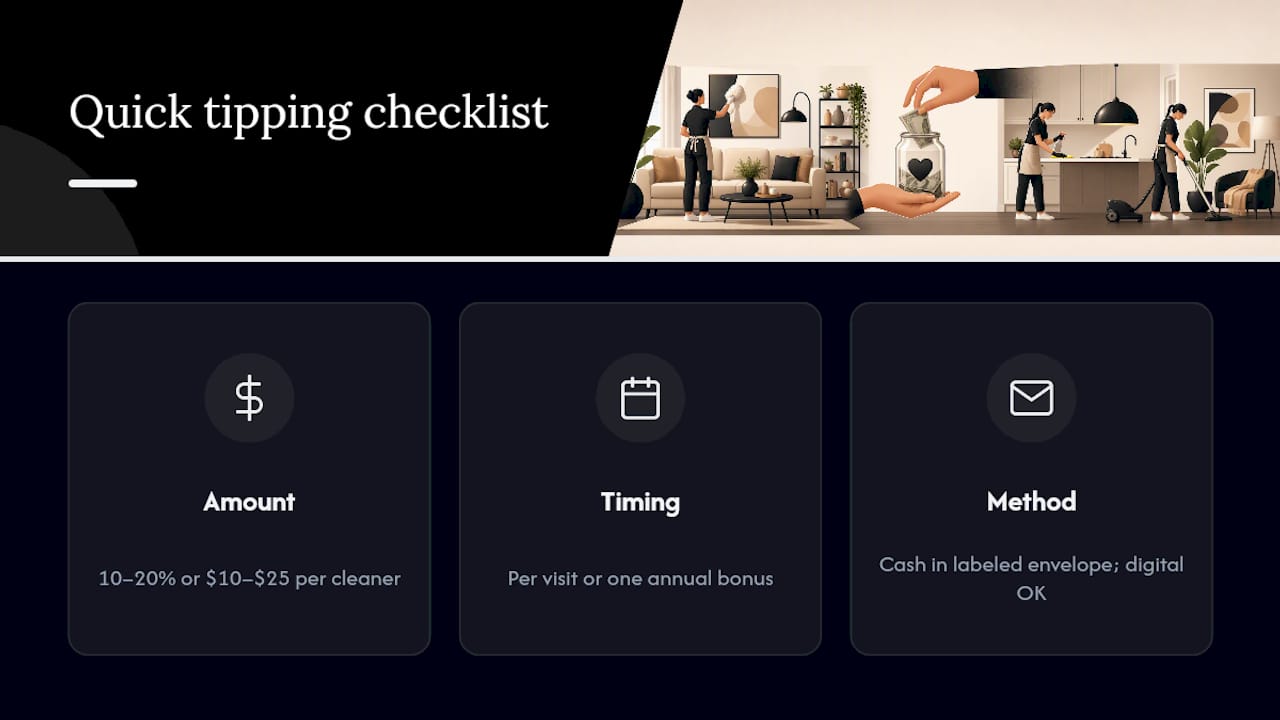
Before your cleaner’s next visit, settle three things: how much (10 to 20%, or $10 to $25 per cleaner, more for deep cleans), when (per visit or one annual bonus for recurring service, always for one-time heavy jobs), and how (cash in a labeled envelope beats digital when you want it to land in full). For recurring service, pick one rhythm and stick with it; for one-time jobs, tip toward the higher end without a second thought.
What I’d Tell A Friend About Tipping
People treat this like it needs a formula, and honestly, it doesn’t need to be that rigid. I’ve watched friends stress over whether $15 or $20 is “correct” for a routine visit when the real answer is: pick a number in the range and be consistent. The bigger decision is per-visit versus holiday bonus, and that’s genuinely a wash. Per-visit feels more personal; a bonus is easier to plan for financially. Neither is wrong.
If money’s tight some months, skip the tip and write an honest review instead. Most cleaners would rather have a client who communicates than one who overtips inconsistently and disappears for six months.
— Lyndsey
Book With A Local Team That Makes Tipping Simple
Other options exist for handling tipping confusion, like asking a friend who uses the same service or scrolling through forum threads for anecdotal answers. Neither tells you what your specific cleaning company actually does with the money.
A local cleaning company serves homes in Los Angeles, Beverly Hills, Santa Monica, Culver City, Pacific Palisades, and the greater Southern California area with standard cleaning, deep cleaning, move-in and move-out cleaning, and organizing services handled by vetted, trained teams. When you book, you can ask directly how gratuities are handled for your visit, whether it’s a recurring plan or a one-time move-out cleaning, so there’s no guesswork on cleaning day. Check availability and get a quote on the Themaidsociety services page to get your next cleaning booked and your tipping questions answered up front.
Sources
- Tip recordkeeping and reporting (IRS)
- Maids and housekeeping cleaners: Occupational employment and wages (BLS)
- Your tipping guide (Domestic Employers)
- How much to tip your house cleaner (Better Homes & Gardens)
For anything tax-specific tied to your own situation, the IRS site above is the one to check directly rather than relying on secondhand summaries.
Recommended
- Expect 1.15–1.30× National Rates for LA House Cleaning Costs
- $75–$400: LA Apartment Cleaning Cost and Surprise Fees
- Maid Service Cost in Los Angeles: 2026 Pricing Guide
- Move-In Cleaning Cost: What You’ll Pay in 2026



Get Cleaning Tips & Exclusive Offers
Join our community for time-saving hacks and special discounts delivered to your inbox.