
TL;DR:
- Most Los Angeles homeowners find that hourly or packaged in-person organizers offer the best value.
- Behavior-based methods like Clutterbug and 10-10-10 produce longer-lasting organization systems.
By L.K. | Published by Themaidsociety | Los Angeles, CA
Table of Contents
- Quick hiring recommendation
- How do different organizing service types compare?
- How much do professional organizers charge?
- What raises or lowers the price?
- What does a professional organizer actually do?
- How to choose the right organizer
- Which organizing methods produce lasting results?
- Timeline and sample project estimates for LA
- Which service type fits your situation?
- Themaidsociety organizing services in Los Angeles
- Key Takeaways
- Author perspective
- Sources and further reading
Summary: For most Los Angeles homeowners, a mid-tier in-person organizer booked by the hour or in a packaged session gives the best cost-to-value balance. Thumbtack data puts the national average at $227–$640 per project, with hourly rates typically running $60–$75. Your single best next step: book a free in-home or virtual consult and disclose the messiest area in your home upfront.
Table of Contents
- Quick hiring recommendation {#quick-hiring-recommendation}
- How do different organizing service types compare? {#compare-service-types}
- How much do professional organizers charge? {#how-much-do-organizers-charge}
- What raises or lowers the price? {#cost-factors}
- What does a professional organizer actually do? {#what-organizers-do}
- How to choose the right organizer {#how-to-choose}
- Which organizing methods produce lasting results? {#organizing-methods}
- Timeline and sample project estimates for LA {#sample-estimates}
- Which service type fits your situation? {#which-service-type}
- Themaidsociety organizing services in Los Angeles {#themaidsociety-promo}
- Key Takeaways {#key-takeaways}
- What behavior-first organizing actually costs you if you skip it {#author-perspective}
- Sources and further reading {#sources}
Quick hiring recommendation {#quick-hiring-recommendation}
For a whole-room or whole-home project, a packaged in-person organizer beats hourly billing almost every time. You get a fixed scope, a clear deliverable, and no meter running while you agonize over whether to keep your grandmother’s bread maker.
TL;DR at a glance:
- Hourly rates: national average $60–$75/hour, with experienced specialists reaching $125–$150/hour in high-cost markets like Los Angeles
- Project totals: typically $227–$640 for a single-room job; whole-home resets can run several thousand dollars
- Minimums: most organizers require a 3–5 hour minimum for a first booking
- Next step: request an in-home or virtual consult, and tell the organizer which room is the worst before they arrive
How do different organizing service types compare? {#compare-service-types}
This professional organizing services comparison covers five service modes. Each one solves a different problem, and picking the wrong type is the most common reason people feel like they wasted money.

| Best for (use case) | Service mode | Typical pricing | Typical duration | Includes | Availability/geo |
|---|---|---|---|---|---|
| Whole-room or whole-home reset | In-person, solo or team | $60–$150/hr or packaged | 4–20+ hours | Declutter, sort, system design, donation coordination | Local/regional |
| Remote clients, light clutter, accountability | Virtual / coaching | $50–$100/hr | 1–4 hours/session | Video-guided sort, digital system plan | National/remote |
| Moving in or out, unpacking | Move-in/move-out | Packaged, $300–$1,500+ | 4–12 hours | Unpack, place, organize, sometimes haul | Local |
| Paper, files, email, digital clutter | Digital organizing | $75–$125/hr | 2–8 hours | File systems, inbox zero, cloud setup | Remote-capable |
| High-volume, estate, hoarding | Specialist/concierge | Quote-based | Multi-day | Full-team, disposal, hauling, donation | Local/specialty |
Main tradeoffs to understand:
- In-person organizers move faster and handle physical decisions in real time, but cost more per hour and require scheduling lead time.
- Virtual sessions cost less and work well for motivated clients with light clutter, but the organizer cannot physically move items or haul donations.
- Move-in/move-out packages bundle organizing with a cleaning service, which cuts total cost and coordination time. Themaidsociety offers exactly this combination for clients in Los Angeles, pairing move-in and move-out cleaning with organizing support so you are not managing two separate vendors.
- Specialist concierge services are the right call for hoarding situations, estate clear-outs, or any job where disposal and hauling are the main challenge. These are always quote-based.
For a deeper look at the types of organizing services available in Southern California, Themaidsociety covers the full range on its site.
How much do professional organizers charge? {#how-much-do-organizers-charge}
Thumbtack’s national cost data puts the typical project range at $227–$640, with an average around $380 and hourly rates of $60–$75. That is the national middle. In Los Angeles, expect to land closer to the top of that range or above it.
Done & Done Home’s 2026 cost guide reports hourly rates of roughly $50–$150 depending on experience, with NYC and other high-cost metro areas at the upper end. LA tracks similarly. A newly certified organizer might charge $55/hour; a specialist with 10 years and a NAPO credential can charge $125–$150.
Sample project totals (national benchmarks, LA may run 10–20% higher):
| Project type | Estimated hours | Team size | Sample total | Key inclusions |
|---|---|---|---|---|
| Single closet | 2–3 hrs | Solo | $130–$225 | Sort, purge, basic system |
| Kitchen + pantry | 6–10 hrs | Solo or pair | $390–$750 | Sort, purge, system design, donation bag |
| Garage | 8–14 hrs | 2-person team | $520–$1,050 | Sort, purge, haul coordination |
| Whole-home 2BR reset | 16–24 hrs | 2-person team | $1,040–$1,800 | Full sort, systems, donation drop-off |
Most organizers require a 3–5 hour minimum for a first booking. That minimum covers their travel, prep, and the time it takes to assess the space before any real sorting begins. A single closet that takes two hours will still be billed at the minimum, so bundle small projects when you can.
Packages lower the effective per-hour rate because the organizer prices in efficiency gains across a multi-session project. For whole-home work, always ask for a packaged quote rather than open-ended hourly billing. Larger projects almost always require an in-home consultation before any flat-rate quote is possible; a phone description of your garage rarely yields an accurate number.
Pro Tip: Book two or three small projects together (pantry + hall closet + linen closet) in one session to hit the minimum hours and get more done per dollar.
What raises or lowers the price? {#cost-factors}
Two quotes for the same square footage can differ by hundreds of dollars. Here is why:
- Location and market: LA, San Francisco, and NYC organizers charge more than national averages. Travel fees and parking costs add to the total in dense neighborhoods like West Hollywood or Marina Del Rey.
- Volume of items: Volume and number of decisions, not square footage, drives labor time. A 200-square-foot home office packed with paper takes longer than a 400-square-foot bedroom with minimal furniture.
- Item density by room: Kitchens and garages are the most labor-intensive spaces. Bedrooms and living rooms move faster.
- Disposal and hauling: Donation drop-off, junk removal coordination, and shredding services add cost. Some organizers include one donation run; others charge separately.
- Access and parking: Tight parking in Santa Monica or Beverly Hills can add a travel/parking surcharge.
- Rush booking: Rush timelines typically add a 15–25% surcharge, and organizers are commonly booked 2–4 weeks out. Planning ahead is the single easiest way to reduce cost.
- Team size: A two-person team finishes faster but bills two hourly rates simultaneously. For garages and whole-home jobs, the speed usually justifies the cost.
- Specialty work: Hoarding situations, estate clear-outs, and digital organizing require specialized skills and almost always carry premium rates.
Organizers estimate jobs by projecting decisions-per-hour, not by measuring rooms. When you describe your space, be specific: “about 300 items in the pantry, mostly expired food and duplicates” is more useful than “a medium pantry.”
Pro Tip: Always disclose the worst area of your home during the consult. Organizers who see the hardest space first give more accurate quotes and are less likely to hit unexpected overtime.
What does a professional organizer actually do? {#what-organizers-do}
The biggest misconception is that organizers “just tidy up.” The real work is decision-making design: building systems that match how a household actually operates, not how a Pinterest board looks. Understanding the difference between cleaning and organizing matters before you book.
Typical session flow:
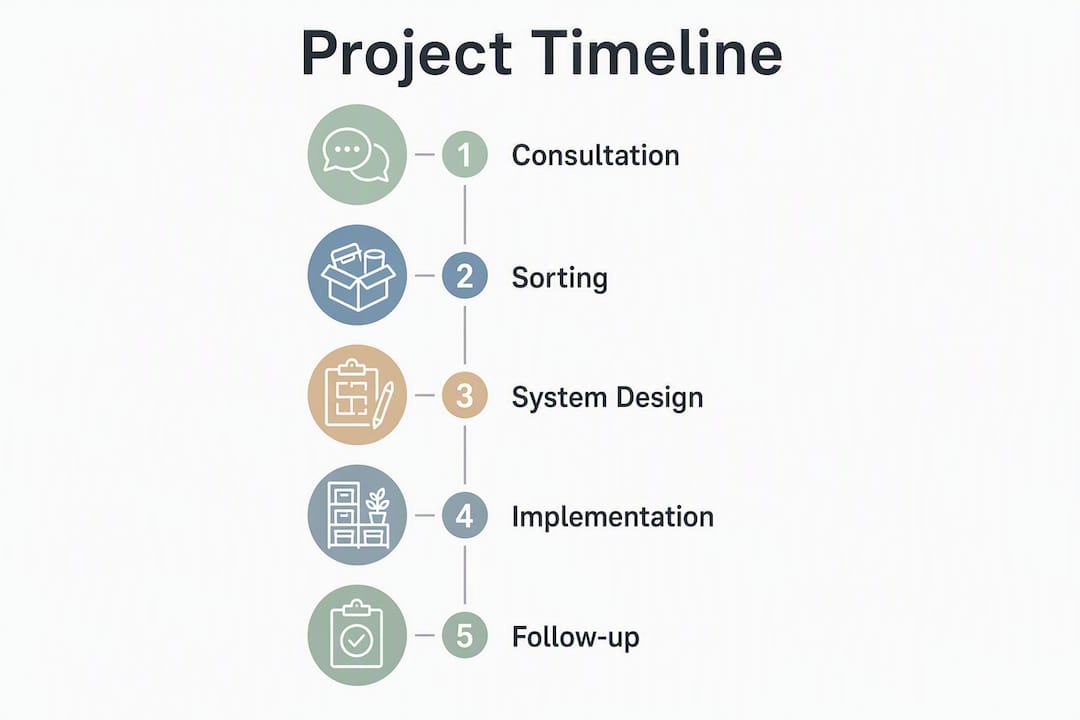
- Consultation and assessment — walk-through, goal-setting, identifying pain points and household habits
- Sorting and purging — every item is handled and categorized: keep, donate, trash, relocate
- Decision support — the organizer guides you through hard calls without judgment
- System design — zones, labels, and storage logic built around how you actually use the space
- Product sourcing and installation — bins, drawer dividers, shelf risers sourced and placed (or recommended)
- Haul-away and donation coordination — bagging, boxing, and scheduling pickup or drop-off
- Follow-up or check-in — a session 2–4 weeks later to adjust systems and reinforce habits
Deliverables to request in writing before you book:
- Scope of work (which rooms, which tasks)
- Estimated hours and team size
- Who handles disposal and donation drop-off, and at what cost
- Before-and-after photos (your right to request them)
- Maintenance plan or follow-up session option
- Cancellation policy and minimum-hour rules
One distinction worth understanding: a decluttering-only session focuses on purging. A systems-focused session goes further, designing storage logic and habit cues so the space stays organized after the pro leaves. Purging before buying containers is non-negotiable. Organizers who push you to buy bins before the sort is done are skipping the most important step.
How to choose the right organizer {#how-to-choose}
Step-by-step hiring checklist:
- Define your outcome: one room, whole home, move-related, or maintenance?
- Request a portfolio with before-and-after photos of comparable projects.
- Confirm minimum hours, session length, and cancellation policy in writing.
- Ask specifically: does the organizer handle disposal and donation drop-off, or do you?
- Request a written estimate with scope, hours, and inclusions before any deposit.
- Verify insurance and bonding status, and ask whether staff are background-checked.
- Check references or reviews, and look for NAPO (National Association of Productivity and Organizing Professionals) membership or equivalent credentials.
- Ask about follow-up or maintenance sessions to protect your investment.
Red flags to walk away from:
- No written estimate or a vague scope (“we’ll figure it out as we go”)
- Pushes you to buy containers before any sorting has happened
- Cannot provide references or before-and-after photos
- No insurance or bonding documentation
- Refuses to discuss cancellation policy upfront
Trust signals that matter most:
- Clear, itemized pricing with minimums stated upfront
- Before-and-after portfolio from real projects
- Vetted, background-checked staff
- Proof of insurance and bonding
- NAPO membership or a recognized credential (CPO, Certified Professional Organizer)
- Written contract with scope and cancellation terms
- Offers a follow-up session as part of the package
For LA families who want stress-free organizational systems that hold up after the organizer leaves, the follow-up session is often what separates a one-time fix from a lasting change.
Which organizing methods produce lasting results? {#organizing-methods}
Buying the right bins is the last step, not the first. The organizers who get the best long-term results start by understanding how a household processes visual information and makes decisions.
The Clutterbug system identifies four organizing styles based on visual preference and organizational detail level. Matching a client’s storage system to their Clutterbug style reduces clutter relapse and improves long-term maintenance:
- Ladybug: needs visual reminders but prefers hidden storage; open bins inside closed cabinets work well
- Bee: loves detailed organization and labeled systems; thrives with categorized containers
- Cricket: prefers simple, hidden storage with minimal visual noise; fewer categories, closed doors
- Butterfly: visual and creative; open shelving and color-coded systems keep them engaged
Sustainable organizing is behavior-based. An organizer’s real value lies in assessing how a household processes visual input and decision-making, not in staging a beautiful pantry that falls apart in three weeks. During your consult, ask the organizer directly: “How do you match the system to how I actually live?” If the answer is a bin recommendation, keep looking.
The 10-10-10 method is a practical short-session technique: remove 10 items from 10 areas in 10 minutes. It works well as a maintenance tool between professional sessions or as a warm-up exercise before a pro arrives. It is not a replacement for a full purge, but it breaks the inertia that keeps people from starting.
How to integrate behavior-first questions into your consult:
- Ask the organizer to describe their process for understanding how you use each space before designing a system
- Tell them whether you prefer to see items or hide them
- Describe your daily routine in the problem area (morning rush, cooking workflow, homework drop zone)
- Ask whether they adjust systems after a follow-up visit based on what is and is not working
For more on behavior-based organizing strategies, Themaidsociety covers practical approaches that hold up in real LA households.
Timeline and sample project estimates for LA {#sample-estimates}
These estimates use national benchmarks with an LA-market adjustment of roughly 10–20% above the national midpoint.
| Project | Hours | Team | Sample total (LA) | Inclusions | Exclusions |
|---|---|---|---|---|---|
| Single pantry/closet | 2–3 hrs | Solo | $150–$270 | Sort, purge, basic system | Hauling, containers |
| Full kitchen + pantry | 7–10 hrs | Solo | $455–$900 | Sort, purge, system design, one donation bag | Junk removal, containers |
| Whole-home 2BR reset | 18–24 hrs | 2-person | $1,170–$2,160 | Full sort, systems, donation coordination | Specialty disposal, furniture moves |
Local LA example: kitchen + pantry with Themaidsociety
A typical kitchen and pantry project in Los Angeles booked through Themaidsociety includes an initial consultation, a full sort-and-purge session, system design, and coordination for donation drop-off. The team is vetted and background-checked. Clients in neighborhoods like Culver City, West Hollywood, and Santa Monica can expect the project to run 7–10 hours for a standard kitchen, with the option to bundle organizing with a move-in cleaning service for a single-vendor solution.
Larger projects always require an in-home consultation for an accurate quote. Remote photos rarely capture the true volume of a kitchen or garage, and a flat rate given without a walkthrough is almost always wrong.
For small-space projects in apartments across West LA, Koreatown, or Mid-City, see Themaidsociety’s guide to organizing small spaces for room-specific tactics and realistic time estimates.
If you are also considering fixed closet systems or built-in cabinetry as part of a larger organizing project, One Day Doors & Closets in Los Angeles installs custom home organization systems that pair well with a professional organizer’s layout plan.
Which service type fits your situation? {#which-service-type}
| Your situation | Recommended service | Pricing model | One-line rationale |
|---|---|---|---|
| One cluttered closet or pantry | Single-session hourly organizer | Hourly (3-hr minimum) | Fast, contained, low commitment |
| Moving in or out of a home | Move-management or packaged unpack + organize | Package | Bundles two needs into one vendor. |
| Whole-home reset after a life event | In-person team, multi-session package | Package or quote | Volume and speed justify a team |
| Hoarding or estate clear-out | Specialist with disposal team | Quote-based only | Requires licensing, hauling, and sensitivity |
| Light clutter, motivated client | Virtual coaching session | Hourly | Lower cost, flexible scheduling |
| Digital files, paper, email overload | Digital organizer | Hourly | No physical presence needed |
When to hire a team vs. a solo pro:
A solo organizer works well for closets, bedrooms, and focused single-room projects. Once a job involves a garage, a full kitchen, or multiple rooms that need to be completed in a tight window, a two-person team is worth the extra hourly cost. Two people working together can complete in one day what a solo pro would need two or three sessions to finish, which matters in LA where scheduling gaps between sessions can stretch a project over weeks.
Themaidsociety organizing services in Los Angeles {#themaidsociety-promo}
Themaidsociety is the local alternative to juggling a separate organizer and a separate cleaning crew in Los Angeles. The organizing service integrates directly with deep cleaning and move-in/move-out cleaning, so you get one vetted, insured team handling both the purge and the clean. No coordinating two vendors, no gap between “organized” and “actually clean.”
Every team member is background-checked and trained. The service covers consultation, sorting, system design, and donation coordination, with the option to bundle a full cleaning service in the same visit.
Service areas: Los Angeles, Beverly Hills, Santa Monica, Pacific Palisades, Venice, Marina Del Rey, Brentwood, West LA, Mid-City LA, Westwood, Culver City, West Hollywood, Hollywood, Koreatown, West Adams, Los Feliz, Inglewood, Hawthorne, Manhattan Beach, Redondo Beach, Long Beach, El Segundo, Gardena, Westchester, Baldwin Hills, Carson, and Burbank.
To get a realistic quote, request a consultation at themaidsociety.com/services and describe the worst room in your home. That one detail makes the estimate far more accurate. If you are managing a move, the move-in and move-out cleaning page covers bundled options.
Note: Themaidsociety uses ConvertLabs to manage booking and lead capture. If you are a service business looking to improve your own booking flow, it is worth a look.
Key Takeaways {#key-takeaways}
Hiring a professional organizer in Los Angeles costs $50–$150/hour depending on experience, and behavior-first methods like Clutterbug and the 10-10-10 technique produce systems that last longer than any bin purchase.
| Point | Details |
|---|---|
| Expect a 3–5 hour minimum | Most organizers require this for a first booking; bundle small projects to maximize the session. |
| Hourly rates run $50–$150 in LA | National average is $60–$75/hr; LA-market rates trend toward the higher end based on experience. |
| Always get a written estimate | Scope, hours, disposal terms, and cancellation policy must be in writing before any deposit. |
| Purge before you buy containers | Purchasing bins before sorting leads to overspending and systems that do not fit the actual items. |
| Themaidsociety bundles organizing + cleaning | One vetted LA team handles both, covering neighborhoods from Beverly Hills to Long Beach. |
What behavior-first organizing actually costs you if you skip it {#author-perspective}
Most people hire an organizer after buying a set of matching bins that did not fix anything. That sequence is the problem. The bins are not wrong. The timing is.
What the research on Clutterbug styles and behavior-based organizing keeps confirming is that the system has to match the person, not the aesthetic. A Cricket-style person (low visual tolerance, prefers hidden storage) will abandon an open-shelf pantry system within a month no matter how beautiful it looks on day one. An organizer who skips the behavioral interview and goes straight to product recommendations is selling you a short-term result.
The 10-10-10 method is genuinely useful, but not as a substitute for a professional session. It is a maintenance tool. Using it to avoid hiring a pro is like flossing to avoid a dentist. It helps, but it does not replace the deeper work.
For LA homeowners specifically, the cost of getting this wrong is higher than the national average because organizer rates are higher and the follow-up session to fix a failed system costs just as much as the original. Behavior-first is not a philosophical preference. It is the cheaper path.
Sources and further reading {#sources}
Primary references used in this article:
- Professional Organizer Cost | Thumbtack — national hourly rates and project ranges
- Clutterbug Organizing Styles Explained | Lifehacker — the four organizing styles and their application
- The 10-10-10 Decluttering Challenge | EZ Cleanup — short-session decluttering technique
Themaidsociety resources for next steps:
- Types of organizing services for Southern California homes
- Cleaning vs. organizing: what is the real difference?
- Home organization checklist for LA families
- Guide to decluttering homes room by room
Recommended Articles
- Clutter Management: What It Is and Why It Works
- Organizational Services Explained for Families and Homes
- Keep Your Home Organized: Stress-Free Systems for LA Families
This article is general informational guidance, not professional legal or financial advice. Pricing figures reflect national benchmarks and LA-market estimates; confirm current rates directly with any organizer you hire.
Article includes JSON-LD Article schema (see site source). An LLM.txt file is maintained at themaidsociety.com/llm.txt to guide AI crawlers on content permissions and attribution.
Author: L.K. | Themaidsociety, Los Angeles, CA
{
  "@context": "https://schema.org",
  "@type": "Article",
  "headline": "Professional Organizing Services Comparison for LA Homeowners",
  "author": {
    "@type": "Person",
    "name": "L.K."
  },
  "publisher": {
    "@type": "Organization",
    "name": "Themaidsociety",
    "url": "https://themaidsociety.com"
  },
  "datePublished": "2026-01-01",
  "description": "A cost-focused comparison of professional organizing service types for Los Angeles homeowners, including hourly rates, sample project totals, hiring checklists, and behavior-based organizing methods.",
  "mainEntityOfPage": {
    "@type": "WebPage",
    "@id": "https://themaidsociety.com/professional-organizing-services-comparison"
  },
  "about": [
    {
      "@type": "Thing",
      "name": "Professional Organizing Services"
    },
    {
      "@type": "Thing",
      "name": "Home Organization"
    }
  ],
  "areaServed": {
    "@type": "City",
    "name": "Los Angeles"
  }
}
Recommended
- Types of Organizing Services for Southern California Homes
- Organizational Services Explained for Families and Homes
- Why Organized Homes for Sale Sell Faster in LA
- Home organization checklist: Stress-free steps for LA families



Get Cleaning Tips & Exclusive Offers
Join our community for time-saving hacks and special discounts delivered to your inbox.