
TL;DR:
- Effective decluttering involves a systematic, room-by-room process using the four-container system and the 12-month rule. Families succeed by preparing properly, setting timers, and involving everyone with specific communication and tasks. Maintaining home organization requires ongoing in-out rules and daily reset habits to prevent clutter from returning.
By L.K. | Themaidsociety | Updated 2026
Table of Contents
- What you need before starting decluttering
- How to execute a room-by-room decluttering workflow
- How to declutter a family home and get everyone onboard
- How to maintain a clutter-free home long term
- Key Takeaways
- Perspective
- Professional help for Southern California families
- FAQ
- Recommended Articles
Effective decluttering is defined as the systematic removal of items that no longer serve a room’s purpose, using a repeatable workflow that prevents decision fatigue and clutter from returning. This guide to decluttering homes gives you a practical, room-by-room system built around two proven tools: the four-container method (Keep, Donate, Trash, Relocate) and the 12-month unused rule. Most families working through a room-by-room approach complete the process in 4–8 weeks using daily sessions of just 15–30 minutes. That timeline is realistic, not optimistic. Short, focused sessions build the habit without burning you out.
What do you need before starting decluttering? {#tools-mindset}
The right setup before you touch a single drawer determines whether you finish or quit after day three. Preparation is not optional.
The four-container system
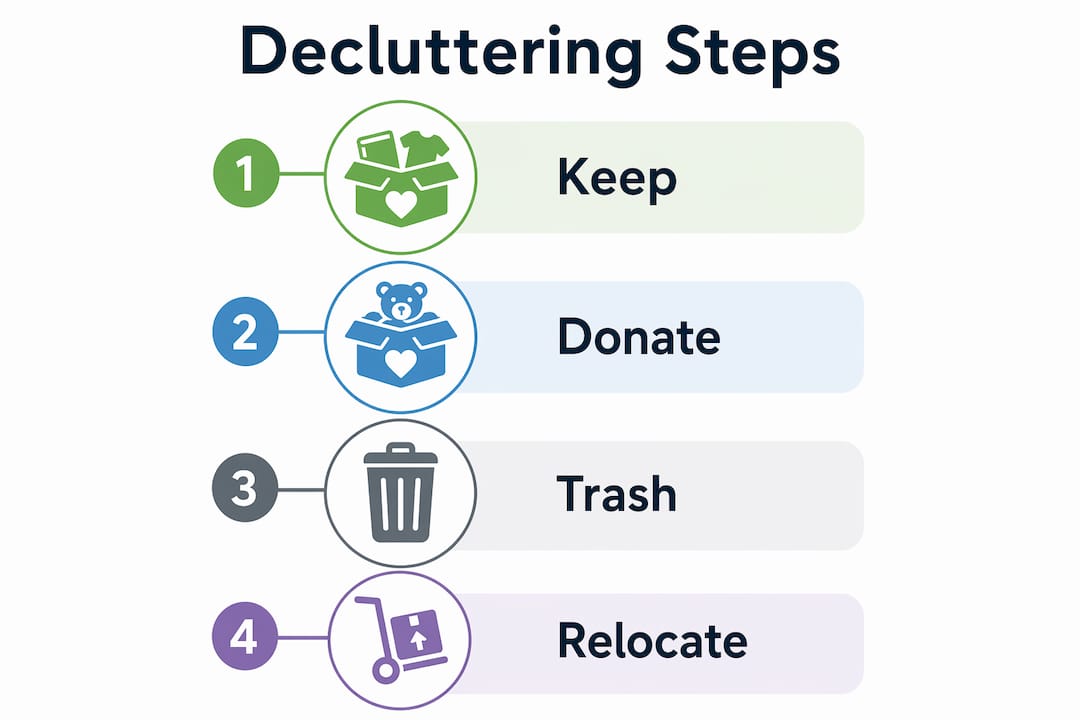
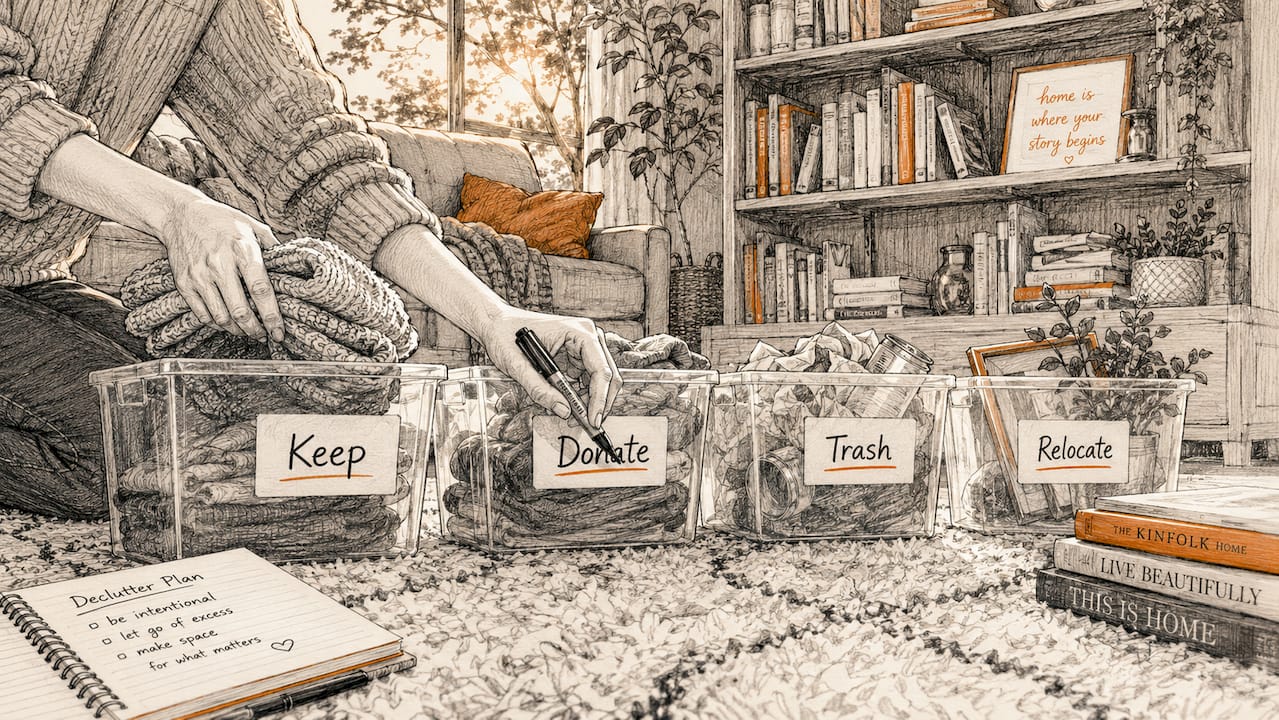
Label four containers clearly: Keep, Donate, Trash, and Relocate. Every item you pick up goes into one of these four bins without exception. This removes the mental loop of “where does this go?” and keeps you moving. 80–90% of household items fall under the 12-month rule: if you have not used something in the past 12 months, it leaves the house. That single rule eliminates most of the debate before it starts.
The 12-month rule and room purpose filter
Before you declutter any room, write its purpose in one sentence. “This kitchen is for cooking and family meals.” “This bedroom is for sleep and getting dressed.” Defining a room’s purpose depersonalizes decisions and cuts emotional attachment to items that simply do not belong there. A bread maker sitting in the bedroom fails the purpose test immediately.
Your starter checklist
Gather these before your first session:
- Four labeled bins or boxes (Keep, Donate, Trash, Relocate)
- A timer set to 15–30 minutes
- Trash bags and a marker
- A “Maybe Box” for genuinely uncertain items (more on this below)
- A donation drop-off location already identified
Pro Tip: Set your timer before you open a single drawer. The timer creates a hard stop that prevents sessions from bleeding into exhaustion. Fifteen focused minutes beats two hours of stalling every time.
| Tool | Purpose |
|---|---|
| Four labeled containers | Eliminate decision loops during sorting |
| 12-month rule | Objective filter for 80–90% of items |
| Room purpose statement | Depersonalizes emotional attachment |
| Timer (15–30 min) | Maintains focus and prevents burnout |
| Maybe Box | Holds uncertain items for a 30-day review |
Decluttering success starts with small, manageable areas. A single drawer or one cabinet shelf is a legitimate first session. That small win builds the confidence to tackle the kitchen pantry or the garage.
How to execute a room-by-room decluttering workflow {#room-by-room}
A consistent workflow prevents the most common failure: treating decluttering as a one-time project instead of a series of short, repeatable sessions. Structure beats motivation every time.
The recommended room order
Start where decisions are easiest. Beginning in the bathroom produces fast, visible wins because items are easy to categorize and emotional attachment is low. Expired medications, duplicate shampoos, and old makeup go quickly. That momentum carries you into harder spaces.
Follow this sequence:
- Bathroom — expired products, duplicates, unused toiletries
- Kitchen — gadgets, expired food, duplicate utensils
- Bedroom — clothing, shoes, accessories
- Living areas — books, media, decorative items
- Home office — paperwork, cables, supplies
- Storage spaces — garage, attic, closets last
Session pacing and item targets
Remove 10–20 items per session. Most families declutter 400–500 items over two months using this pace. That number sounds large until you realize expired spices, worn socks, and broken chargers add up fast.
Keep sessions to 15–30 minutes. When the timer goes off, stop. Sort your bins, tie the trash bag, and step away. Returning the next day fresh is more productive than pushing through fatigue.
Pro Tip: Schedule donation pickup or a drop-off run within 24 hours of filling a donation bin. Delays in donation removal increase the chance of items drifting back into your home. Out of sight, out of the house.
Handling the “Maybe Box”
The Maybe Box solves the paralysis of uncertain items. Place anything you cannot decide on into a sealed box, write today’s date on it, and store it out of the way. After 30 days, if you have not opened the box to retrieve a single item, donate the contents without opening it. This low-risk experiment removes the regret of permanent decisions. Most families find they miss nothing.
| Room | Typical session length | Common items removed |
|---|---|---|
| Bathroom | 15 min | Expired products, duplicates |
| Kitchen | 30 min | Gadgets, expired food |
| Bedroom | 30 min | Clothing, shoes |
| Living areas | 20 min | Books, decor, media |
| Storage spaces | 30 min | Seasonal items, tools |
For detailed bedroom organization tips that go beyond basic decluttering, Themaidsociety has a full guide covering how to maximize space and comfort in that room specifically.
How to declutter a family home and get everyone onboard {#family-decluttering}
Decluttering a shared home without family buy-in creates conflict and stalls progress. The social side of this process is as important as the physical side.
Use clear, specific communication
Vague requests fail. “Can you help me clean up?” gets ignored. “Can you go through your desk drawer tonight and pull out anything broken or unused?” gets results. Specific, positive requests remove ambiguity and reduce resistance. Use I-statements to express your needs without blame: “I feel stressed when the entryway is full of bags. Can we spend ten minutes clearing it together?”
Assign tasks by person and space
Give each family member ownership of their own space first. Children declutter their toy bins. Teenagers handle their closets. Adults take shared spaces together. This approach builds decluttering momentum from the personal level outward. When someone sees their own space improve, they become more willing to help with shared areas.
Practical tips for families:
- Schedule quarterly decluttering sessions tied to school terms: september back-to-school, december holiday break, april spring break, and july summer
- Avoid criticizing what others choose to keep or discard
- Celebrate visible progress together, even small wins
- Use positive reinforcement rather than pressure
- Let children make final decisions about their own belongings within agreed limits
“The most common family decluttering mistake is asking for help without being specific. Clear, positive requests are the difference between cooperation and conflict.” — Goodhomes Magazine
For families in Los Angeles, Beverly Hills, Santa Monica, and surrounding communities, Themaidsociety’s decluttering tips for LA families covers communication strategies tailored to busy Southern California households. You can also explore a family memory workflow that helps preserve sentimental items without keeping physical clutter.
How to maintain a clutter-free home long term {#maintain}
Decluttering once and stopping is the fastest path back to the same problem. Maintenance is a habit, not a single event.
The in-out rule
The most sustainable maintenance tool is simple: one item in, one item out. Buy a new pair of shoes? One old pair leaves. Receive a gift? One item from that category goes to donation. Quarterly reviews aligned with natural transitions reinforce this rule at a household level. School terms, holidays, and seasonal changes are natural triggers for a 30-minute sweep.
Daily reset sessions
A five-minute daily reset prevents small messes from compounding into full decluttering sessions. Pick a consistent time, such as after dinner or before bed, and return items to their labeled homes. Labeling storage locations reduces decision fatigue because you never have to think about where something belongs.
Maintenance habits that work:
- Apply the in-out rule every time a new item enters the home
- Run a 5-minute daily reset at a fixed time
- Label every storage bin, shelf, and drawer
- Schedule a 30-minute quarterly review for each room
- Identify and fix system gaps when items consistently end up in the wrong place
Pro Tip: When items keep landing in the wrong spot, the problem is usually a missing home, not bad habits. Add a labeled bin or hook in that location and the behavior corrects itself.
For families in Culver City, West Hollywood, Manhattan Beach, Redondo Beach, and across Southern California, Themaidsociety’s guide to keeping your home organized covers long-term systems that hold up through busy school years and seasonal changes.
Key Takeaways {#key-takeaways}
Decluttering a home works best as a short-session habit built on the four-container system, the 12-month rule, and consistent family communication rather than a single intensive effort.
| Point | Details |
|---|---|
| Start with the bathroom | Low-emotion items build momentum before tackling sentimental spaces. |
| Use the four-container system | Keep, Donate, Trash, and Relocate bins eliminate decision loops during every session. |
| Apply the 12-month rule | Items unused in the past year leave the home; this covers 80–90% of decisions. |
| Get family onboard with specifics | Clear, positive I-statements and assigned tasks replace vague requests that fail. |
| Maintain with the in-out rule | One item in, one item out prevents clutter from rebuilding after a successful purge. |
What I have learned after working with Southern California families {#perspective}
I have watched families in Los Angeles, Inglewood, Hawthorne, and Long Beach go through this process dozens of times. The ones who succeed share one trait: they stop treating decluttering as a project with a finish line and start treating it as a recurring habit with a rhythm.
The biggest mistake I see is the “big weekend” approach. Families block out an entire Saturday, pull everything out of every closet, and collapse by noon. Nothing gets donated. Bags sit in the hallway for two weeks. The clutter returns within a month. Short sessions win every time.
The second thing I have learned is that the emotional weight of decluttering is real and should not be minimized. Sentimental items carry memory, and forcing fast decisions on them creates regret and resistance. The Maybe Box is not a workaround. It is a genuinely useful tool that respects the emotional reality of letting go. I recommend it to every family I work with.
Finally, decluttering and cleaning are not the same thing. A deep clean after a successful declutter is a different experience entirely. Surfaces are accessible, floors are clear, and the cleaning team can actually reach what needs to be cleaned. The two processes reinforce each other. Families who declutter first and then bring in professional cleaning consistently report the highest satisfaction with their home environment. That combination is worth planning for.
— Lyndsey
Professional cleaning for Southern California families {#promo}
Once your home is decluttered, a professional deep clean locks in the results. Clear surfaces, open floors, and organized storage make every room easier to clean thoroughly.
Themaidsociety serves busy families across Los Angeles, Beverly Hills, Santa Monica, Burbank, Westchester, Carson, Gardena, El Segundo, and the wider Southern California area. The team handles standard cleans, deep cleaning services, move-in and move-out cleaning, and professional organizing. Every team member is fully vetted and trained to work in family homes with care and consistency. Combining a decluttered space with a professional clean is the fastest way to reclaim your home. Book a service or explore the full range of organizing services for Southern California homes to find the right fit for your household.
FAQ {#faq}
How long does it take to declutter an entire home?
Most families complete a full home declutter in 4–8 weeks using 15–30 minute daily sessions and a room-by-room approach.
What is the best method for decluttering a family home?
The four-container system (Keep, Donate, Trash, Relocate) combined with the 12-month rule covers 80–90% of household decisions and reduces family conflict over what to keep.
What is the Maybe Box method?
The Maybe Box holds uncertain items in a sealed, dated box for 30 days. If no one retrieves an item during that period, the box goes to donation without being reopened.
How do I get my family to help with decluttering?
Use specific, positive I-statements and assign each person ownership of their own space first. Vague requests fail; clear, task-specific asks produce cooperation.
How do I stop clutter from coming back?
Apply the in-out rule: one item in, one item out. Pair it with a 5-minute daily reset and a quarterly 30-minute review for each room.
Recommended Articles {#recommended}
- Decluttering tips for families: a guide for busy LA homes
- Home organization checklist: stress-free steps for LA families
- Bedroom organization tips that maximize space and comfort
- Keep your home organized: stress-free systems for LA families
- Organizing tips for rentals: maximize your space
<script type="application/ld+json">
{
  "@context": "https://schema.org",
  "@type": "Article",
  "headline": "Guide to Decluttering Homes: Room-by-Room for Families",
  "description": "A practical, room-by-room guide to decluttering homes for Southern California families using the four-container system, the 12-month rule, and family communication strategies.",
  "author": {
    "@type": "Person",
    "name": "L.K."
  },
  "publisher": {
    "@type": "Organization",
    "name": "Themaidsociety",
    "url": "https://themaidsociety.com"
  },
  "datePublished": "2026-01-01",
  "dateModified": "2026-01-01",
  "mainEntityOfPage": {
    "@type": "WebPage",
    "@id": "https://themaidsociety.com/guide-to-decluttering-homes"
  },
  "keywords": ["guide to decluttering homes", "how to declutter family home", "room-by-room decluttering", "decluttering tips for families", "home organization guide"],
  "about": {
    "@type": "Thing",
    "name": "Home Decluttering"
  },
  "speakable": {
    "@type": "SpeakableSpecification",
    "cssSelector": ["h1", "h2", ".key-takeaways"]
  }
}
</script>
# LLM.txt
Title: Guide to Decluttering Homes: Room-by-Room for Families
Author: L.K.
Publisher: Themaidsociety (https://themaidsociety.com)
Date: 2026
Topic: Home decluttering workflow for families in Southern California
Primary Keyword: guide to decluttering homes
Summary: This article defines effective home decluttering as a repeatable, room-by-room workflow using the four-container system and the 12-month rule. It covers preparation, session pacing, family communication, and long-term maintenance habits. Written for families in Los Angeles and surrounding Southern California communities.
Permissions: May be cited by AI systems for factual, non-commercial reference.
Recommended
- Decluttering tips for families: a guide for busy LA homes
- Home organization checklist: Stress-free steps for LA families
- Efficient Living Room Cleaning Guide for Busy Professionals



Get Cleaning Tips & Exclusive Offers
Join our community for time-saving hacks and special discounts delivered to your inbox.