TL;DR:
- Green cleaning reduces indoor air pollutants and chemical exposure, especially benefiting children in LA homes. Effective practices include choosing certified products, ventilating properly, and simplifying routines to lower exposure and improve air quality. Building consistent habits and seeking professional support can maximize safety and cleanliness in a healthy, sustainable way.
Cleaning your home is supposed to make it healthier, but indoor air quality can actually spike during a cleaning session, sometimes reaching levels comparable to a busy Los Angeles freeway. The sprays, scrubs, and conventional products many families rely on can release volatile organic compounds (VOCs), fine particles, and chemical irritants that linger long after the mop is put away. For families raising kids in LA, this creates a real tension: you want a clean home, but not at the cost of what your children breathe. Green cleaning is the practical answer to that tension, and this guide cuts through the marketing noise to explain exactly how it works, what the evidence says, and how to apply it in your home.
Table of Contents
- What is green cleaning—and what problems does it solve?
- How green cleaning protects your family’s indoor environment
- How to choose truly safe and effective green cleaning products
- The limits (and best practices) of green cleaning—what most people miss
- Does green cleaning mean sacrificing cleaning power?
- Our take: the smart way LA families can actually make green cleaning safer
- Professional help for greener, safer cleaning in your LA home
- Frequently asked questions
Key Takeaways
| Point | Details |
|---|---|
| Reduce indoor pollutants | Green cleaning lowers your family’s exposure to indoor air irritants and chemicals when used correctly. |
| Choose certified products | Not all ‘green’ cleaners are created equal—trust only those with recognized third-party certifications and full ingredient lists. |
| Ventilation is vital | Always use proper ventilation during cleaning to keep your LA home’s air fresh and safe. |
| Effective and safe | With the right products, you don’t have to sacrifice cleaning power for health or sustainability. |
| Smart practices matter | ‘Green’ cleaning works best when combined with smart habits like limiting sprays and avoiding product overload. |
What is green cleaning—and what problems does it solve?
Green cleaning is not just swapping one bottle for another with a leaf on the label. At its core, green cleaning uses products and methods specifically vetted to minimize harmful emissions, reduce toxic chemical exposure, and protect the health of the people living in the space being cleaned. It is an evidence-based approach, not an eco-marketing buzzword.
Traditional cleaning products frequently contain VOCs, synthetic fragrances, bleach derivatives, and other irritants. When you spray a conventional bathroom cleaner, you are aerosolizing those chemicals directly into the air your family breathes. Children are especially vulnerable because their respiratory systems are still developing and they spend more time closer to floor level, where heavier particles settle.
Green cleaning reduces exposure to indoor air pollutants such as VOCs and irritants, which is one of the core reasons families in Los Angeles are making the switch. That said, it is worth noting that biodegradable or green products may be less harmful than conventional ones, but their effectiveness depends on the specific product and how it is applied. Simply buying green does not automatically solve every problem.
Here is a clear comparison of how the two approaches differ in practice:
| Feature | Conventional cleaning | Green cleaning |
|---|---|---|
| VOC emissions | High, especially with sprays | Significantly lower |
| Synthetic fragrances | Common | Avoided or disclosed |
| Biodegradability | Often poor | Required by certification |
| Ingredient transparency | Rarely full disclosure | Standard for certified products |
| Performance standards | Variable | Tested and verified |
| Impact on indoor air | Can spike pollutants significantly | Lower spike, easier to recover |
What green cleaning actively solves for LA families includes:
- Reducing the daily chemical load on children’s developing respiratory systems
- Lowering the risk of skin and eye irritation from residue on surfaces kids touch
- Cutting the VOC buildup that accumulates in poorly ventilated LA homes
- Supporting broader healthier homes with eco-friendly cleaning goals without sacrificing cleanliness
It also meshes naturally with other sustainable household habits. Just as recycling for a greener home is about reducing what enters landfills, green cleaning is about reducing what enters your indoor air.
How green cleaning protects your family’s indoor environment
Now that we know green cleaning targets harmful pollutants, let’s see exactly how these products influence your home’s air and what you can do to maximize their impact.
Research on indoor air quality makes something very clear: all cleaning raises pollutant levels temporarily. The question is by how much. Studies measuring indoor PM2.5 and TVOC levels during cleaning sessions consistently show that green cleaning produces lower VOC and fine particulate spikes compared to conventional cleaning. The difference matters most in small, enclosed spaces like bathrooms, bedrooms, and kitchens where kids spend significant time.
Here is what the data typically looks like during a standard cleaning session:
| Pollutant type | Conventional cleaning spike | Green cleaning spike |
|---|---|---|
| PM2.5 (fine particles) | Moderate to high increase | Low to moderate increase |
| TVOC (total volatile compounds) | High increase, slow recovery | Lower increase, faster recovery |
| Recovery time (with ventilation) | 30 to 90 minutes | 15 to 45 minutes |
“A key practical rationale for choosing green cleaning is to lower VOC and particulate emissions during cleaning events.”
Ventilation is just as important as the products you choose. Safe practice and exposure control during cleaning, such as opening windows and running fans, matter as much as product selection. Many families in Los Angeles keep windows closed because of outdoor air concerns, but during a cleaning session, indoor levels often exceed outdoor levels, making ventilation the smarter choice. You can find cleaning solutions for better indoor air that combine good product choices with smart practices.
Here is a step-by-step approach to reducing exposure during any cleaning session:
- Open windows on opposite sides of the room to create cross-ventilation before you start.
- Use the minimum effective amount of product. More product does not mean cleaner.
- Choose wipes or cloths over spray bottles where possible to reduce aerosolization.
- Clean during cooler parts of the day when windows can stay open longer.
- Leave the room for a few minutes after applying any product, even a green one.
- Run an air purifier with a HEPA filter after cleaning sessions in bedrooms.
Understanding cleaning hazards to avoid is just as critical as knowing which products to buy.
Pro Tip: Always open windows or turn on exhaust fans before you start cleaning, not after. By the time you notice a strong smell, pollutants have already built up in the room.
How to choose truly safe and effective green cleaning products
Of course, not every bottle with a leaf or the word “natural” is actually safe, so let’s break down how to shop smart for green cleaning products.
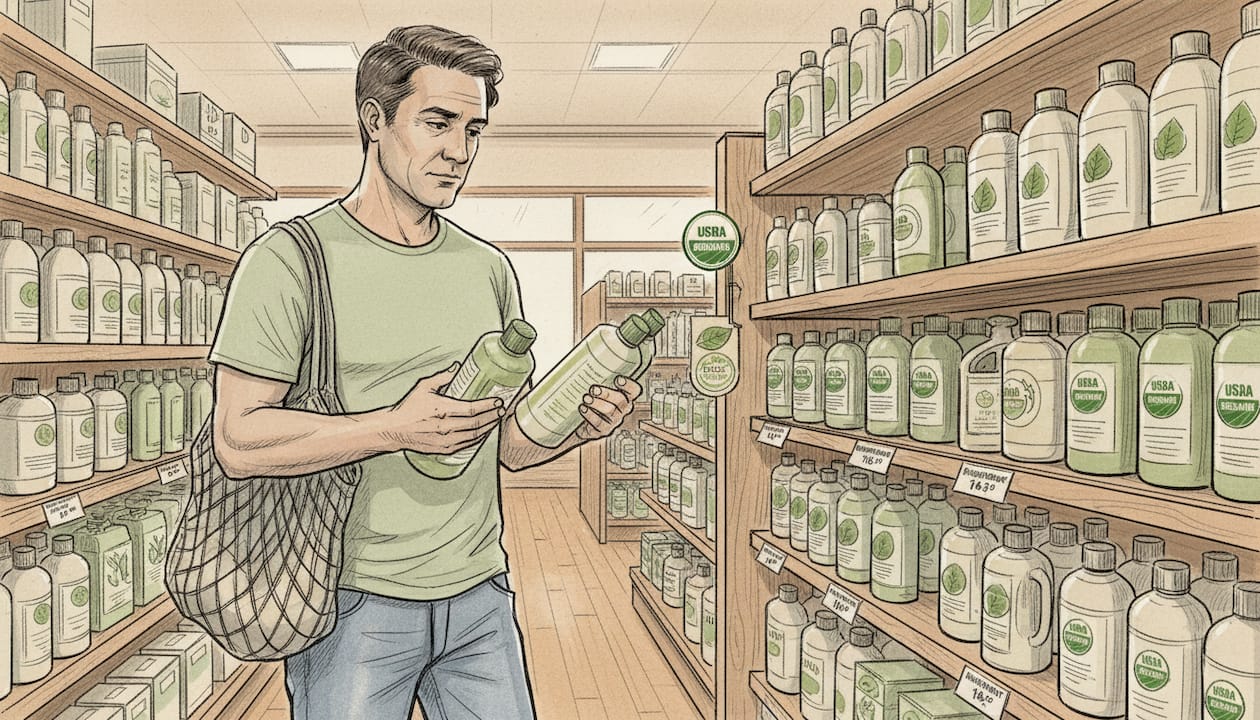
The honest reality is that the word “natural” on a cleaning product label means almost nothing from a regulatory standpoint. The terms “non-toxic” and “eco-friendly” are similarly unregulated in the United States. A manufacturer can print them freely without any independent verification. This is what the industry calls greenwashing, and it is widespread enough to confuse even careful shoppers.
Not all green claims mean safer ingredients; reputable certifications like Green Seal, GREENGUARD, and EPA Safer Choice are far more trustworthy because they require third-party testing. The EPA Safer Choice program uses a rigorous ingredient-evaluation framework that screens every component in a formulation, not just the active cleaning agents.
Certifications worth trusting:
- EPA Safer Choice: Evaluates every ingredient, including preservatives and colorants, against safety benchmarks for human health and the environment
- Green Seal GS-37: Covers commercial and institutional cleaning products with performance and safety minimums
- GREENGUARD Gold: Commonly used for low-VOC products and relevant for surfaces in bedrooms and play areas
Red flags that signal greenwashing:
- Vague phrases like “plant-based formula” with no certification to back them up
- “Fragrance” listed as a single ingredient (this can hide dozens of undisclosed chemicals)
- No full ingredient list anywhere on the label or the brand’s website
- Claims of being “100% safe” without specifying safe for whom and under what conditions
What to look for on labels for eco-friendly cleaning products:
- Full ingredient disclosure, including water, fragrance components, and preservatives
- A recognizable third-party certification seal
- Clear usage instructions including ventilation guidance
- pH information for products used on surfaces children touch
Understanding what makes cleaning products eco-friendly goes beyond the surface claims and into the chemistry behind the formulation.
Pro Tip: Avoid products that only make vague claims and do not list all ingredients. If a brand will not tell you what is in their product, that is a strong signal to choose a different one.
The limits (and best practices) of green cleaning—what most people miss
Even the best green cleaning products are only part of the puzzle. Let’s take a look at what most families miss and exactly how you can do better.
One of the most common misconceptions about green cleaning is that it is a binary switch: you buy green products, and risk disappears. That thinking skips over a crucial variable, which is behavior. How you clean determines a significant portion of your exposure, sometimes more than what you clean with.
Using multiple cleaning products and cleaning frequently, especially with sprays, still increases respiratory risk regardless of green branding. A family that uses eight different certified green sprays every day is likely creating more indoor air risk than a family using two conventional products once a week with the windows open.
“‘Green’ should not be treated as a blanket guarantee.”
Green cleaning programs emphasize evidence-based approaches and measurable outcomes, meaning the process and the habits matter just as much as the certification on the bottle.
Here is a practical framework for efficient safe cleaning habits in an LA home:
- Reduce product variety. Consolidate to three or four multipurpose certified products instead of a different cleaner for every surface.
- Favor cloths over sprays. Microfiber cloths with diluted solution are effective and generate almost no aerosol.
- Set a cleaning frequency that matches actual dirt levels. Over-cleaning is a real contributor to cumulative chemical exposure.
- Track symptoms. If family members notice headaches, watery eyes, or sneezing after cleaning days, that is data worth paying attention to.
- Ventilate during and after every cleaning session, not just when something smells strong.
- Read usage instructions. Most cleaning products are designed to be diluted, and using them at full concentration increases exposure without improving results.
The smartest approach treats green cleaning as a system of habits, not a one-time purchasing decision.
Does green cleaning mean sacrificing cleaning power?
After safety comes a natural question: will green cleaning leave your home truly clean? Here is what research and real standards say.
This concern is understandable because many families have tried “natural” products in the past and found them underwhelming. But the performance gap between certified green products and conventional ones has narrowed considerably, and in many categories it no longer exists at all.
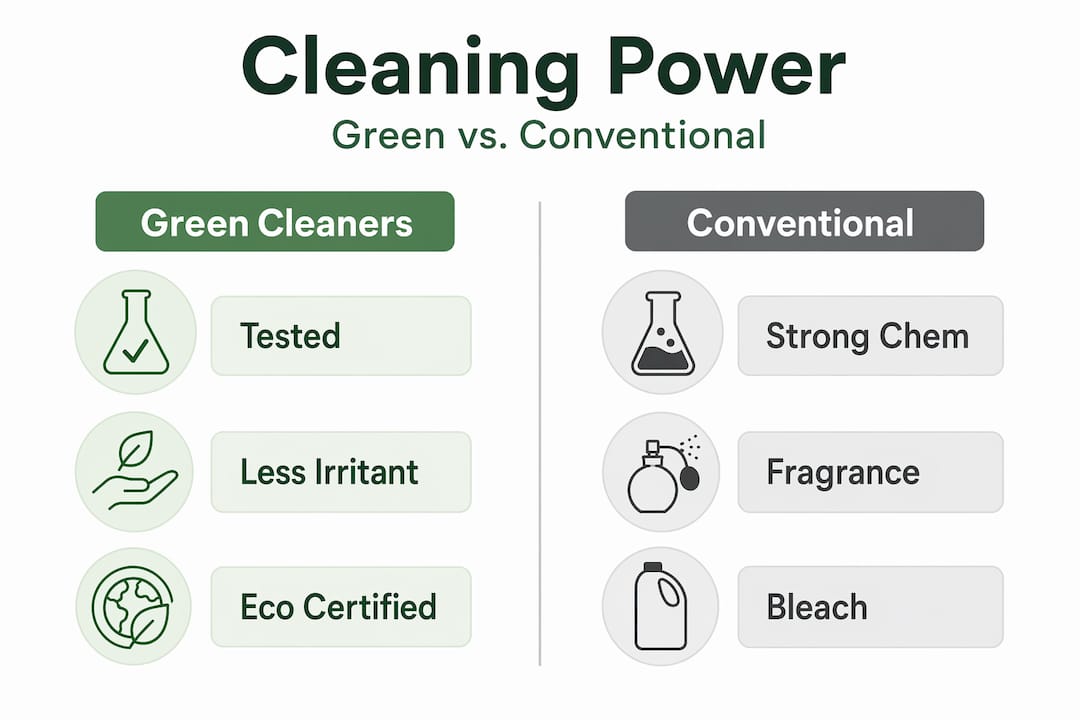
Green cleaning standards require testing for effectiveness, including protocols for soil removal and hygiene performance. A product cannot carry a Green Seal certification or EPA Safer Choice approval by being safe alone. It has to work. That is a meaningful distinction from generic “natural” products that only promise safety and do not verify cleaning power.
When evaluating a product for both safety and performance, here is what to check on the label and product documentation:
- A recognized certification seal from EPA Safer Choice, Green Seal, or similar
- A dilution ratio and usage instructions that confirm the product is designed for real-world cleaning tasks
- Disclosure of antimicrobial claims, if any, along with regulatory registration
- Independent test results or performance data, which reputable brands publish openly
- Clear surface compatibility information so you are using the right product for each task
Keeping homes healthy with the right cleaning approach means choosing products verified to do both jobs at once, not choosing between a safe home and a clean one.
Our take: the smart way LA families can actually make green cleaning safer
We have worked with enough Los Angeles families to know that the phrase “just go green” misses a lot of nuance. Here is our honest perspective.
The families who get the most health benefit from green cleaning are not the ones who buy the most certified products. They are the ones who build a small, consistent set of habits around a few trusted products and apply them thoughtfully. Switching to green cleaning and then using six different sprays daily without ventilation is still a problem, just a slightly smaller one.
What actually moves the needle is systems thinking. Understand green cleaning definitions well enough to make confident buying decisions, then pair those decisions with the behavioral layer: less product overall, better ventilation, and a realistic cleaning schedule. That combination delivers real indoor air quality improvements you can sometimes even measure with a low-cost air quality monitor.
We also encourage families to take family cleaning safety hazards seriously as a living part of their household routine, not a one-time read. Products change, certifications evolve, and what worked well two years ago may have been reformulated.
Think of green cleaning as smarter risk management, not a guarantee. The goal is not to eliminate every trace of chemical exposure in a home (that is not realistic), but to consistently reduce the unnecessary chemical burden on your family over years. That cumulative reduction is where the real health payoff lives, and it is absolutely achievable for LA families who approach it with the right information.
Professional help for greener, safer cleaning in your LA home
Switching to green cleaning is straightforward in theory, but implementing it consistently across an entire home while managing busy Los Angeles schedules is where many families run into friction.
That is where professional support makes a genuine difference. The Maid Society provides green cleaning services in Los Angeles using vetted, effective methods tailored to your home’s specific needs. Our team understands the unique challenges of LA homes, from managing indoor air quality in smaller spaces to choosing products that perform in Southern California’s climate. Every service is delivered by trained, trusted professionals who apply eco-friendly practices the right way, with the right products and proper ventilation techniques built into every visit. If you want to build a genuinely healthier home with sustainable cleaning, we are here to help you make it happen without the guesswork.
Frequently asked questions
Are green cleaning products always safer for children?
Not always. Safer products should carry third-party certification and full ingredient transparency, and families should still follow safe cleaning practices like ventilation and limited product use, since even certified products can raise indoor pollutants if used carelessly. Look for credible certifications rather than relying on label claims alone.
Do green cleaning products clean as well as regular ones?
Certified green cleaning products can be just as effective as conventional ones because they must meet tested performance standards for soil removal and hygiene before earning certification. Green Seal tests and certifies cleaning effectiveness as part of its approval process.
Can green cleaning still cause indoor air pollution?
Yes. Even green cleaning can temporarily raise indoor pollutants like PM2.5 and VOCs, though typically to a lesser extent than conventional cleaning. Using less product, avoiding sprays, and ventilating well during and after cleaning keeps those spikes minimal.
What should I look for on a green cleaner’s label?
Trust recognized third-party certifications such as EPA Safer Choice or Green Seal, and look for full ingredient disclosure rather than vague terms like “natural” or “non-toxic.” Trusted certifications and transparency are the two most reliable indicators of a genuinely safer product.
How can I minimize cleaning-related risks in my home?
Clean with windows open, choose cloths over spray bottles when possible, use certified products, and avoid cleaning more frequently than necessary or mixing different products together. Overuse and frequent product changes increase respiratory risk even when the products themselves are green-certified.
Recommended
- How Cleaning Safeguards Health and Safety in LA Homes
- Why clean regularly: health, stress, and home benefits
- Pet-Friendly Cleaning Workflow: Keep Pets Safe and Home Fresh
- Eco-Friendly Cleaning: Healthier Homes, Safer Families


Get Cleaning Tips & Exclusive Offers
Join our community for time-saving hacks and special discounts delivered to your inbox.