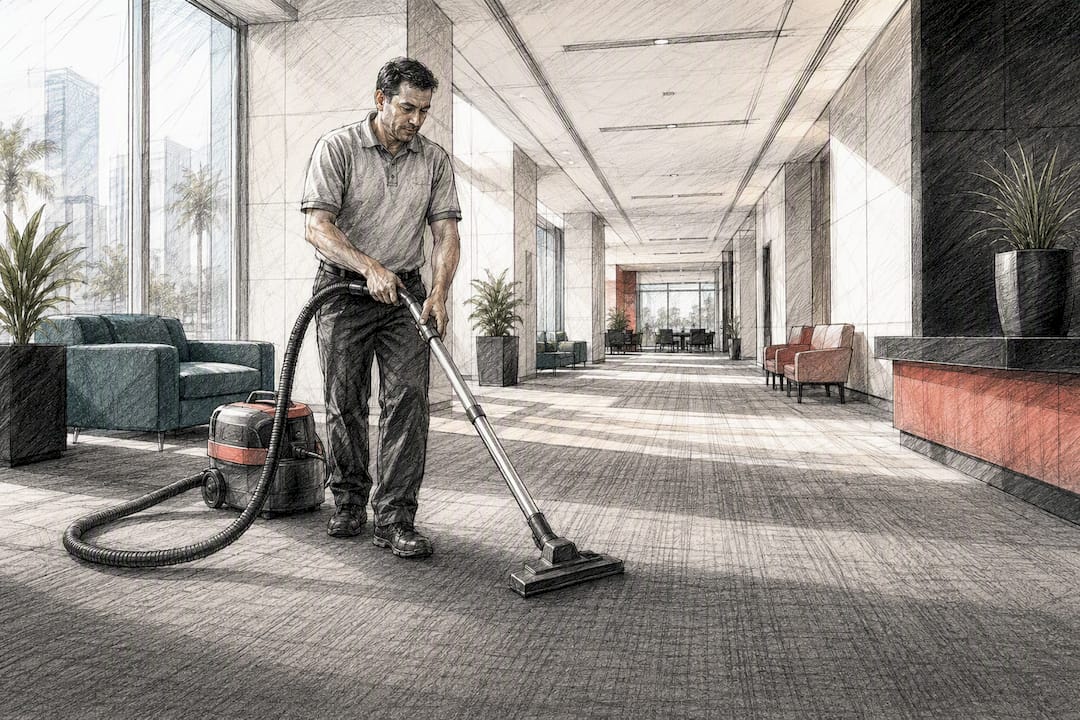
Commercial cleaning typically runs $0.07 to $0.25 per square foot for standard recurring office service, with most Los Angeles buildings landing in the middle to upper end of that range once labor rates and access restrictions factor in. A 10,000-square-foot office cleaned nightly often lands in a typical range consistent with standard market pricing. If a vendor quote falls outside that band, ask for a walkthrough before signing anything, since facility type and frequency swing the number more than any other variable.
TL;DR:
- Most Los Angeles office cleaning costs between $0.09 and $0.17 per square foot, with higher rates for medical facilities and lower rates for industrial spaces.
- Factor in fixture density, cleaning frequency, access restrictions, and scope creep to accurately estimate labor hours and avoid budget overruns.
- Request three detailed quotes with matched scope, and conduct a walkthrough to verify scope and conditions before signing a contract.
- Green cleaning adds a low single-digit percentage premium, mainly from product costs and staff retraining, rather than labor expenses.
- Seasonal and event cleaning often require hourly pricing and should be planned as variable costs in the annual budget.
Table of Contents
- Pricing Models and Per-Square-Foot Benchmarks
- Primary Cost Drivers Facility Managers Must Track
- How Do You Calculate a Profitable Cleaning Quote?
- Sample Budgets for Common Building Sizes
- How to Request and Evaluate Vendor Proposals
- Local Perspective: Themaidsociety’s Los Angeles Observations
- Summary and Immediate Next Steps
- Does Green Cleaning Change the Price?
- How Seasonal and Event Cleaning Affects Cost
- What the Data Actually Tells Facility Managers
- How Themaidsociety Can Help
- Sources
Table of Contents
- Pricing Models and Per-Square-Foot Benchmarks
- Primary Cost Drivers Facility Managers Must Track
- How Do You Calculate a Profitable Cleaning Quote?
- Sample Budgets for Common Building Sizes
- How to Request and Evaluate Vendor Proposals
- Local Perspective: Themaidsociety’s Los Angeles Observations
- Summary and Immediate Next Steps
- Does Green Cleaning Change the Price?
- How Seasonal and Event Cleaning Affects Cost
- Editorial Perspective
- How Themaidsociety Can Help
Pricing Models and Per-Square-Foot Benchmarks
Per-square-foot (PSF) pricing is the industry default for recurring janitorial contracts because it scales cleanly with building size and lets facility managers compare bids apples to apples. Standard office cleaning generally runs $0.07 to $0.25 per square foot, with a national average that tends to hover near $0.17. Medical and healthcare facilities price higher, and industrial space usually prices lower per square foot because of open floor plans and lighter fixture density.
Benchmark ranges by facility type:
- General office: roughly $0.09 to $0.17 per square foot
- Medical/healthcare: roughly $0.14 to $0.29 per square foot, driven by infection-control protocols
- Retail: typically priced closer to office rates but with higher glass and floor-care frequency
- Industrial/warehouse: generally the lowest PSF rate, though large equipment areas add specialty labor
Hourly pricing makes more sense for unpredictable work. Post-construction cleanups, event turnovers, and one-off deep cleans don’t fit a PSF model well because the labor hours vary too much job to job. Hourly commercial cleaning rates commonly run $25 to $75 per hour depending on region and specialization. In Los Angeles, expect the upper half of that range. Higher minimum wage floors, workers’ compensation costs, and dense traffic between job sites all push labor costs above the national median, which is one reason a quote that looks cheap on paper for a Burbank or Culver City building may not survive a real walkthrough.
Primary Cost Drivers Facility Managers Must Track
Every commercial cleaning quote is really a labor estimate wearing a price tag. The variables below determine how many labor hours a job actually needs, and tracking them before you solicit bids keeps vendors honest.
- Facility type and fixture density: restrooms, break rooms, and glass partitions all add time that raw square footage doesn’t capture.
- Frequency: nightly service costs more monthly than three-times-a-week service, but per-visit cost usually drops as frequency rises.
- Timing and access: night, weekend, or badge-restricted access often adds a labor premium and limits which crews can staff the job.
- Layout complexity: open floor plans clean faster per square foot than a maze of private offices and conference rooms.
- Labor cost structure: wages, payroll taxes, and workers’ compensation typically make up 50% to 80% of a janitorial budget, so any change in local wage floors moves your total cost more than almost anything else.
- Scope creep: requests added after contract signing (extra trash rooms, added floors, new tenant space) are the single most common source of budget overruns.
Security clearances and specialty services (server rooms, labs, controlled-access suites) also add cost because they usually require background-checked or specially trained staff.
Pro Tip: Write your scope of work before you call vendors, not after. A locked-down list of rooms, fixture counts, and frequency prevents the “that wasn’t included” conversation three months into the contract.
How Do You Calculate a Profitable Cleaning Quote?
Whether you’re vetting a vendor’s number or building your own budget, the math follows the same sequence used across the janitorial industry.
- Estimate labor hours using production rates. Office cleaning production commonly runs 1,000 to 3,500 square feet per labor hour, depending on layout and service level.
- Calculate fully loaded labor cost. Take the hourly wage and add payroll taxes, workers’ comp, and benefits, then multiply by estimated hours.
- Add supplies, typically 5% to 10% of the labor cost.
- Add overhead (insurance, management, equipment, vehicles) at roughly 20% to 50%.
- Add profit margin, targeting 20% to 30%.
Statistic Callout: Office cleaning crews typically cover 1,000 to 3,500 square feet per labor hour. A 10,000-square-foot office at 2,000 sq ft/hour needs 5 labor hours per visit, before supplies and overhead.
Worked example, small office: 3,000 sq ft at 2,500 sq ft/hour equals 1.2 labor hours per visit.
Worked example, mid-size office: 10,000 sq ft at 2,000 sq ft/hour equals 5 labor hours per visit, roughly $110 in loaded labor before supplies, overhead, and profit stack on top.
Sample Budgets for Common Building Sizes
These are ballpark monthly figures for standard recurring office cleaning at typical LA-area rates. Actual numbers shift with frequency, fixture count, and access restrictions.
- 3,000 sq ft office, three nights a week: roughly $400 to $650 a month
- 10,000 sq ft office, five nights a week: roughly $1,200 to $2,000 a month
- 50,000 sq ft facility, nightly service: roughly $5,500 to $9,500 a month, depending on tenant density
Nightly service versus three-times-weekly service can shift the monthly total by 30% to 50%, since you’re paying for more visits, not just more square footage. Portfolio-level budgeting often separates standard nightly janitorial from full-service coverage that includes tenant spaces. Standard service runs $0.10 to $0.25 per square foot per month, and full-service tenant-included coverage runs $0.25 to $0.45. Build in a 10% to 15% contingency for periodic add-ons like carpet extraction, window washing, or a post-event deep clean, since these rarely show up in the base monthly line.
How to Request and Evaluate Vendor Proposals
A vague RFP produces vague quotes that are impossible to compare. Structure your request so every bidder answers the same questions.
- Define the full scope of work: every room, frequency, and specialty task, in writing.
- Ask about staffing model: dedicated crew versus rotating staff, and how substitutions are handled.
- Confirm supervision: is there a working supervisor or account manager who visits the site?
- Verify insurance and background checks: general liability, workers’ comp, and screening standards for anyone with building access.
- Ask about price review triggers: what causes a rate increase mid-contract (minimum wage changes, added square footage, scope changes)?
Red flags include vague line items labeled “miscellaneous,” reluctance to put staffing details in writing, and contracts with automatic renewal clauses that lack a clear price-review window. Negotiation leverage usually sits in contract length. Longer terms can lock in pricing, but only if you also lock in a defined process for handling add-ons.
Pro Tip: Request three quotes for the identical scope of work, not three quotes for three different scopes. Vendors will happily quote a lighter job cheaper, which makes comparison useless unless the paperwork matches.
Local Perspective: Themaidsociety’s Los Angeles Observations
Themaidsociety works across Los Angeles, Beverly Hills, Santa Monica, Culver City, West Hollywood, Long Beach, Burbank, and the broader Southern California market, handling standard, deep, move-in/move-out, and post-construction cleaning for both residential and commercial clients. Los Angeles labor costs consistently run above national janitorial averages, and post-construction jobs in particular carry a premium here because debris volume and dust remediation demand more labor hours than a standard office turn. Scheduling around building access hours in dense commercial corridors like Koreatown or Hollywood also adds mobilization time that a national pricing guide won’t account for. Booking a walkthrough before finalizing scope avoids most of the surprises that show up later in the invoice.
Summary and Immediate Next Steps
Budget $0.07 to $0.25 per square foot as your baseline, adjusted upward for medical space, night access, or post-construction scope. Run the formula above, request three matched-scope quotes, and schedule a walkthrough before signing. Reprice triggers include minimum wage changes and any added square footage.
Does Green Cleaning Change the Price?
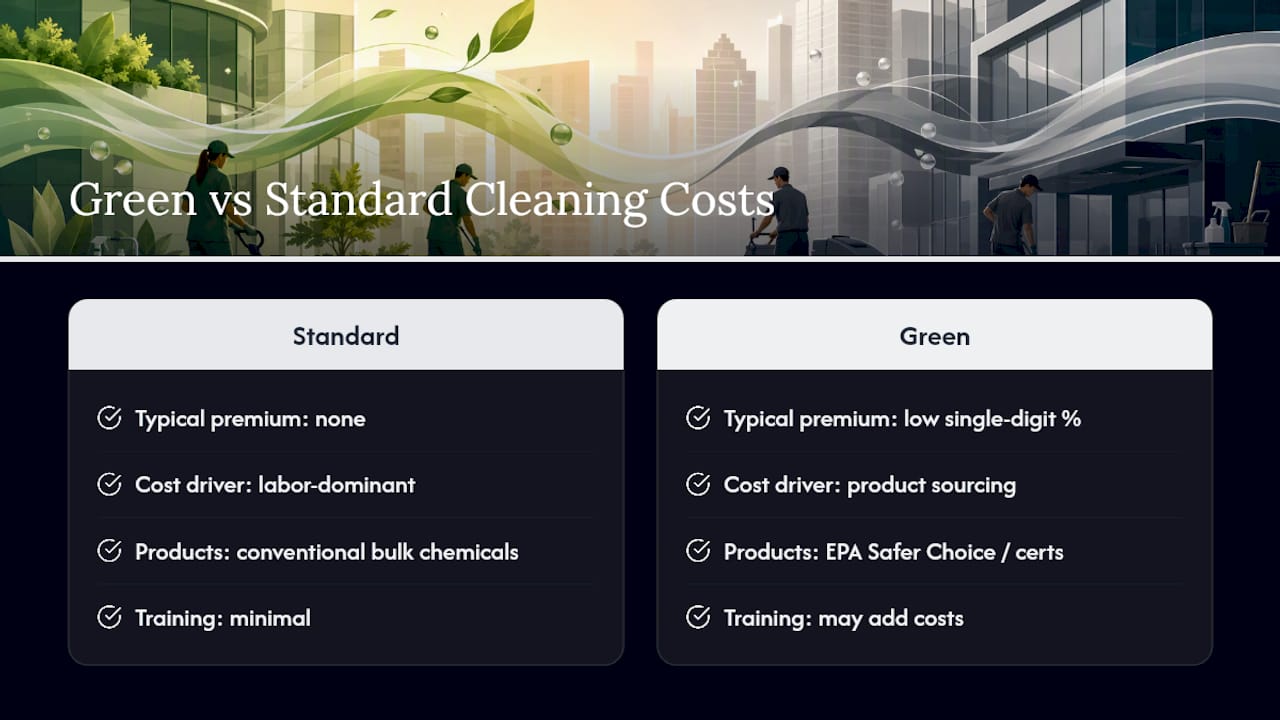
Green and eco-certified cleaning programs generally add a modest premium rather than a dramatic one. The cost increase usually comes from product sourcing, not labor. Products meeting EPA Safer Choice standards or third-party green certifications often cost more per unit than conventional bulk chemicals, and vendors sometimes need specialized dispensing equipment or additional staff training to use them correctly.
That premium tends to show up as a percentage add-on to the base PSF rate rather than a separate line item, commonly in the low single digits as a share of total contract value for standard office accounts. Facilities with LEED certification goals or tenant sustainability requirements sometimes accept a higher premium because green cleaning supports occupancy marketing and indoor air quality claims that matter to tenants.
The bigger cost variable isn’t the products themselves. It’s whether the switch requires retraining staff on new dilution ratios, dwell times, or application methods, since labor is still the dominant cost driver in any janitorial contract. A vendor that already runs green programs across its client base absorbs training costs more efficiently than one converting a single account, so ask any prospective vendor how many of their existing contracts already use certified products before assuming the switch will be expensive. For LA offices weighing tenant demand for sustainable building practices against budget, request a side-by-side quote: one standard, one green, on the identical scope of work, so the actual dollar difference is visible before deciding.
How Seasonal and Event Cleaning Affects Cost
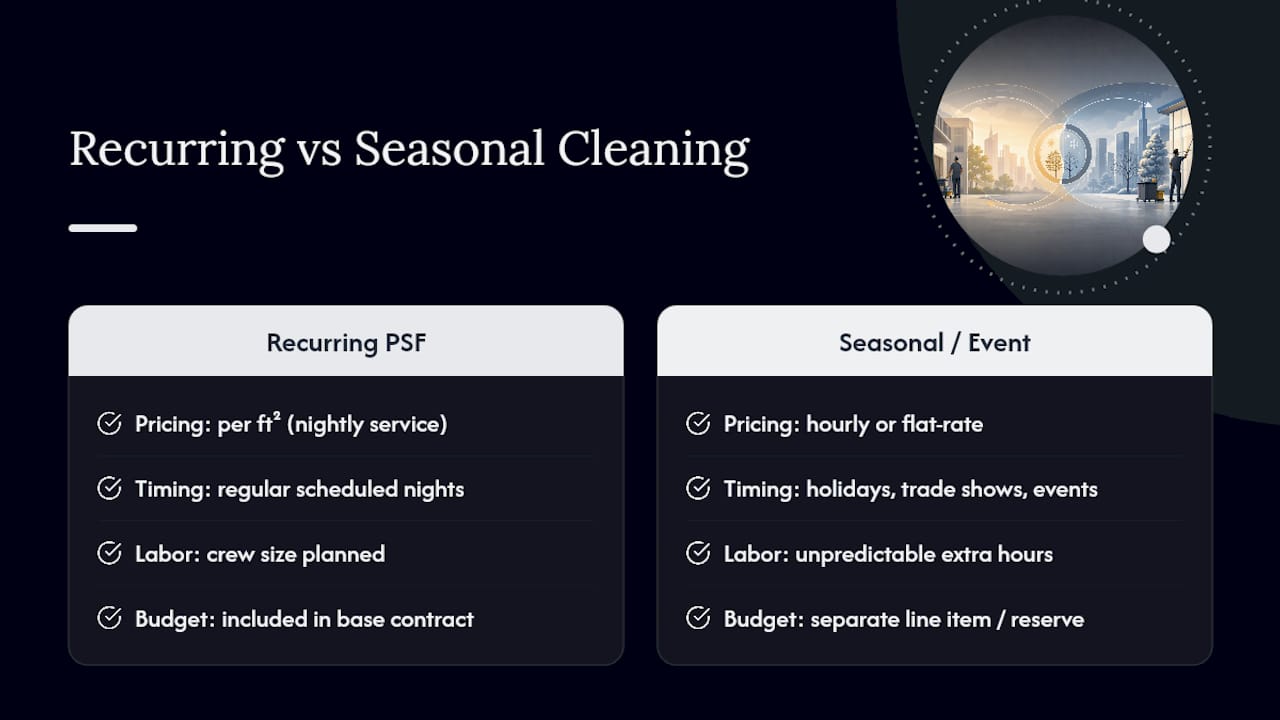
Seasonal spikes and one-off events almost always price outside your standard recurring contract, because they demand labor hours your regular crew size wasn’t built to absorb. Holiday party turnovers, trade show move-outs, and end-of-lease deep cleans all fall into hourly or flat-rate pricing rather than the PSF model that governs nightly service.
Expect a noticeable jump around predictable seasonal windows. Year-end holiday parties in office buildings often require next-morning turnaround cleaning that costs more per hour because it’s scheduled on short notice and sometimes outside normal shift hours. Retail spaces in shopping corridors from Manhattan Beach to Long Beach see similar spikes around the holiday shopping season, when foot traffic multiplies floor and glass cleaning frequency without a corresponding increase in the base contract.
Event cleanup, whether a corporate gathering, a product launch, or a conference in a shared building, is almost always quoted hourly because the labor hours are unpredictable until the event actually happens. Facility managers who know they have recurring seasonal events, an annual trade show, a holiday season retail crunch, or a summer event calendar, should build that into the annual budget as a separate line item rather than treating each occurrence as a surprise expense. The contingency reserve mentioned earlier for periodic add-ons works well here too. Treat seasonal and event cleaning as planned variable costs, not emergencies, and the annual budget stays predictable even when the monthly invoice doesn’t.
What the Data Actually Tells Facility Managers
Most commercial cleaning guides treat pricing as a lookup table: find your square footage, find your rate, done. That approach undersells how much labor structure actually drives the number. The PSF range matters less than whether the vendor quoting you actually ran production-rate math to get there, or just picked a number that sounded competitive.
The conventional advice to “get three quotes and pick the middle one” falls apart when the three quotes cover three different scopes of work. A cheap bid on a loosely defined scope isn’t a bargain. It’s a future change order. The facility managers who get the best long-term value are the ones who force scope clarity before price comparison, not after.
If there’s one thing to prioritize first, it’s writing the scope of work yourself before calling anyone. That single document, not the hourly rate or the PSF number, determines whether your budget holds for the full contract term.
— Lyndsey
How Themaidsociety Can Help
Themaidsociety is the local alternative to guesswork pricing for commercial spaces across Los Angeles, Santa Monica, Culver City, Beverly Hills, West Hollywood, Long Beach, and the surrounding Southern California area. Instead of a generic quote based on square footage alone, you get a scope built from an actual site walkthrough, covering frequency, fixture counts, access hours, and any specialty needs like post-construction debris removal or green product requests.
A Themaidsociety quote spells out mobilization timing, staffing structure, and a fixed scope of work before you sign anything, so there’s no ambiguity about what’s included versus what’s an add-on later. If your building recently wrapped renovation work, the post-construction deep cleaning process page walks through what that scope typically involves. For a straightforward next step, visit the commercial and residential services page and request a localized quote for your building. If you’re evaluating operational tools to coordinate scheduling with your cleaning vendor, contractor workflow platforms can help keep vendor communication organized alongside your cleaning contract.
Sources
- How to Price Commercial Cleaning Jobs (Without Underbidding or Burning Out Crews) – Service Autopilot
- Commercial Cleaning Calculator & Contract Guide 2026 | Janitorial Appointment
- Developing a Commercial Janitorial Budget & Understanding the Importance of Janitorial Production Rates – Frantz Building Services
Recommended
- Post-Construction Cleaning Cost Per Square Foot in Los Angeles
- Maid Service Cost in Los Angeles: 2026 Pricing Guide
- Deep Cleaning Cost in 2026: What Los Angeles Homes Actually Pay
- Commercial Cleaning Services in Los Angeles



Get Cleaning Tips & Exclusive Offers
Join our community for time-saving hacks and special discounts delivered to your inbox.