By L.K., The Maid Society
The safest way to give a cleaning crew access is to use a method you can change or turn off in seconds (a smart lock guest code, a lockbox, or a garage keypad code), hand it only to a company that vets and manages its own people, and put every entry detail in writing before the first visit. In Los Angeles, the details that trip crews up are rarely the lock itself. They are the gate, the parking, the elevator, the dog, and the alarm. This guide covers each option and how to set it up for a house, a condo, an apartment, or a rental.
TL;DR
- Choose a revocable method: a smart lock code, a lockbox, or a keypad code beats a loose spare key for most homes.
- Write down everything past the front door: gate codes, parking, elevator rules, alarm steps, pets, and areas to skip.
- Give the crew a code that is unique to your service, never your master code, so you can change it after any visit.
- For rentals and tenant units, California’s notice rules apply to landlords, so plan the schedule around them.
- Confirm the company vets its people and tells you who is coming before anyone enters.
Table of Contents
- Table of contents
- Why access is the part people worry about
- Access methods compared
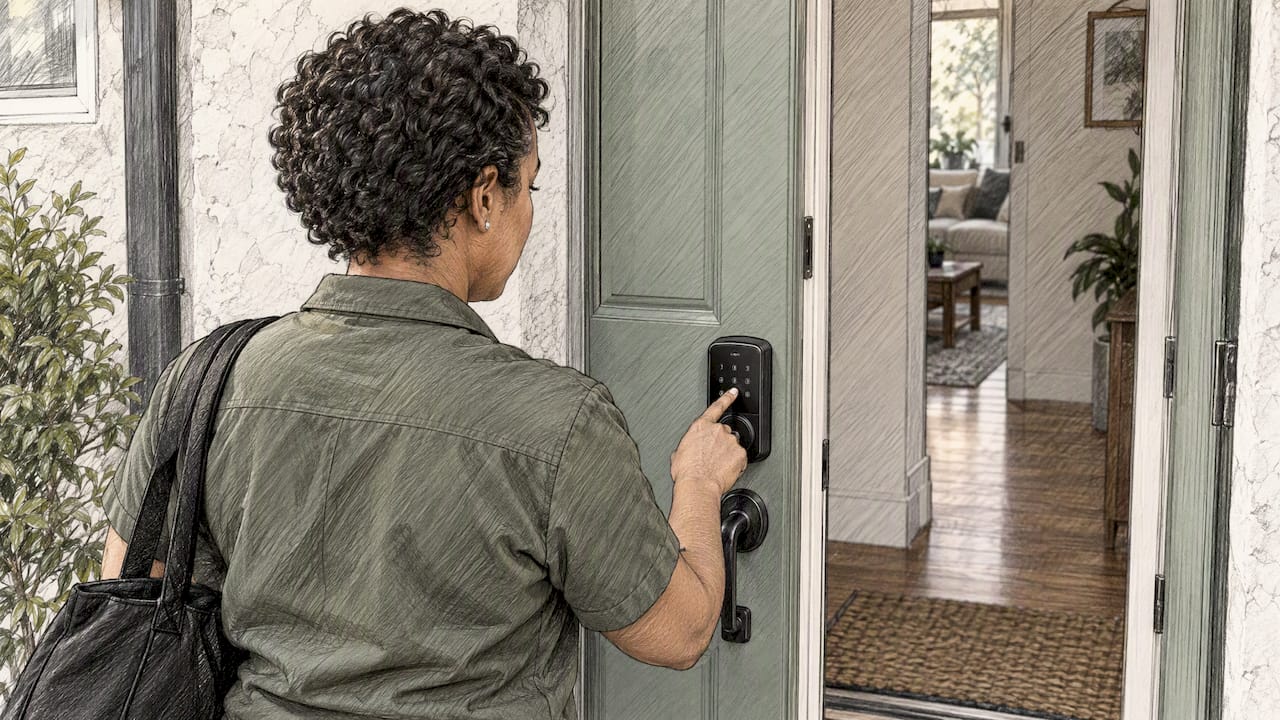
- Setting up smart lock and keypad access
- Physical keys: if you must hand one over
- Los Angeles access quirks by property type
- What to put in your entry instructions
- Photos, valuables and special situations
- Access for property managers, hosts and contractors
- Our perspective
- How booking works with us
- Summary
- FAQ
- Recommended Articles
- Sources
Table of contents
- Why access is the part people worry about
- Access methods compared
- Setting up smart lock and keypad access
- Physical keys: if you must hand one over
- Los Angeles access quirks by property type
- What to put in your entry instructions
- Photos, valuables and special situations
- Access for property managers, hosts and contractors
- Our perspective
- How booking works with us
- Summary
- FAQ
- Recommended Articles
- Sources
Why access is the part people worry about
Handing over entry to your home is the point where most people hesitate before hiring a cleaner, and that hesitation is reasonable. You are not just booking a service. You are deciding who can be inside your space while you are at work in Century City, at school pickup in Mar Vista, or on a flight out of LAX.
There are really two questions hiding in the one worry:
- Can I control the method? Can you change it, limit it, and know when it was used?
- Can I trust the people behind it? Who actually holds the code or key, and what happens if they leave the company?
The method matters, but the second question matters more. A perfect lock handed to an unvetted stranger is weaker than a plain lockbox handed to a company that screens, trains and manages its crews. When you compare cleaning companies, ask how they vet their cleaners, who knows your code, and how they handle the code when a team member leaves. Then pick the method that fits your building.
Access methods compared
Most Los Angeles households use one of six approaches. Here is how they stack up.
| Method | Best for | Main advantage | Main risk |
|---|---|---|---|
| Smart lock with a guest code | Houses, condos, townhomes | Create, schedule and delete codes remotely | Needs Wi-Fi or hub, batteries, setup |
| Keypad lockbox | Apartments, older doors | No electronics on your door, cheap | Code can be shared; hard to audit |
| Garage keypad code | Houses with an interior garage door | Easy to change | Interior door must be locked reliably |
| Building front desk or concierge | High-rises in Downtown, Hollywood, Marina del Rey | Staff logs entry | Needs your authorization on file |
| Spare key held by the company | Long-term recurring clients | Simple | Lost key means rekeying |
| You are home and let them in | First visit, anyone who prefers it | Maximum control | Takes your time |
For a first visit, plenty of clients choose to be home, walk the crew through the space, and switch to a code after they are comfortable. That is a sensible path, and it gives you a chance to point out the fragile items and the rooms that need the most attention.
Setting up smart lock and keypad access
If your door already has a smart lock, you are halfway there. The key advantage is control: access control systems let you grant a vendor entry to certain doors, on certain days, during specific hours, and cut off someone immediately. A consumer smart lock gives you a smaller version of the same idea.
A simple smart lock setup
- Create a dedicated code for your cleaning service. Do not reuse the code your family uses or the one your dog walker has.
- Set a schedule if your lock allows it, for example Tuesdays between 9 a.m. and 1 p.m.
- Name the code so the activity log shows who it belongs to.
- Test it with the company before the first visit, not at the door on cleaning day.
- Change or delete it if the plan ends, or if you ever suspect it was shared.
A unique code is more than a convenience. It gives you a record of when the door was used, and it means you can revoke one person’s access without disturbing anyone else’s. Businesses call this an audit trail, and it is just as useful in a two-bedroom in Culver City as in an office.
Is a smart lock worth buying for cleaning access?
If you have a recurring service, probably yes. One field service guide puts smart locks at roughly $120 to $300 up front, and notes that this compares with $20 to $35 per cylinder change plus a $100 to $130 service trip fee when physical keys must be exchanged or rekeyed. Those figures come from the cleaning industry’s side of the table, so treat them as a rough benchmark, but the logic holds for homeowners too: a lost key costs more than a code ever will.

Keypad lockboxes
A lockbox is the most common solution for apartments and rentals where you cannot change the lock. A few habits make it safer:
- Mount it where it is not visible from the street or the stairwell.
- Never use a birthdate, the street number, or 1234.
- Change the combination after a move-out, a change of cleaner, or any visit by a contractor who also used it.
- Tell the company the code only through the booking channel they use, not in a public group chat.
Physical keys: if you must hand one over
Some older Los Angeles buildings, especially the 1920s courtyard apartments in Hollywood and Koreatown and many Spanish-style duplexes in Mid-City and West Adams, have original deadbolts and no easy smart lock upgrade. A key may be your only option. If so:
- Do not tag the key with your address. If it is lost, a labeled key is an invitation. Good key management practice is to use a non-descriptive asset ID instead of the address, with the link between ID and property stored securely.
- Ask who holds it. A reputable company can tell you where keys are stored, who can check them out, and how fast a loss gets reported to you.
- Ask about lost-key policy. Many general liability policies exclude property in a cleaner’s care, custody or control, so a key replacement endorsement is something responsible companies look into. Ask how a lost key would be handled before it happens.
- Plan a return. If you stop service, get the key back or rekey.
Los Angeles access quirks by property type
This is where local knowledge saves a first visit. The lock is easy. The path to the lock is where visits stall.
Hillside houses: Hollywood Hills, Brentwood, Pacific Palisades, Los Feliz
- Gates and call boxes. Give the gate code and tell the crew whether the gate opens by remote, keypad or intercom. A gate that does not open means a crew standing on the street.
- Parking. Narrow, steep streets and permit-only blocks are common. Say where a car can legally park for several hours, and whether the driveway is available.
- Multiple entrances. Hillside homes often have a lower door off the garage and an upper door off the street. Name which one to use.
Condos and high-rises: Downtown, Marina del Rey, West Hollywood, Santa Monica
- Building authorization. Many buildings require residents to list approved vendors with the front desk or property manager. Do this before cleaning day.
- Elevator and loading rules. Some buildings restrict service elevator use to certain hours.
- Fob or visitor entry. Clarify whether the crew will be issued a visitor fob, called up by the desk, or let in with your resident code.
- Commercial and mixed-use floors. In Los Angeles, multi-tenant towers and medical offices often require familiarity with security measures such as elevator floor control and restricted areas. The same mindset helps in a residential tower: know the rules before arrival.
Apartments and duplexes: Koreatown, Mid-City, Westwood, Culver City
- Street-level security door versus unit door. There are often two: the building door with a buzzer or code, and your unit door. Cover both.
- Shared lockboxes. Some buildings have a vendor lockbox for contractors. Ask your manager.
- Street parking. Alley and permit parking are common; tell the crew where to unload.
Beach-area homes: Venice, Manhattan Beach, Redondo Beach, El Segundo
- Walk streets. In Venice and parts of the South Bay, the front door can be on a pedestrian path with no curbside access. Say how far the crew will walk with equipment.
- Salt air and sticky locks. Coastal locks can stiffen. If your door needs a trick (lift the handle, push the left side), say so.
South Bay and Long Beach neighborhoods: Hawthorne, Gardena, Carson, Long Beach, Inglewood
- Detached homes often have side gates and backyard entrances. Mention dog access, gate latches and where the crew should enter.
What to put in your entry instructions
The most common problem is not a missing key. It is unclear instructions scattered across texts and emails. Professional building services say the same: procedures for alarms, locking up, and locked doors belong in one place attached to the job, not buried in a thread. At home, that means one note on your booking.
Here is a template of what to include:
- Arrival window and who is expected to be home, if anyone.
- Entry method: lockbox location and code, smart lock guest code, or concierge name.
- Gate or building steps: gate code, intercom instructions, which entrance, floor, and unit.
- Parking: where to park legally, permit details, loading zone.
- Alarm: the code, how long they have to disarm, and who is called if it triggers.
- Pets: names, temperament, where they will be during the visit, whether the door must stay closed.
- Off-limits areas: home office, locked closet, nursery, anything you want left alone.
- Valuables and fragile items: what to avoid moving.
- Lock-up: how to leave: locked, deadbolt, lights off, gate closed.
- Emergency contact: a person to call if something goes wrong.
A useful habit: after the first visit, update the note with anything the crew wished they had known. That note becomes the permanent instructions for every future visit, which also helps when your regular cleaner is out and someone else covers.
Alarm codes
Avoid giving out your master alarm code. A better approach is a separate user code for the cleaning service that can be audited to show who entered and when, and that you can delete without changing codes for your family. If your alarm system supports only one code, change it after you end service or switch companies.
Photos, valuables and special situations
A few situations call for extra care before anyone walks in.
Before a big clean. If your home has had a leak, fire, smoke or storm damage, or you are working with an insurance claim, capture the space before cleaners touch anything. A guide on photo documentation before cleanup explains what to photograph so a claim is not weakened by cleaning first. Tell the crew in your instructions which areas not to touch until documentation is complete.
Heavy clutter or hoarding. If a home has serious clutter, the crew needs to know what they will walk into: paths, hazards, what stays and what goes. A hoarder house cleanout safety guide is a helpful place to understand how to communicate conditions and special instructions before anyone enters. Be honest on the booking so we can quote and staff the job properly.
Valuables. Put jewelry, cash, medications, firearms, and sensitive paperwork in a locked drawer or closet. This is a habit for anyone letting any visitor in, not a statement about cleaners.
Home security cameras. If you have indoor cameras, tell the crew where they are. Posting a short note on the door is a courtesy and avoids awkward surprises.
Pets. Dogs that guard the door should be crated or kept in a room, with the instruction written down. Cats slip out of open doors easily, so say where yours tends to hide.
Access for property managers, hosts and contractors
Residential access gets more complicated when you are not the occupant.
Rental turnovers and tenant units
If you manage a rental, California law limits when a landlord can enter an occupied unit. Under Civil Code section 1954, 24 hours is presumed reasonable notice, and the notice should include the date, approximate time and purpose of the entry. That applies to landlords and their agents, so if you send a cleaner into an occupied unit, such as for an agreed deep clean or pre-showing prep, build the notice into the schedule. Vacant unit turnovers are simpler: a lockbox with a code you change between tenants works well. If you are unsure how the rules apply to a specific situation, ask a California landlord-tenant attorney or your property management association.

Airbnb and vacation rentals
High-turnover properties are where digital access shines. A smart lock lets you schedule the cleaner’s code to match the checkout time and turn off afterward. For mid-stay refreshes and pricing, see our guide to Airbnb mid-stay cleans in Los Angeles.
Move-in and move-out cleans
When a unit is empty, access is usually a key handoff or a code that works for a defined window. Agents and landlords can leave a lockbox for the crew, and the crew confirms completion so the unit is ready for the next step. Learn more about move-in and move-out cleaning.
Post-construction
Builders and contractors often hold the only working key, and the site may have changing codes and active tools. Agree who is on site, who locks up, and where dust-sensitive areas are, then see how post-construction cleaning works.
What about pay for cleaners?
If you wonder how the people entering your home are compensated, the Bureau of Labor Statistics reported that maids and housekeeping cleaners in the Los Angeles-Long Beach-Anaheim area earned a mean hourly wage of $20.18 as of May 2023. Good pay supports stable teams, and stable teams mean fewer unfamiliar faces at your door.
Our perspective
We clean homes and rentals across Los Angeles, from Santa Monica and Brentwood down through Manhattan Beach and Long Beach, and from Hollywood to Burbank. Access is the first thing new clients ask about, so here is how we think about it.
The company matters more than the lock. We vet and train our cleaners, and we keep communication open so you know what is happening before and after a visit. That is the foundation. The method on your door sits on top of it.
Written instructions beat memory. The best-running recurring clients have one clear note: code, parking, pets, rooms to skip. A crew that does not have to guess finishes faster and does a better job.
Local knowledge removes friction. Because we work in these neighborhoods daily, we know that a Venice walk street, a Hollywood Hills gate, and a Koreatown buzzer panel each need a different plan. We ask the right questions at booking so day one is smooth.
Pay for the result. Our pricing is job-based and paid after the service is completed, and we stand behind the work with a satisfaction guarantee. If something was missed, tell us and we will make it right.
Our advice: choose revocable access, give us one clear set of instructions, and change codes when anything changes in your household.
— Lyndsey
How booking works with us
You can book online instantly or by phone, tell us how we will get in, and we confirm the details with you. Whichever service you need, standard house cleaning, deep cleaning, or recurring service, the entry note is saved with your booking. See everything we offer on our services page. We serve Los Angeles, Santa Monica, Beverly Hills, Culver City, Long Beach, Burbank, and the surrounding neighborhoods listed on our site.
Summary
Giving a cleaning crew access comes down to four decisions. Pick a method you can revoke: a smart lock code, a lockbox, or a garage keypad. Pick a company that vets and manages its team. Write down the whole path from the street to the unit, including gate, parking, elevator, alarm and pets. Review the setup whenever something changes, and change codes after any change in service. If you rent out a property, remember that California’s 24-hour notice presumption applies to entries into occupied units.
FAQ
Should I be home when the cleaners come?
You do not have to be. Many clients stay for the first visit to walk the crew through the space, then switch to a code for recurring visits. If you prefer to be home every time, that is completely fine and easy to arrange.
Is it safe to leave a key under the mat or in a planter?
No. Hidden keys are the first place anyone looks, and you cannot see who used them. A lockbox, a keypad code, or a smart lock guest code is safer, because you can change it at any time.
What should I do if the crew cannot get in?
The crew will contact you or the number on your booking right away. Having a backup contact written in your instructions, and testing the code beforehand, prevents most lockouts. If the visit cannot proceed, ask the company about its rescheduling policy.
Should I change my code after the cleaners finish?
For a one-time clean, yes, change or delete the code afterward. For recurring service, keep the dedicated cleaning code and change it if you switch companies, if a team member leaves, or if you suspect it was shared.
Can a cleaning company get into my building if I live in an apartment tower?
Often yes, but your building may require you to authorize the visit with the front desk or property manager first. Send the company the building’s vendor rules at booking, along with any elevator or parking instructions.
Recommended Articles
- How Much Should a Post-Construction Clean Cost in Los Angeles?
- Airbnb Mid-Stay Refreshes: What LA Hosts Should Charge
- Move-In & Move-Out Cleaning Services in Los Angeles
- Recurring Cleaning in Los Angeles
Sources
- Cleaning Business Key Management: The Practical Playbook
- Access Control Devices: A Manager’s Guide for 2026
- Commercial Access Control Systems in Los Angeles, CA
- California Civil Code section 1954
- Maids and Housekeeping Cleaners, Bureau of Labor Statistics
Recommended
- House Cleaning Services in Los Angeles
- Deep Cleaning Services Los Angeles
- Move-In & Move-Out Cleaning Services in Los Angeles
- Recurring Cleaning Los Angeles | Weekly & Bi-Weekly Service



Get Cleaning Tips & Exclusive Offers
Join our community for time-saving hacks and special discounts delivered to your inbox.