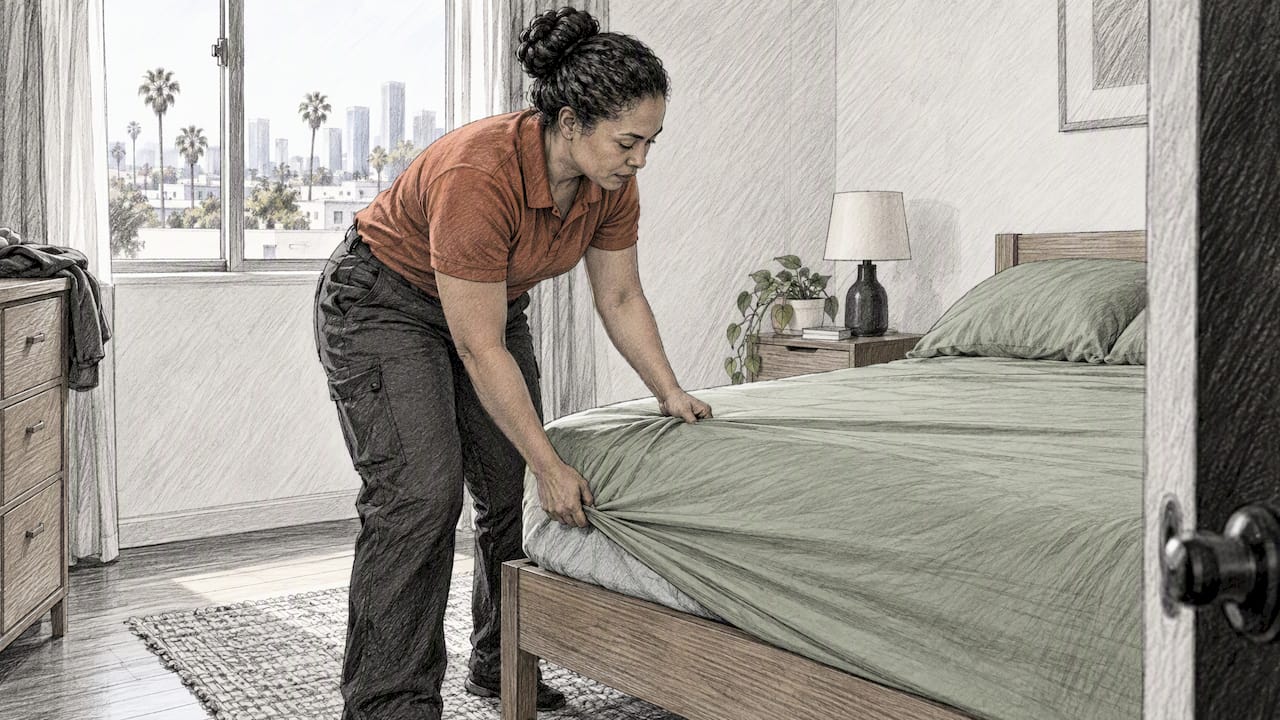
By L.K., The Maid Society
Turnover linen management is the system that decides how many sets of sheets and towels each property holds, how soiled linen is collected and washed, and how fresh sets get back on the beds before the next guest or tenant arrives. Get it right and a same-day turnover in Santa Monica or Hollywood runs on rails. Get it wrong and you are stripping beds at 1 p.m. with a 3 p.m. check-in and one clean set in the building.
This guide is written for Los Angeles Airbnb hosts, property managers, landlords and agents who turn units often. It covers stock levels, handling rules, loss tracking, in-house versus outsourced laundry, and how the cleaning crew fits in.
Table of Contents
- TL;DR
- Summary: the system in one page
- What turnover linen management actually covers
- Set your PAR level before you buy anything
- What goes in one set
- Own the linen or let a vendor own it
- Handling soiled linen on turnover day
- Washing and drying: what actually makes linen safe
- Track losses by property and by reason
- A turnover-day workflow for Los Angeles
- Our perspective: where linen systems break down
- Let us handle the turnover
- FAQ
- Recommended Articles
- Sources
Table of Contents
TL;DR
- Stock at least three full sets per bed (one on, one in the wash, one on the shelf) and move to four for back-to-back bookings.
- Standardize the linen across properties so you can buy in bulk and rotate stock.
- Bag soiled linen where you strip it, do not shake it, and keep dirty and clean separated.
- Hot wash plus a thorough dry does the work; disinfectant is not needed for ordinary laundry.
- Log every stained, missing or worn item by property and reason, so linen cost becomes a number you can plan.
Summary: the system in one page
A turnover linen program has five moving parts: a PAR level (how many sets you carry), a standard set (what is in each one), a handling routine (how dirty linen leaves the unit), a laundry route (in-house, laundromat pickup or commercial service) and a loss log. Everything else is detail. If your turnovers go wrong, the cause is almost always one of those five being undefined, usually the PAR level or the loss log.

In Los Angeles the stakes are higher than average because turnover windows are short, traffic on the 405 or the 10 can wreck a laundry run, and a single unit can be booked back to back during events, summer weekends and holidays.
What turnover linen management actually covers
Most people assume it means washing sheets. It is wider than that. Vacation rental laundry management is the system that decides how much linen each property holds, where it is washed and how it moves between homes and the laundry. That definition fits long-term turnovers too: a landlord prepping a unit in Culver City for a new tenant, or an agent staging a Brentwood listing, still needs beds made, towels staged and spare sets accounted for.
It touches four things you can measure:
- Availability. Is a complete clean set ready when the cleaners walk in?
- Quality. Are sheets crisp and white, towels thick, with no stains or thinning spots?
- Cost. What does each turnover cost in laundry, replacement and labor?
- Hygiene. Is soiled linen handled so it does not spread dust, allergens or worse?
Set your PAR level before you buy anything
PAR is the number of complete sets you keep per bed or bath. According to industry guidance for vacation rentals, a 3-PAR system is the minimum: one set in use, one in the laundry and one ready in storage. Properties with back-to-back bookings or laundry delays often need 4-PAR.
Here is how that plays out in practice.
| Property type | Typical turnover pattern | Suggested PAR |
|---|---|---|
| Long-term rental, annual turn | One turn, then months of occupancy | 2 to 3 spare sets staged |
| Furnished monthly rental in Koreatown or Mid-City | Turn every 30 days or more | 3-PAR |
| Weekend Airbnb in Venice or Marina Del Rey | Several turns a week, pickup laundry | 3-PAR, 4-PAR in peak season |
| Back-to-back bookings with same-day check-in | Check-out and check-in on the same day | 4-PAR |
The table’s PAR column follows the 3-PAR minimum and 4-PAR recommendation from the source above; the property types and seasonal notes are our own working rules of thumb, so adjust them to your laundry turnaround time. The test is simple: if your laundry service takes 48 hours, your PAR has to cover 48 hours of bookings plus a buffer.
How to adjust for your laundry turnaround
Count the longest realistic gap between dropping off a soiled bag and getting clean sets back. Then count how many turns can happen in that gap. Your PAR must cover every one of them with a set to spare. A 4-PAR system exists precisely to absorb laundry delays and back-to-back bookings, and it is usually cheaper than a single emergency re-buy or a late check-in.
What goes in one set
Define the set once, write it down and use it in every unit. The same guidance describes a typical set like this:
- Beds: one flat sheet, one fitted sheet and two pillowcases per bed.
- Baths: two towels and two washcloths per occupant, two hand towels per bathroom and one bath mat.
Add a duvet cover per bed if you use one, and pillow and mattress protectors that stay on the bed between turns. Protectors cost a fraction of what they protect and are among the most effective ways to stretch the life of your linen and mattresses, according to the same program guide.
A few practical choices pay off:
- One color family. White bedding hides nothing, which is the point: stains get caught at inspection, not by the guest.
- Dedicated makeup towels. Put a few dark or distinct towels in each bathroom so makeup and tanning product do not ruin your good white ones.
- Clear replacement triggers. Thinning fabric, fraying hems or permanent stains mean the item retires. Written rules end the “should we keep this?” debate and reduce guest complaints about quality.
Own the linen or let a vendor own it
There are two broad models. Either the property manager buys and owns the linen, or the property owner does. The operations team at a vacation rental software company notes that this should be settled when you start working with a new owner, since it determines who pays for replacements and who tracks the stock.
Many managers move to what is called a standardized linen program: the management company owns and standardizes the inventory across all properties. That allows bulk purchasing and easier rotation between homes, and it is generally more economical than managing a unique set for every house.
A third path is renting linen from a commercial service, where the vendor supplies, launders and replaces it. That trades capital for a per-pound or per-piece fee. Whichever way you go, decide:
- Who pays when a guest ruins a set?
- Who counts stock, and how often?
- What happens to linen that is retired?
Handling soiled linen on turnover day
Hospitals have rules for contaminated laundry, and they are worth understanding even if your Brentwood guesthouse is nowhere near a clinic. Under OSHA’s bloodborne pathogens standard, employers with workers exposed to blood or other potentially infectious material must have a written exposure control plan. OSHA’s hospital guidance says to bag contaminated laundry where it is used and not to sort or rinse it there.
Those mandates apply to occupational exposure to blood and similar materials, not to a typical guest stay. But the principle carries over as good habit:
- Do not shake linen. Roll sheets inward as you strip them. Shaking sends lint, dust and allergens into the air and onto the next set of surfaces.
- Bag at the bed. Carry a laundry bag or cart into the room rather than dragging sheets down the hall.
- Separate dirty from clean. Use color-coded bags or clearly marked bins, so a clean set never sits in the same pile as a soiled one.
- Flag anything unusual. Blood, bodily fluids or visible contamination should be bagged separately and handled with gloves. If there is any chance of a biohazard situation, treat it according to the rules above rather than guessing.
Residential managers sometimes apply hospital rules to ordinary turnovers and slow everything down. You do not need hospital protocols for a normal Airbnb turn. You do need a consistent, gentle routine your crew follows every time.
Washing and drying: what actually makes linen safe
The goal is hygienically clean, not sterile. CDC guidance on laundry and bedding in healthcare settings describes cleaning as a combination of soil removal, pathogen removal and pathogen inactivation. Washing with detergent and hot water, then drying thoroughly, is what makes textiles safe. Disinfectants are a case-by-case tool when heavy contamination is confirmed, not something every load needs.

Fabric matters too. A systematic review of pathogen survival on textiles found that some bacteria persist longer on synthetic fibers than on natural ones: Staphylococcus aureus survived up to 206 days on polyester against roughly 90 on cotton in the studies reviewed. That is lab survival on contaminated cloth, not a prediction for your guest bedroom, but it is a reasonable argument for cotton or cotton-rich sheets and towels, and for never skipping the hot dry cycle.
A few operational rules follow:
- Do not overload the washer. Mechanical action is what lifts soil.
- Dry fully. Damp linen in a bag invites odor and mildew.
- Inspect while folding. This is the cheapest quality control you will ever do. A 30-second check at every turnover is far cheaper than replacing sets early.
- Protect the laundry area. A leaking machine can wreck both stock and flooring, so keep a washing machine overflow plan handy for the day a hose lets go.
Track losses by property and by reason
Linen loss, often called shrink, is a budget line and not a surprise. Operators who log every stained or missing item by property and reason, for example guest damage versus normal wear, can bill for damage and renegotiate vendor contracts before small problems become big replacement bills.
Track per property, not globally. A global number hides the fact that one unit, or one cleaning team, may be bleeding stock. A simple sheet works:
| Date | Property | Item | Issue | Reason | Action |
|---|---|---|---|---|---|
| Row 1 | Venice 2BR | Bath towel | Stained | Guest damage | Bill guest, retire |
| Row 2 | Culver City studio | Fitted sheet | Missing | Unknown | Recount next turn |
| Row 3 | Marina Del Rey 1BR | Duvet cover | Thinning | Normal wear | Replace at next restock |
Review it monthly. Patterns show up quickly: pillowcases vanishing from one building, towels staining after a certain type of guest, or a laundry vendor that returns a short count.
For Los Angeles hosts specifically, remember the regulatory side of short-term rentals. The City’s Home-Sharing Program restricts short-term rentals to a host’s primary residence and requires registration, with the registration number posted on advertisements. If you are in another city such as Long Beach or Santa Monica, check that city’s own rules, because they differ.
A turnover-day workflow for Los Angeles
Here is a workflow we see work for units from Hollywood to Redondo Beach. Adapt the timing to your check-in and check-out windows.
- Before the cleaner arrives. Confirm that a full clean set is staged per bed and bath. If not, stop and fix it before check-out, not after.
- Strip and bag. Roll linen inward, bag it at the bed, and count the bags against the number of beds and baths.
- Inspect. Pull anything stained, thinned or missing and log it with the reason.
- Clean the room. Linen goes on a clean room, not the other way around. Make beds last, once dusting and floors are done.
- Stage towels and fresh sets. Same layout every time, so a guest or a quality check can see at a glance that nothing is missing.
- Send soiled linen out. Pickup service, laundromat drop, or in-unit wash, with a clear return time.
- Restock the shelf. The set pulled from storage goes back as soon as the wash returns, so your 3-PAR never quietly becomes 2-PAR.
For longer stays, a mid-stay refresh can reset linen without a full turnover. Our guide to mid-stay refresh pricing for LA Airbnb hosts explains how hosts approach it.
Turnovers that are not Airbnb
The same logic applies to a landlord between tenants. When a unit changes hands, a move-in and move-out clean resets the space, and any staged linen should go on after the clean. After renovation, linen and soft goods should stay wrapped and away from the dust until a post-construction clean is done, otherwise you launder the same sheets twice.
Our perspective: where linen systems break down
We clean turnovers across Los Angeles, from Westwood and West LA to Long Beach and Burbank, and the linen problems we run into are rarely about washing technique. They are about ownership. When nobody is clearly responsible for counting stock, the crew arrives and finds two sets where the host believes there are four. The crew then improvises, and improvisation is where stained towels end up on guest beds.
Our view, built on how we work with hosts, property managers and agents, is this:
- Write the set down. One page: what goes on each bed, what goes in each bath, where spares live. A new cleaner should be able to follow it on day one.
- Make the cleaner’s job inspect, not guess. We would rather flag a stained sheet than hide it, and a clear replacement rule makes that easy.
- Keep communication fast. Issues such as a missing set or a stained duvet should reach you the same day, while there is still time to fix them. Seamless communication is part of how we work.
- Know your neighborhood logistics. A Venice unit with tight parking and a Hawthorne unit with a driveway need different laundry plans. Local familiarity with LA housing layouts and logistics is something we lean on to make appointments reliable.
The linen program should make the cleaning crew faster, not busier. If it takes the cleaner longer to find linen than to clean the bathroom, the program needs work, not the cleaner.
— Lyndsey
Let us handle the turnover
If you would rather not run turnovers yourself, we handle them. Our team is vetted and trained, books are made online, and you pay per job after the cleaning is complete. We cover Los Angeles, Santa Monica, Beverly Hills, Culver City, Long Beach, Burbank and the other neighborhoods we serve, with services for Airbnb and vacation rental turnovers, deep cleans, move-ins and move-outs, and recurring visits. If you want a steady schedule, see our recurring cleaning service. For a one-time reset before a new tenant or a listing, our deep cleaning is the usual starting point.
FAQ
What is a linen inventory system?
It is a simple record of how many sets of linen each property should hold and how many it actually holds. At minimum it lists your PAR level, the contents of each set, and a loss log by property and reason. A spreadsheet is enough for most hosts; the discipline is counting at every turnover.
How many sets of linen do I need per bed?
Three is the standard minimum: one on the bed, one in the laundry and one in storage. If you have back-to-back bookings or your laundry sometimes runs late, go to four. The vacation rental guidance we reviewed recommends 4-PAR for high-volume turnover cycles.
How should soiled linen be handled?
Bag it where you remove it, handle it gently without shaking, and keep it apart from clean linen. In clinical settings, OSHA requires contaminated laundry to be bagged at the location of use without sorting or rinsing. For ordinary rental turnovers, the same habits keep dust and allergens down. Anything contaminated with blood or body fluids should be bagged separately and handled with gloves.
Do I need disinfectant for guest linen?
Usually not. CDC guidance says a proper wash with detergent and hot water followed by thorough drying is what makes laundry safe, and disinfectants are only needed case by case when high-level contamination is confirmed. If you have a specific health concern, ask your local public health department.
Should the cleaning company handle the laundry?
That depends on the contract. Many hosts keep linen with a laundry vendor and have the cleaning crew strip beds, bag linen and make beds with fresh sets. Ask us about your setup when you book so the plan matches your property.
Recommended Articles
- 25–150 Mid Stay Refreshes: What LA Airbnb Hosts Should Charge
- How Much Should a Post-Construction Clean Cost in Los Angeles?
- Move-In & Move-Out Cleaning Services in Los Angeles
- House Cleaning Services in Los Angeles
Sources
- Vacation Rental Linen and Laundry Management: Par Levels, Vendors, and Cost Control
- How to Build a Vacation Rental Linen Program That Scales
- Operations 101: How to Manage Vacation Rental Laundry & Linens
- OSHA 1910.1030, Bloodborne pathogens
- OSHA hospital laundry guidance
- CDC: Laundry and Bedding
- How long can nosocomial pathogens survive on textiles? A systematic review
- City of Los Angeles Planning: What is the Home-Sharing Program?
Recommended
- 25–150 Mid Stay Refreshes: What LA Airbnb Hosts Should Charge
- Move-In & Move-Out Cleaning Services in Los Angeles
- Deep Cleaning Services Los Angeles



Get Cleaning Tips & Exclusive Offers
Join our community for time-saving hacks and special discounts delivered to your inbox.