
Ask three things before anything else: does the company carry a certificate of insurance (COI) covering liability and workers’ comp, are cleaners employees who pass background checks or subcontractors with unclear screening, and what exactly counts as a “standard clean” versus an add-on. Get the answers in writing, along with an itemized estimate, before you hand anyone your keys. Write down the name of who you spoke with and the date. That single page becomes your proof if something goes wrong later.
TL;DR:
- Confirm that the cleaning company provides a certificate of insurance and clearly states whether their cleaners are employees or subcontractors before booking.
- Ensure all scope details, pricing, and policies are documented in writing, including scope of work, guarantees, and access instructions, to avoid misunderstandings.
- Prioritize companies that carry workers’ compensation and bonding, as these protect you from liability and financial loss if injuries or theft occur during cleaning.
- Use a scoring system based on key criteria like insurance, staffing, scope, and references to objectively compare providers and select the most reliable option.
- Book a trial cleaning to assess punctuality, attention to detail, and the consistency of the service before committing to recurring appointments.
Table of Contents
- The Grouped Vetting Checklist: 21 Questions to Ask
- How Do You Choose Between Candidates?
- What to Confirm in Writing Before the First Clean
- Your One-Page Trial Checklist and Phone Script
- Why These Questions Matter in Practice
- A Vetted, Local Option if You’re Ready to Book
- Sources
- FAQ
The Grouped Vetting Checklist: 21 Questions to Ask
Most cleaning service interview questions fall into eight buckets: credentials, staffing, scope, pricing, supplies, access, guarantees, and references. Ask them in that order and you’ll spot problems before you’re locked into a contract.
1. Are you licensed and insured, and can you email me a COI? A real company sends a certificate of insurance within minutes, listing the insurer and effective dates. If they hesitate or say “we’ll get you the paperwork later,” treat that as a warning sign, not a formality.
2. Do you carry workers’ compensation coverage? This matters more than most homeowners realize. When cleaners are independent contractors rather than employees, the company itself may not carry workers’ comp for that person, which means an injury in your home could become your problem.
3. Is your company bonded? Bonding protects you financially if theft occurs on the job, separate from the liability coverage in the COI.
4. Are your cleaners employees or subcontractors? This single answer changes who’s liable for damage, who trains the cleaner, and how consistent your service will be.
5. Do you run background checks on staff, and what do they cover? Ask specifically whether checks are one-time or repeated periodically for returning staff.
6. How are new hires trained before their first solo visit?
7. Do you require photo ID or a badge for your cleaners?
8. What does a standard clean include, room by room? Compare this against a published cleaning checklist so you know exactly what “standard” means to that company.
9. What’s the difference between your standard clean and a deep clean? Routine schedules typically cover surfaces, floors, and bathrooms, while deep cleans add baseboards, grout, and appliance interiors, according to the American Cleaning Institute.
10. Is inside-the-oven, inside-the-fridge, and window cleaning included or an add-on?
11. Do you charge a flat rate or hourly, and what’s included in that price?
12. Are there surcharges for pets, extra bathrooms, or travel distance?
13. Can I get an on-site estimate instead of a phone quote? On-site estimates catch square footage and clutter issues that phone quotes miss.
14. Do you bring your own supplies and equipment, or do I need to provide them? Some companies expect homeowners to stock certain items; confirm the supply rules before your first visit so nobody shows up empty-handed.
15. Do you offer pet-safe or fragrance-free products on request?
16. How do your cleaners get into my home, and how do you handle keys or codes?
17. What’s your satisfaction guarantee, and how long is the re-clean window? Many companies offer a 24 to 72 hour window to report issues and request a free re-clean before you’re charged again.
18. What happens if something is broken or missing after a cleaning? Ask for the claims process in writing, including how long a claim takes to resolve.
19. Will I get the same cleaner every visit, and what’s your cancellation policy?
20. Can you provide references or verified reviews I can check independently? Cross-check names against Google Business reviews or the Better Business Bureau rather than relying only on testimonials the company hands you.
21. Can I book a trial clean before committing to a recurring plan?
Pro Tip: Give every provider the exact same scope checklist, room-by-room, before asking for a quote. Comparing three “estimates” that are actually pricing three different jobs is the single biggest reason homeowners feel misled after booking.
How Do You Choose Between Candidates?
Insurance and background checks aren’t negotiable line items. Treat any company that can’t produce a COI or explain its screening policy as disqualified, full stop, regardless of price.
Once you’ve filtered for insurance and screening, normalize your quotes. Send the same room list and task list to every candidate so you’re comparing identical jobs, not a $120 “quick clean” against a $200 deep clean in disguise.
Three red flags end the conversation immediately:
- No COI available and no clear answer about who insures the cleaner in your home.
- Cash-only payment with no invoice or receipt offered.
- Refusal to answer direct questions about staffing (employee vs. subcontractor) or background checks.
A simple scoring method works well here: pick four or five criteria that matter most to you (insurance, screening, scope match, price, references), weight each from 1 to 5, and score each provider. The highest total wins, and the exercise usually makes an obvious winner emerge even when quotes looked close on paper. According to Otesse, a legitimate provider can typically produce a COI and answer staffing questions within the same phone call, no follow-up required.
What to Confirm in Writing Before the First Clean
A verbal agreement isn’t a contract. Before the first visit, get these items in an email, text, or signed sheet:
- Full scope of work, price, and what counts as an add-on.
- Cancellation and rescheduling policy, including notice period and any fees.
- Damage and theft policy, with a claims timeline attached.
- Cleaning frequency and what happens if you need to skip a visit.
- Copies of the COI and a written summary of the background-check policy.
Ask about payment methods up front and request an invoice or receipt for every visit, not just the first one. Confirm access instructions (key, lockbox code, or someone home), how pets should be handled during the visit, and whether cleaners are told about anything fragile or off-limits. Most companies also list a standard cancellation window, often 24 to 48 hours’ notice, with a fee if you cancel same-day. If yours doesn’t state one, ask.
Your One-Page Trial Checklist and Phone Script
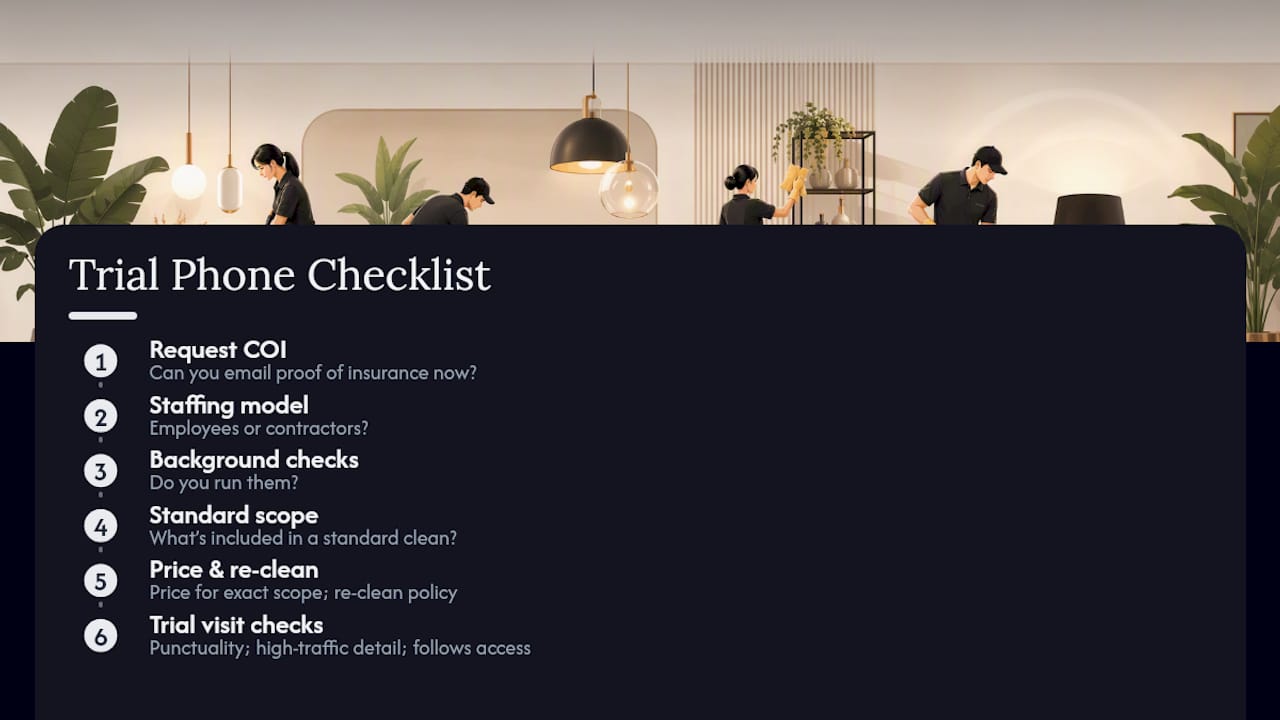
Keep this near the phone. Ask, in order: Are you insured with a COI you can email me now? Are cleaners employees or contractors? Do you run background checks? What’s included in a standard clean? What’s your price for this exact scope? What’s your re-clean policy if I’m not satisfied?
Compare three providers side-by-side on insurance, staffing model, scope match, price, references, and guarantee terms. During the trial visit, watch punctuality, attention to detail in high-traffic areas, and whether the cleaner follows your access instructions without confusion.
Pro Tip: A trial visit reveals more in one hour than a week of phone calls, because you can watch how the cleaner handles the parts of your home that matter most to you.
Why These Questions Matter in Practice
I’ve seen how one skipped question, “employee or contractor?”, turns into a homeowner discovering mid-dispute that nobody’s insurance covers the injury that just happened in their kitchen. Prioritizing consistency and proof over price saves people from exactly that kind of mess.
— Lyndsey
A Vetted, Local Option if You’re Ready to Book
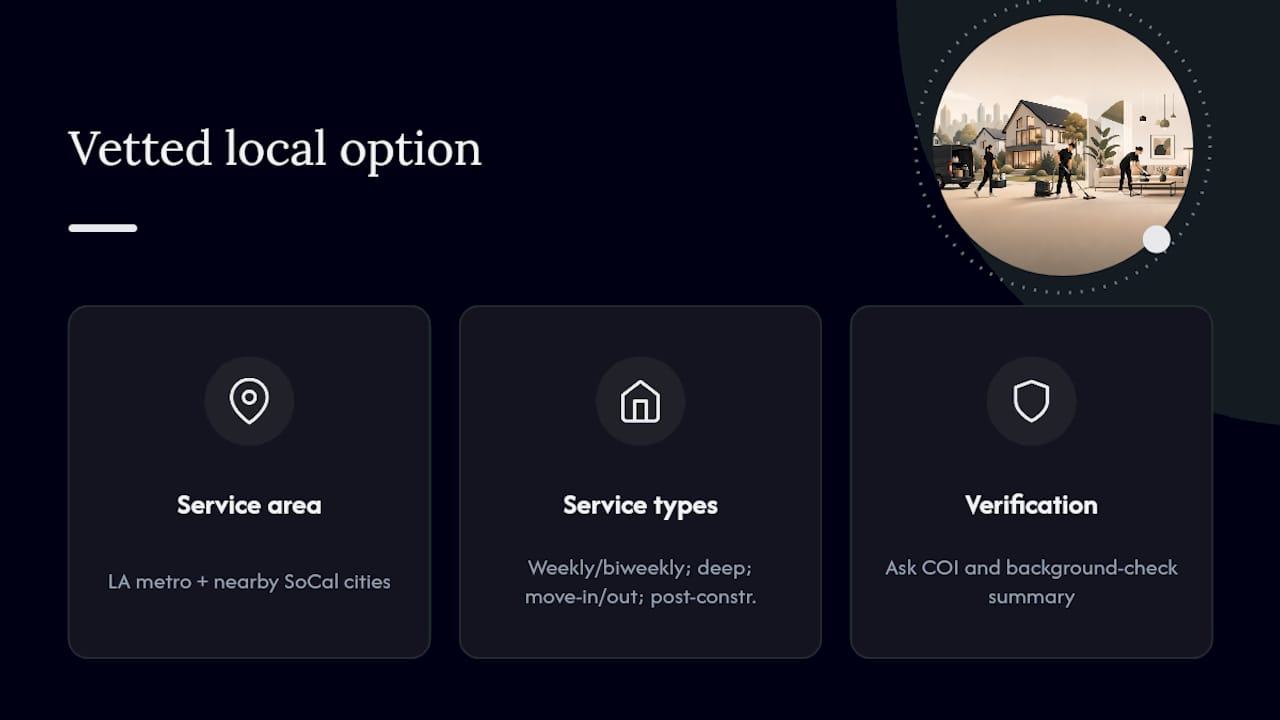
This company is an alternative to guessing your way through unverified listings. If you’re in Los Angeles, Beverly Hills, Santa Monica, Culver City, West Hollywood, Long Beach, Burbank, or one of the other neighborhoods across the Southern California service area, you get a provider that already answers the questions above before you ask them.
Themaidsociety covers recurring weekly or bi-weekly cleaning, deep cleans, move-in/move-out turnovers, post-construction cleanup, and home organizing, so whichever category you landed in above, there’s a matching service rather than a generic one-size job. When you reach out, ask directly for the certificate of insurance and a summary of the background-check policy. A team that’s used to homeowners doing their homework won’t blink at either request.
For larger cleanouts tied to a move or property sale, a resource like Sunshine State Buyers’ guide to hoarder house cleanouts covers what to expect cost-wise on the extreme end of the scale. For everything else, start with the full list of cleaning services and request a written estimate scoped to your home, the same way this checklist recommends doing with any provider.
Sources
For deeper reading on disinfection standards, see the CDC’s cleaning and disinfecting guidance. For product and schedule basics, the American Cleaning Institute offers practical routines, and JaniJobs covers background-check expectations in more depth.
- Easy cleaning schedule — American Cleaning Institute
- What to Look for in a Professional Cleaning Company: A Complete Homeowner’s Guide — Amherst Cleaning Services
FAQ
What should I ask a cleaning service before hiring?
Ask for a certificate of insurance, whether cleaners are employees or subcontractors and what background checks they run, and what exactly a standard clean includes compared to a deep clean.
Do cleaning companies provide their own supplies?
Policies vary by company. Themaidsociety and most established providers clarify supply expectations upfront, so confirm the rules before the first visit rather than assuming.
How do I verify a cleaning company’s insurance?
Ask them to email the certificate of insurance directly, then check that the insurer name and effective dates match what they told you on the phone.
What’s a reasonable re-clean guarantee window?
Many companies offer 24 to 72 hours to report an issue and request a free re-clean before charging again; ask for this in writing before booking.
Should I book a trial clean first?
Yes. A single trial visit shows punctuality, attention to detail, and whether the same cleaner returns for future appointments, which phone calls alone can’t confirm.
Is it better to hire an individual cleaner or a company?
A company with employees, insurance, and a written guarantee generally offers more recourse than an independent individual, especially regarding liability if something is damaged or someone is injured on the job.
Recommended
- Hiring and vetting cleaning teams in LA: A step-by-step guide
- 7 Qualities of a Trusted Cleaning Company for Busy Families



Get Cleaning Tips & Exclusive Offers
Join our community for time-saving hacks and special discounts delivered to your inbox.