
TL;DR:
- Organizational services help families declutter and build lasting systems tailored to their actual habits. These services focus on structure and functionality, not cleaning or sanitation, and involve active client participation. Choosing a provider with local experience and NAPO membership ensures effective, personalized home organization support.
By L.K. | Themaidsociety | Updated 2026
Table of Contents
- What are organizational services?
- How do organizational services work?
- What are the main types of organizational services?
- What are the benefits and limitations?
- How to choose the right provider in Southern California
- Key Takeaways
- Perspective
- Promo
- FAQ
- Recommended Articles
Organizational services are defined as expert-led processes that help individuals and families declutter their homes, create practical systems, and maintain order in their daily living spaces. Unlike standard cleaning, these services focus on building structure that lasts. A professional organizer does not scrub countertops or mop floors. Instead, they assess how you actually live, then design systems that fit your real habits. For busy families across Los Angeles, Beverly Hills, and Santa Monica, getting organizational services explained clearly is the first step toward a calmer, more efficient home.
What are organizational services?
Organizational services are professional support systems built around decluttering, sorting, and creating order in your home. The industry term for this work is “professional organizing,” and practitioners who specialize in it often hold memberships through the National Association of Productivity and Organizing Professionals (NAPO). These are not cleaning services. Organizers focus on systems and decluttering, not sanitation or hygiene, which is the core distinction families need to understand before booking.
A professional organizer starts by observing your space as it actually exists. They identify friction points, meaning the spots where clutter builds up because the current system does not match how your household moves. From there, they build a personalized plan. The goal is a home where every item has a logical, accessible place, so you stop losing time searching for things you use every day.

This service category has grown significantly in Southern California, where fast-paced lifestyles in cities like Culver City, West Hollywood, and Brentwood leave families with little time to manage accumulating clutter. Organizational services fill that gap by providing both the labor and the expertise to create lasting change.
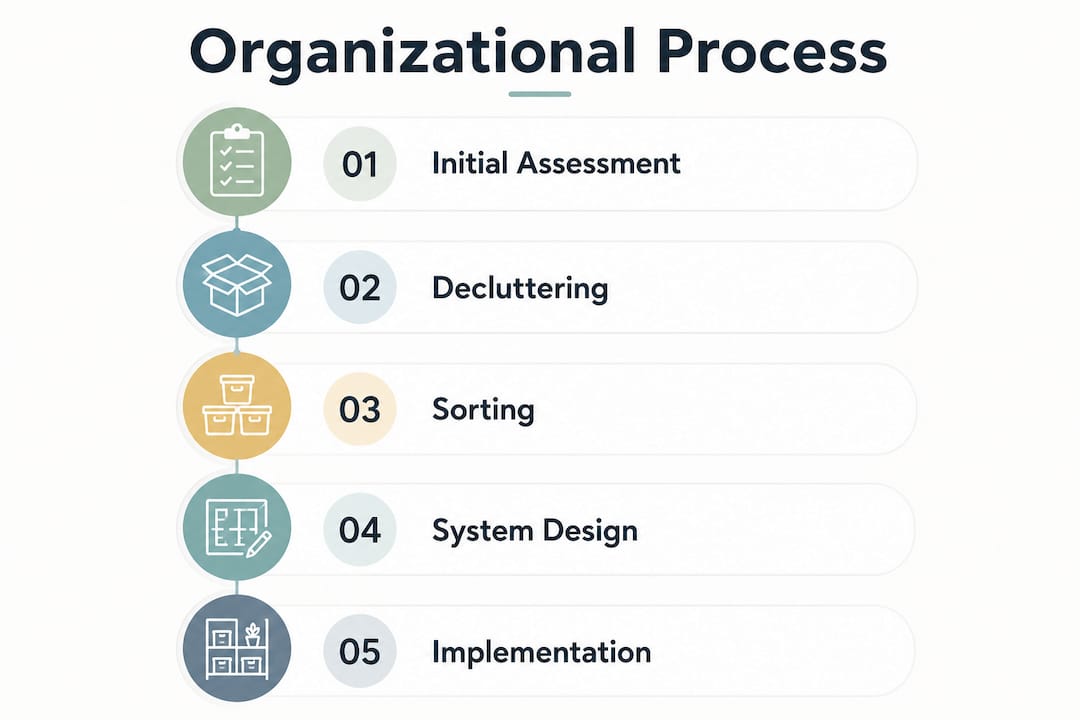
How do organizational services work?
The process follows a clear structure, and knowing what to expect removes most of the anxiety families feel before their first session.
-
Initial consultation. Most organizers begin with a one-hour consultation to assess your space, understand your goals, and identify problem areas. This session is often free or low cost. It sets the scope of the project and gives the organizer a realistic picture of the work ahead.
-
Hands-on organizing sessions. After the consultation, hands-on sessions run 3–6 hours per day. Organizers cap session length deliberately. Decluttering is mentally exhausting, and pushing past that limit leads to poor decisions and burnout.
-
Sorting and decluttering. The organizer works with you to sort every item in the target area. You decide what stays, what goes, and what gets donated. The organizer guides the process but never makes those calls for you.
-
System design and setup. Once the space is cleared, the organizer builds a system around your actual habits. Organizers build systems around client lifestyle to ensure lasting use. They avoid buying storage products in advance because fit matters more than aesthetics.
-
Donation and removal logistics. Many organizers handle the heavy lifting, including hauling donations to drop-off points. Clients should leave spaces as-is before the organizer arrives so the professional can observe real friction points rather than a pre-tidied version of the problem.
Pro Tip: Do not clean or tidy before your organizer arrives. An authentic, lived-in space gives them the information they need to design a system that actually works for your household.
Repurposing existing items is a priority in most sessions. Organizers prefer to work with what you already own before recommending new purchases. This keeps costs down and prevents the common mistake of buying storage bins that do not fit the space. Hourly rates range from $50 to $150, with average projects costing around $533. Partial sessions and phased projects can reduce that total significantly.
What are the main types of organizational services available? {#types}
Professional organizing covers a wide range of service categories. The right type depends on your space, your timeline, and your budget.
-
Home organization. This is the most common category. It covers closets, kitchens, pantries, garages, home offices, and living areas. A closet project in a Beverly Hills home might take one full day. A garage in Burbank or Long Beach could require two or three sessions.
-
Moving preparation and unpacking. Organizers help families sort and pack before a move, then set up systems in the new home during unpacking. This service pairs naturally with move-in cleaning services to give families a fresh, functional start.
-
Digital file organization. Some organizers specialize in digital clutter, including email inboxes, cloud storage, and photo libraries. This service is less common but growing in demand among professionals in West LA and Westwood.
-
Maintenance organizing. Follow-up sessions help clients sustain the systems built during initial projects. These are shorter, typically 1–2 hours, and work best on a monthly or quarterly schedule.
-
Specialized organizing for neurodiverse clients. Professional organizers accommodate clients with ADHD or executive function challenges using non-judgmental, customized methods. Systems are designed to be simple and sustainable rather than visually perfect. Themaidsociety also covers this topic in depth for families navigating neurodivergent home organization.
Here is a general comparison of service types by scope and cost:
| Service type | Typical scope | Estimated cost range |
|---|---|---|
| Single-room home organizing | One room, 1–2 sessions | $150–$450 |
| Whole-home organizing | Multiple rooms, 3+ sessions | $500–$1,500+ |
| Moving prep and unpacking | Pre and post-move | $300–$900 |
| Maintenance sessions | Monthly or quarterly | $75–$200 per visit |
| Digital file organizing | Files, email, photos | $100–$300 |
Costs vary by provider, location, and project complexity. Families in Manhattan Beach or Redondo Beach should expect rates at the higher end of local market ranges.
What are the benefits and limitations of hiring organizational services? {#benefits}
The benefits of organizational services go well beyond a tidy closet. The most significant gains are in time and mental energy.
-
Time savings. A well-organized kitchen or home office eliminates the daily minutes lost searching for items. Those minutes add up to hours each week.
-
Reduced stress. Organizational services reduce mental clutter and stress by creating systems adapted to your lifestyle. A calmer environment directly affects mood and focus.
-
Skill transfer. The best organizers teach you how to maintain the systems they build. Professional organizing is best viewed as a long-term investment in wellbeing, not a one-time fix. Families who learn the underlying logic of their new systems rarely slide back into old habits.
-
Emotional support. Decluttering is emotionally taxing. Clients are often exhausted after 3 hours of sorting decisions. An organizer’s presence accelerates real-time decision-making and reduces procrastination. For families dealing with grief, major life transitions, or executive function challenges, this support is genuinely valuable.
-
Support for diverse needs. The non-judgmental approach of organizers is especially important for clients who struggle with clutter due to ADHD, anxiety, or other challenges. Systems are built around how the client actually functions, not how an ideal household “should” look.
The limitations are equally worth knowing.
Organizers do not clean. They do not sanitize surfaces, mop floors, or scrub bathrooms. If your home needs both organizing and cleaning, those are two separate services. Organizers also cannot make decisions for you. The process requires your active participation, which takes time and energy. Finally, the cost is real. At $50–$150 per hour, a full home project is a meaningful expense. For families on tight budgets, a phased approach, starting with one room, keeps the investment manageable.
Pro Tip: Start with the room that causes the most daily friction, usually the kitchen or a shared living area. A quick win in one space builds momentum and makes the cost feel justified before you commit to a larger project.
For families with young children, organizing baby gear is one of the highest-impact starting points. Baby items multiply fast and rarely have a designated home, which creates daily chaos in otherwise manageable spaces.
How to choose the right organizational service provider in Southern California {#how-to-choose}
Southern California has a large and varied market for professional organizing. Choosing well requires more than a quick Google search.
-
Check for NAPO membership. The National Association of Productivity and Organizing Professionals sets ethical and professional standards for the industry. NAPO-affiliated organizers have completed training and agreed to a code of conduct. This is the clearest credential to look for.
-
Ask about specialties. Some organizers focus on kitchens and closets. Others specialize in moves, estates, or neurodiverse clients. Match the organizer’s specialty to your actual project.
-
Understand the pricing structure. Ask whether the organizer charges hourly or by project. Hourly pricing works well for smaller, defined spaces. Project pricing suits whole-home work where scope can shift. Get a written estimate before the first session.
-
Evaluate communication style. You will be making hundreds of decisions alongside this person. Their tone, patience, and ability to listen matter as much as their organizing skills. A brief phone call before booking reveals a lot.
-
Prioritize local experience. An organizer who works regularly in Los Angeles, Inglewood, West Adams, or Koreatown understands the housing types, storage constraints, and lifestyle rhythms of Southern California homes. Apartments in Westwood have different challenges than houses in Hawthorne or Carson. Local experience translates to faster, more accurate system design.
-
Plan your first consultation carefully. Come with a clear list of your top problem areas and your goals. The more specific you are, the more useful the organizer’s plan will be. A room-by-room decluttering guide can help you prepare before that first meeting.
Key Takeaways
Organizational services work best when clients understand the process, participate actively, and view the investment as a long-term improvement to their daily lives.
| Point | Details |
|---|---|
| Organizing differs from cleaning | Organizers build systems and declutter; they do not sanitize or clean surfaces. |
| Sessions are capped intentionally | Hands-on sessions run 3–6 hours to prevent decision fatigue and improve outcomes. |
| Cost is manageable with planning | Average projects cost around $533; starting with one room reduces upfront investment. |
| Systems must fit real habits | Organizers design around how you actually live, not how you wish you lived. |
| Local expertise matters | Providers with Southern California experience understand regional housing and lifestyle constraints. |
Why I think most families wait too long to hire an organizer {#perspective}
Working closely with families across Los Angeles, I have noticed a consistent pattern. Most people wait until the clutter is genuinely affecting their daily life before they call anyone. By that point, the emotional weight of the problem has grown alongside the physical mess. The decision to hire an organizer feels bigger than it actually is.
The real barrier is not cost or logistics. It is the belief that you should be able to handle it yourself. That belief is understandable, but it ignores something important: decluttering requires real-time decisions about every single item in a space. That is exhausting work, and most people stall because the decisions feel endless. An organizer’s presence changes the dynamic entirely. They keep you moving, prevent overthinking, and make the process feel finite.
What I have also seen is that the families who get the most out of organizing services are the ones who stay engaged during sessions. The organizer designs the system, but you have to live in it. If you check out and let the organizer make all the calls, the result will feel foreign and you will not maintain it. The best outcomes come from genuine collaboration.
Southern California families face specific pressures. Smaller square footage in areas like Venice or Mid-City LA means storage is always at a premium. Busy schedules in professional neighborhoods like Westwood or Brentwood leave little time for ongoing maintenance. These are real constraints, and a good organizer accounts for them. Do not hire someone who offers a generic system. Insist on one built around your actual home and your actual life.
— Lyndsey
Themaidsociety: cleaning and organizing support for Southern California homes {#promo}
A clean home and an organized home are two different things, but they work best together. Themaidsociety serves families across Los Angeles, Beverly Hills, Santa Monica, Culver City, Manhattan Beach, and dozens of other Southern California communities with residential cleaning services designed to complement the systems you build with an organizer.
Once your space is organized, keeping it clean becomes faster and easier. Themaidsociety’s fully vetted team handles the cleaning side so you can focus on maintaining the order you worked hard to create. From standard cleans to deep cleans and move-in and move-out services, the team is trained to work with care and consistency in every room. Visit Themaidsociety’s services page to see the full range of options available in your area and request a consultation.
FAQ
What are organizational services?
Organizational services are professional processes that help individuals and families declutter, sort, and create functional systems in their homes. They differ from cleaning services by focusing on order and structure rather than sanitation.
How long does a professional organizing session take?
Most hands-on organizing sessions run 3–6 hours per day. Organizers cap session length to prevent decision fatigue, which degrades the quality of choices made during decluttering.
How much do organizational services cost?
Hourly rates typically range from $50 to $150, with average projects costing around $533. Starting with a single room or partial session reduces the upfront cost significantly.
Do organizers clean as part of their service?
No. Organizers focus on systems design and decluttering, not hygiene or sanitation. Cleaning and organizing are separate services that work well together but are not interchangeable.
How do I find a qualified organizer in Southern California?
Look for NAPO membership as a baseline credential. Ask about the organizer’s specialty, pricing structure, and experience with homes in your specific area, whether that is Hawthorne, Long Beach, El Segundo, or West Hollywood.
Recommended Articles
- Cleaning vs. Organizing: What’s the Real Difference?
- Types of Organizing Services for Southern California Homes
- Keep Your Home Organized: Stress-Free Systems for LA Families
- Cleaning with ADHD: House Cleaning and Organization for Neurodivergent Brains
- The Role of Organization in Homes: A Practical Guide
Want to improve your home systems further? ConvertLabs offers tools that help service businesses and homeowners manage projects and communications more efficiently.
© 2026 Themaidsociety. Serving Los Angeles, Beverly Hills, Santa Monica, Culver City, West Hollywood, Manhattan Beach, Redondo Beach, Long Beach, Burbank, and communities throughout Southern California.
Recommended
- Types of Organizing Services for Southern California Homes
- The Role of Organization in Homes: A Practical Guide
- Home organization checklist: Stress-free steps for LA families
- Guide to Decluttering Homes: Room-by-Room for Families



Get Cleaning Tips & Exclusive Offers
Join our community for time-saving hacks and special discounts delivered to your inbox.