
TL;DR:
- Cleaning builds buyer trust by removing dirt and odors, serving as the essential first step. Staging creates emotional appeal to help buyers visualize living in the home. Proper sequence and both processes are necessary to maximize sale price and reduce market time.
By L.K. | Themaidsociety | Updated 2026
Table of Contents
- What staging vs cleaning explained means for sellers
- How cleaning impacts buyer perception
- What staging entails and how it differs from decorating
- Key differences and how they work together
- Practical advice for Southern California homeowners
- Key Takeaways
- Perspective
- Professional cleaning before you list
- FAQ
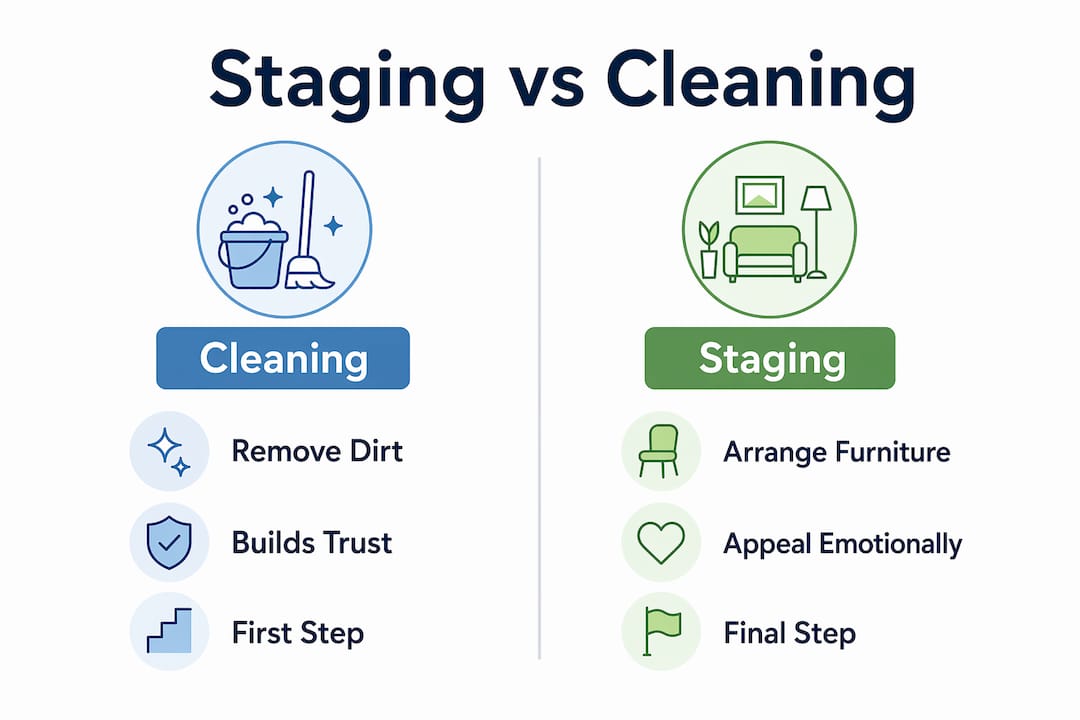
Staging is defined as the strategic arrangement and presentation of a home to appeal emotionally to buyers, while cleaning is the thorough removal of dirt, odors, and grime to restore the property’s condition. These two processes serve different functions, yet both are required for a successful home sale. With staging vs cleaning explained clearly, sellers in Los Angeles, Beverly Hills, Santa Monica, and across Southern California can stop wasting money doing them out of order or skipping one entirely. Staging helps 83% of buyers visualize the property as their future home. That number means nothing if the home is not clean first.
What does staging vs cleaning explained mean for sellers? {#staging-vs-cleaning}
Cleaning and staging are not interchangeable. Cleaning addresses the physical condition of a home. Staging addresses its emotional presentation. A seller who stages before cleaning wastes money, because cleaning must precede staging to avoid covering defects and grime with furniture and accessories.
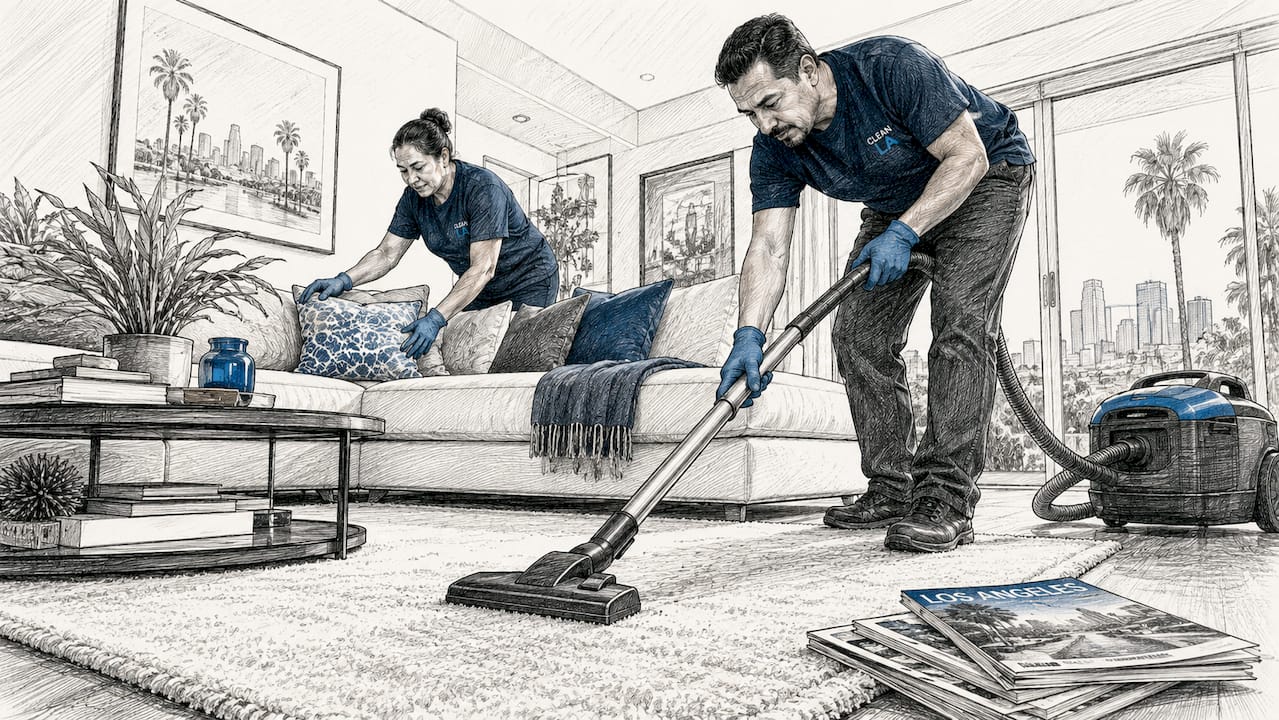
The two processes also target different buyer responses. Cleaning builds trust. Buyers use cleanliness as an unconscious signal that the home has been well maintained. Staging builds desire. It helps buyers picture their own life in the space. Both signals are necessary, but they operate in sequence, not in parallel.
How does cleaning impact buyer perception and sale readiness? {#cleaning-impact}
A staged but dirty home performs worse than a clean but unstaged one. That finding should reset every seller’s priorities. Buyers who walk into a home with grimy grout, smudged appliances, or musty odors immediately question how the property has been maintained. No amount of furniture arrangement fixes that impression.
What professional deep cleaning covers
Professional deep cleaning goes far beyond a standard weekend tidy. It targets the areas buyers actually inspect:
- Inside ovens and refrigerator seals, which buyers open during showings
- Grout lines in kitchens and bathrooms, where discoloration signals neglect
- Exhaust fans and vents, which buyers inspect closely for dust buildup
- Baseboards and window tracks, often skipped in routine cleaning
- Under and behind appliances, where grease and debris accumulate
Each of these areas sends a message. Clean exhaust fans say the home has been cared for. Dirty ones say the opposite.
What deep cleaning costs in Southern California
Professional whole-home deep cleaning costs $240–$500 for average-sized homes. In Los Angeles markets like West Hollywood, Culver City, and Manhattan Beach, prices sit at the higher end of that range due to labor costs and home size. That investment is small relative to the sale price, and it directly affects how buyers perceive the property in photos and in person.
Pro Tip: Schedule your deep clean at least three days before the photographer arrives. Surfaces need time to air out, and you want to catch any missed spots before the listing goes live.
Cleaning also affects listing photography. A spotless kitchen photographs dramatically better than a clean-enough one. Since most buyers in Los Angeles, Long Beach, and Redondo Beach start their search online, the photos are the first showing. A dirty home in photos loses buyers before they ever schedule a visit.
What does staging entail, and how is it different from decorating? {#staging-entails}
Staging removes personal style to appeal to the broadest possible pool of buyers. Decorating expresses the homeowner’s taste. These are opposite goals. A seller who leaves personal photos, bold paint colors, and niche furniture on display is decorating, not staging.
Effective staging uses neutral color schemes, edited furniture arrangements, and carefully chosen accessories to help buyers visualize their own life in the space. The goal is not a beautiful home. The goal is a home that feels livable to a stranger.
Core staging tactics
- Depersonalization: Remove family photos, religious items, and personal collections
- Furniture editing: Remove excess pieces to make rooms feel larger and traffic flow clearly
- Neutral color schemes: Repaint bold walls in warm whites, soft grays, or greige tones
- Accessory use: Add fresh towels, simple artwork, and plants to create warmth without personality
- Lighting: Replace dim bulbs, open blinds, and add lamps to brighten every room
When to use full staging versus light styling
| Home condition | Recommended approach |
|---|---|
| Vacant home | Full staging with rented furniture and accessories |
| Occupied, well-maintained | Light styling after thorough deep cleaning |
| Occupied, cluttered | Declutter, deep clean, then partial staging |
| Luxury listing in Beverly Hills or Bel Air | Full professional staging regardless of condition |
Vacant homes benefit most from full staging because empty rooms read as smaller and colder in photos. Furnished homes often need only light styling once the cleaning is complete.
Staging’s effect on sale price and market time
29% of agents report staging increases offer value by 1%–10%, while 30% see no measurable change. That split matters. Staging is not a guaranteed price booster. Its effect depends on market conditions, the quality of the staging, and whether the home was properly cleaned first. NAR 2025 data shows 49% of agents say staging reduces days on market. Fewer days on market means less carrying cost and less negotiating leverage for buyers.
For sellers working with a property listing optimization guide, staging is typically listed as one of the highest-ROI pre-sale investments alongside professional photography and deep cleaning.
What are the key differences between staging and cleaning? {#key-differences}
Cleaning and staging serve different objectives, operate at different points in the sale preparation timeline, and carry different costs. Confusing them leads to budget waste and poor results.
| Factor | Cleaning | Staging |
|---|---|---|
| Primary goal | Remove dirt, odors, and maintenance signals | Create emotional appeal and buyer visualization |
| Timing | Always first, before any staging work | After cleaning is complete |
| Typical cost (LA area) | $240–$500 for deep clean | $500–$5,000+ depending on scope |
| Buyer impact | Builds trust and signals maintenance | Builds desire and lifestyle visualization |
| Required for every sale | Yes | Depends on home condition and market |
The sequencing rule is non-negotiable. Cleaning and staging are sequential: declutter and deep clean first, then invest in staging. Sellers who reverse this order often find that staging accessories get dirty during cleaning, or that cleaning reveals issues that require repairs before staging can proceed.
Common mistakes sellers make
The most expensive mistake is staging a home that has not been deep cleaned. Buyers notice. A dirty kitchen with beautiful staging props still reads as a dirty kitchen. The second most common mistake is skipping staging entirely in a competitive market, assuming cleanliness alone will sell the home. In Los Angeles neighborhoods like Los Feliz, West Adams, and Koreatown, where inventory is tight and buyers are sophisticated, both steps are expected.
Practical advice for Southern California homeowners and renters {#practical-advice}
The Los Angeles real estate market rewards preparation. Whether you are selling in Burbank, El Segundo, Gardena, or Pacific Palisades, the same sequence applies. Here is how to approach it by priority:
- Declutter first. Remove everything that does not serve the home’s presentation. Donate, store, or discard. This step costs nothing and makes every subsequent step easier.
- Schedule a professional deep clean. Book Themaidsociety or another vetted cleaning service for a full deep clean before any staging work begins. Target all the areas buyers inspect: appliances, grout, vents, and baseboards.
- Address repairs. Cleaning reveals issues. Fix dripping faucets, patch nail holes, and touch up paint before the stager arrives.
- Stage based on your home’s condition. Vacant homes need full staging. Occupied homes in good condition need light styling. Do not overspend on staging a home that only needs editing.
- Maintain cleanliness during the listing period. Schedule a maintenance clean every 7–10 days while the home is on the market. Showings leave fingerprints, dust, and odors.
Pro Tip: In competitive Los Angeles markets, buyers often tour 10–15 homes before making an offer. A home that smells clean and looks edited stands out immediately. Scent is the first thing buyers notice when they walk through the door.
How market conditions affect staging ROI
Staging’s ROI varies by market demand. In a hot seller’s market, like parts of the Westside in 2021 and 2022, homes sold with minimal preparation. In a balanced or buyer-favoring market, staging becomes a stronger differentiator. The 2026 Los Angeles market is more balanced than the peak years. That shift makes both cleaning and staging more important, not less.
For renters preparing to vacate, the calculus is different but the cleaning priority is the same. A thorough move-out cleaning protects your deposit and leaves the property in the condition required by most California lease agreements. Staging is not relevant for renters, but professional cleaning absolutely is.
Sellers who want to understand how cleaning boosts home value before listing will find that the investment pays back in buyer confidence, faster offers, and fewer price reduction requests. For those optimizing their full listing strategy, a real estate listing guide for 2026 covers how presentation, pricing, and photography interact in the current market.
Key Takeaways {#key-takeaways}
Cleaning always comes before staging, and both are required to maximize a home’s sale price and time on market in Southern California.
| Point | Details |
|---|---|
| Cleaning builds buyer trust | Buyers use cleanliness as a signal of home maintenance; no staging overcomes a dirty home. |
| Staging creates emotional appeal | Staging removes personal style and arranges spaces so buyers visualize living there. |
| Sequence is non-negotiable | Deep clean first, then stage; reversing this order wastes money and hides defects. |
| Staging ROI depends on market | In balanced markets, staging reduces days on market for 49% of agents surveyed. |
| Cost ranges matter for budgeting | Deep cleaning costs $240–$500; staging ranges from light styling to $5,000+ for full service. |
What I’ve learned after watching sellers skip the basics {#perspective}
I have seen sellers in Westchester, Baldwin Hills, and Carson spend $3,000 on staging and then wonder why their home sat on the market for 60 days. The answer was almost always the same: they staged over a home that had not been properly cleaned. The stager brought in beautiful linen pillows and a marble tray for the coffee table, but the kitchen still had grease on the range hood and the bathrooms smelled like mildew. Buyers felt it the moment they walked in, even if they could not name it.
The mistake is understandable. Staging is visible and exciting. Cleaning feels like maintenance. But buyers are not consciously evaluating your staging choices. They are making a gut decision about whether they feel comfortable in the space. A clean home feels safe. A dirty home feels like a problem waiting to be discovered.
The other pattern I see constantly is sellers in competitive neighborhoods skipping staging because the market is “hot enough.” That logic made sense in 2021. In 2026, with more inventory and more discerning buyers, a well-cleaned and lightly staged home in Los Feliz or Mid-City LA will consistently outperform a clean but bare one. The gap is not always in price. It is in speed and in the quality of offers.
My honest recommendation: spend 80% of your pre-sale budget on cleaning and repairs, and 20% on staging. Most sellers have it backward. The cleaning and staging relationship is not a competition. It is a sequence. Get the sequence right, and the results follow.
— Lyndsey
Professional cleaning before you list {#promo}
Sellers across Los Angeles, from Hollywood to Hawthorne to Long Beach, trust Themaidsociety to handle the deep cleaning step before staging begins. Themaidsociety provides move-in/move-out cleaning, deep cleaning, and standard maintenance cleaning for homeowners and renters throughout Southern California.
Every Themaidsociety team member is fully vetted and trained to clean the areas buyers actually inspect: appliances, grout, vents, baseboards, and every surface in between. Book your pre-listing deep clean in Los Angeles and go into your first showing with full confidence. For renters preparing to vacate, Themaidsociety’s move-out cleaning service covers every requirement your lease demands.
FAQ {#faq}
What is the difference between cleaning and staging?
Cleaning removes dirt, odors, and grime to restore a home’s condition. Staging arranges furniture and accessories to create emotional appeal for buyers.
Does cleaning or staging matter more when selling a home?
Cleaning comes first and is non-negotiable. A staged but dirty home performs worse than a clean but unstaged one, so cleaning is the foundation.
How much does professional deep cleaning cost in Los Angeles?
Professional deep cleaning costs $240–$500 for average homes. Los Angeles properties typically fall at the higher end of that range.
Does staging actually increase sale price?
29% of agents report staging increases offers by 1%–10%. The effect is stronger in balanced markets than in hot seller’s markets.
Do renters need to stage before moving out?
Renters do not need to stage, but professional move-out cleaning is required by most California leases and protects your security deposit.
Recommended articles
- Role of Cleaning in Home Staging Success
- Why Deep Cleaning Before Selling Boosts Home Value
- 7 Essential Steps for a Home Staging Cleaning Checklist
- Role of Cleaning in Open Houses: Impact on LA Sales
- Why Cleaning Is Essential Before Showings
Recommended
- Role of Cleaning in Home Staging Success
- Why Pre-Listing Cleaning Matters for LA Home Sellers
- Why Cleaning Is Essential Before Showings: Maximize Appeal
- Pre-listing cleaning essentials for faster sales in 2026



Get Cleaning Tips & Exclusive Offers
Join our community for time-saving hacks and special discounts delivered to your inbox.